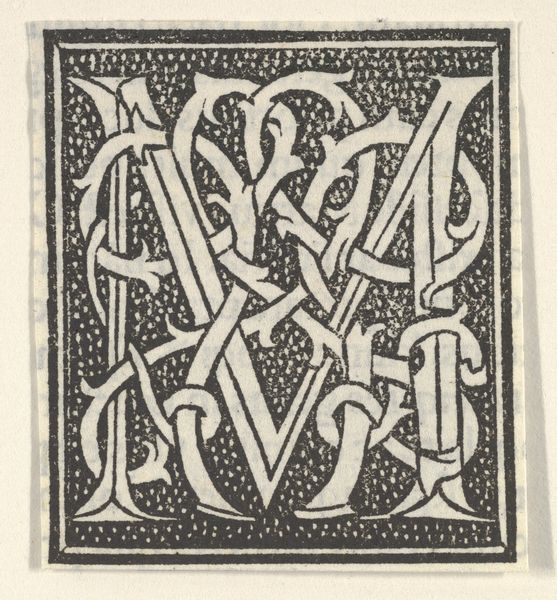
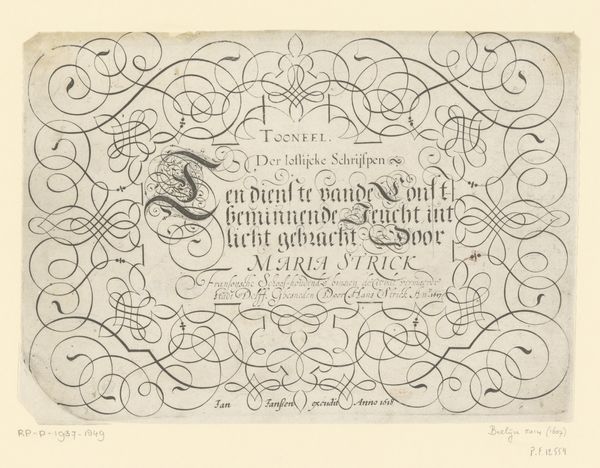
Vignet met een gedenksteen met daarop een inscriptie 1836 - 1912
0:00
0:00

isaacweissenbruch
Rijksmuseum
drawing, graphic-art, print, textile, ink, engraving
#
drawing
#
graphic-art
#
medieval
# print
#
textile
#
ink
#
engraving
Dimensions: height 89 mm, width 104 mm
Copyright: Rijks Museum: Open Domain
Curator: Well, this appears to be an ink drawing or engraving of a medieval-style inscription on what looks like a stone plaque. Made by Isaac Weissenbruch, it's called "Vignet met een gedenksteen met daarop een inscriptie," placing it sometime between 1836 and 1912. The text itself is quite intriguing. Editor: My immediate reaction is how tactile it feels despite being a print. The incised lines really emphasize the three-dimensionality of the letters. Curator: Absolutely. Consider the labor involved in creating these lines, mimicking stone carving with ink. We have to ask, what is Weissenbruch referencing, and for whom? The old gothic lettering suggests a specific historical period and evokes a sense of authority, perhaps linking to ideas of lineage and power in 19th-century European society. Editor: And the choice to render it as a print implies dissemination, wider accessibility. It reminds me of craft traditions; the labor of writing celebrated as a process of production, and how these forms reference not only the text but the stone where the text is supposed to be written. The contrast heightens our awareness of material translation. What's being inscribed beyond words, would you say? Curator: That’s a sharp question. It reflects a nostalgic yearning for a crafted past. Perhaps it highlights how rapidly industrialization threatened those skilled traditions. Weissenbruch is engaging with the rise of the machine by focusing on something manual. His emphasis underscores the perceived loss of authentic connection, suggesting social anxieties around shifts in artistic creation. Editor: This certainly pushes us to confront those material conditions shaping artistic identity and legacy. There’s that constant tension, isn't there, between artistic innovation and cultural preservation? Weissenbruch’s image becomes more than an artistic depiction, it embodies this clash. Curator: Indeed. I now feel like examining other memorial art forms of that era and the role of drawing, graphic art, and medievalism within national identity and historical narratives. Editor: I find myself curious about the original inscription. Where was it? What happened to the material that carried that carving? Did it decompose, collapse? How did time and weather impact it?
Comments
No comments
Be the first to comment and join the conversation on the ultimate creative platform.
 Collect
 React
React Comment
More like this