About this artwork
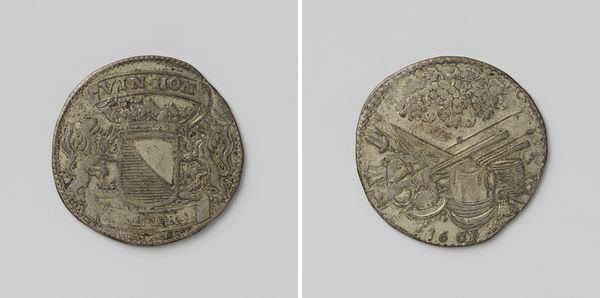
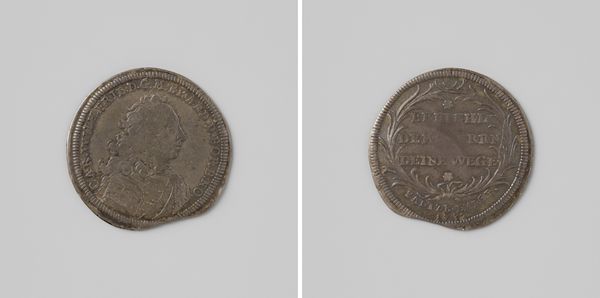
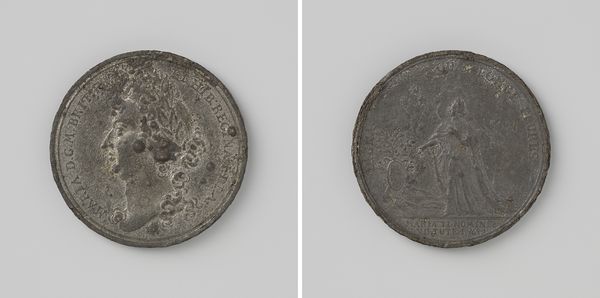
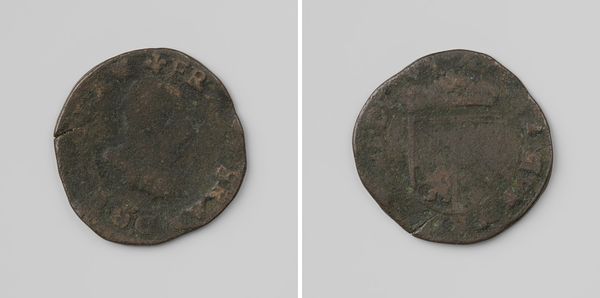
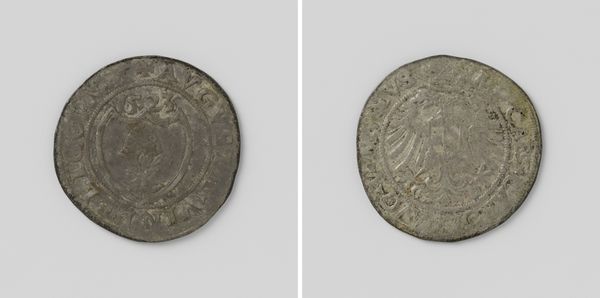
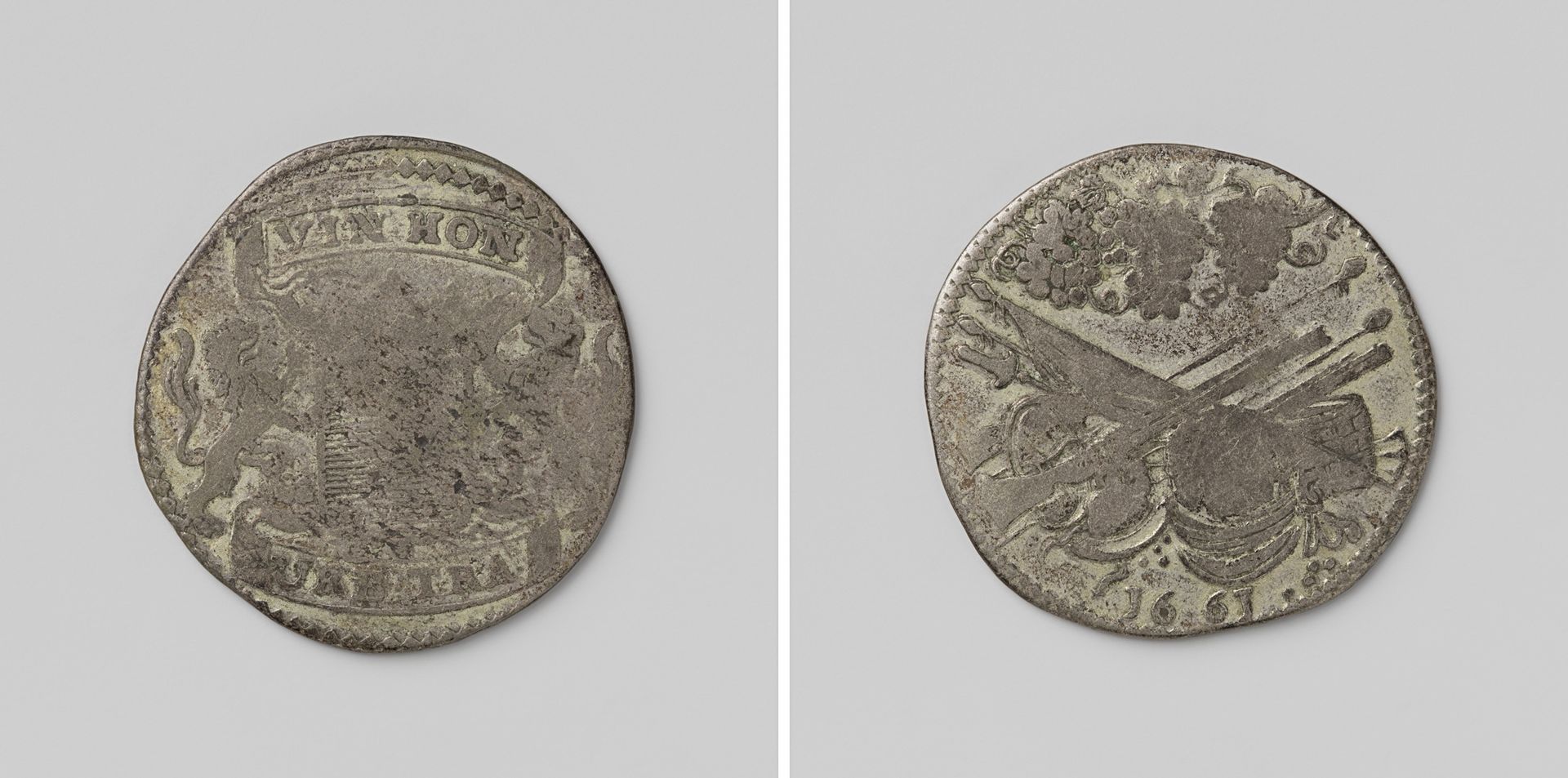
This is a small medal, just 3 centimeters in diameter, created by Roelof van Cuylenburch. It granted members of the Utrecht civic guard the right to a jug of wine. The medal presents a fascinating study in contrasting forms and textures. One side features a heraldic composition with rampant lions flanking a coat of arms. Above, a banner proclaims "Vry Von," while below, we see the word "Utrecht." The opposite side disrupts this formality with a more dynamic arrangement of crossed weapons and foliage, punctuated by the date 1661. The semiotic interplay here is striking. The heraldic side evokes tradition and civic authority through symmetry and representational imagery. The reverse side presents a more active, almost chaotic scene that hints at the guard's practical function. The circular form of the medal itself, with its worn edges and subtle imperfections, reminds us that art exists not in a vacuum but as part of everyday life.
Schutterij van Utrecht, penning die schutters recht gaf op een kan wijn
1661

Artwork details
- Medium
- print, metal, relief
- Dimensions
- diameter 3 cm, weight 6.54 gr
- Copyright
- Rijks Museum: Open Domain
Tags
Comments
Share your thoughts
About this artwork
This is a small medal, just 3 centimeters in diameter, created by Roelof van Cuylenburch. It granted members of the Utrecht civic guard the right to a jug of wine. The medal presents a fascinating study in contrasting forms and textures. One side features a heraldic composition with rampant lions flanking a coat of arms. Above, a banner proclaims "Vry Von," while below, we see the word "Utrecht." The opposite side disrupts this formality with a more dynamic arrangement of crossed weapons and foliage, punctuated by the date 1661. The semiotic interplay here is striking. The heraldic side evokes tradition and civic authority through symmetry and representational imagery. The reverse side presents a more active, almost chaotic scene that hints at the guard's practical function. The circular form of the medal itself, with its worn edges and subtle imperfections, reminds us that art exists not in a vacuum but as part of everyday life.
Comments
Share your thoughts