About this artwork
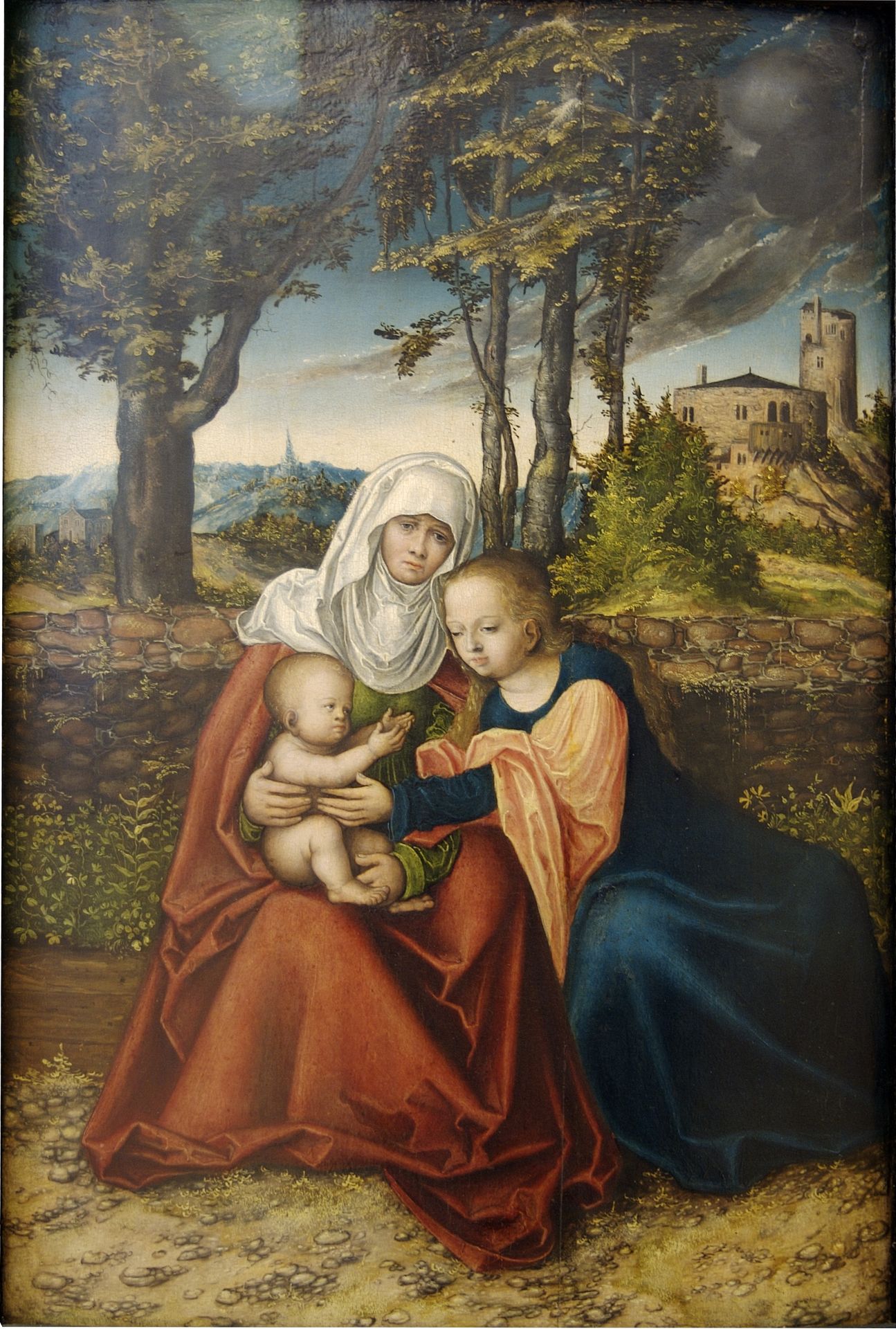
Lucas Cranach the Elder created this oil on wood panel, "Virgin and Child with St. Anne", whose symmetry is immediately striking. The composition is anchored by the figures arranged in a triangular form, set against a detailed landscape. A muted palette dominates, with the red and blue robes providing contrast, evoking a sense of solemnity. Cranach's use of line is precise, defining forms with clarity while texture is rendered smoothly. The scale of the figures, particularly the child, introduces a sense of intimacy, inviting viewers to engage with the theological narrative on a personal level. The artwork challenges traditional Late Gothic representations by incorporating a landscape. Ultimately, the painting exemplifies how formal elements intersect with religious content, creating a complex interplay between aesthetics and meaning. It remains a site for ongoing interpretation, reflecting our evolving understanding of art's role in shaping cultural values.
Virgin and Child with St. Anne 1520

Lucas Cranach the Elder
1472 - 1553
Alte Pinakothek, Bayerische Staatsgemäldesammlungen
Alte Pinakothek, Munich, GermanyArtwork details
- Medium
- oil-paint
- Dimensions
- 61 x 40 cm
- Location
- Alte Pinakothek, Munich, Germany
- Copyright
- Public domain
Tags
portrait
oil-paint
landscape
figuration
oil painting
history-painting
northern-renaissance
academic-art
Comments
No comments
About this artwork
Lucas Cranach the Elder created this oil on wood panel, "Virgin and Child with St. Anne", whose symmetry is immediately striking. The composition is anchored by the figures arranged in a triangular form, set against a detailed landscape. A muted palette dominates, with the red and blue robes providing contrast, evoking a sense of solemnity. Cranach's use of line is precise, defining forms with clarity while texture is rendered smoothly. The scale of the figures, particularly the child, introduces a sense of intimacy, inviting viewers to engage with the theological narrative on a personal level. The artwork challenges traditional Late Gothic representations by incorporating a landscape. Ultimately, the painting exemplifies how formal elements intersect with religious content, creating a complex interplay between aesthetics and meaning. It remains a site for ongoing interpretation, reflecting our evolving understanding of art's role in shaping cultural values.
Comments
No comments