About this artwork
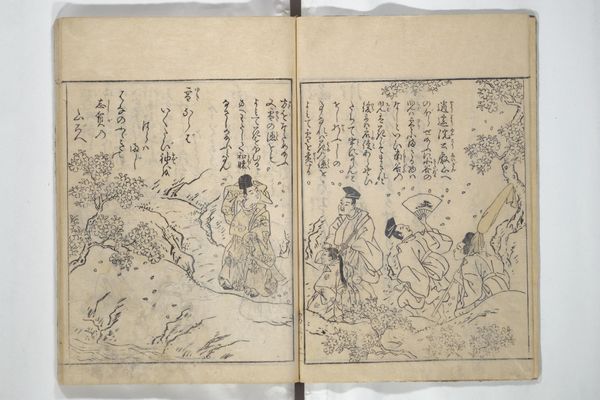
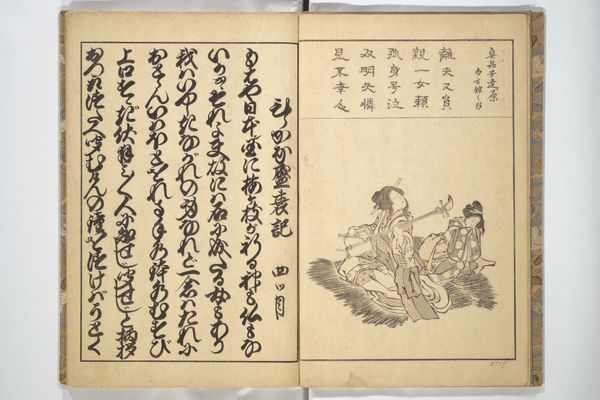
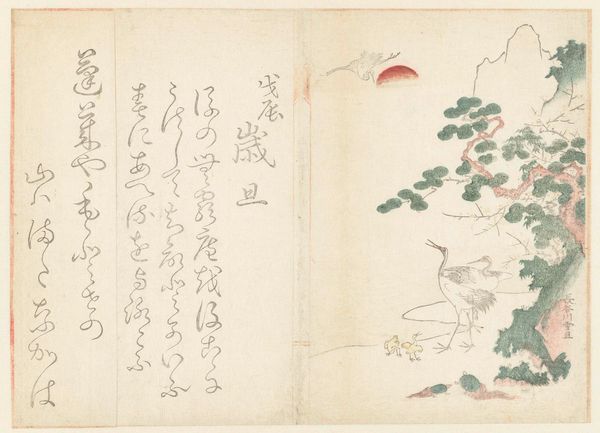
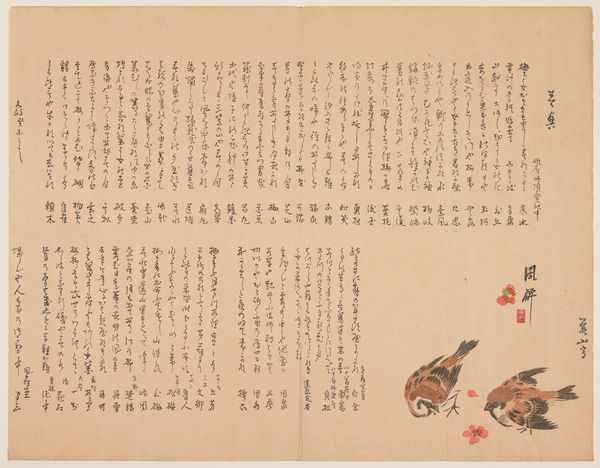
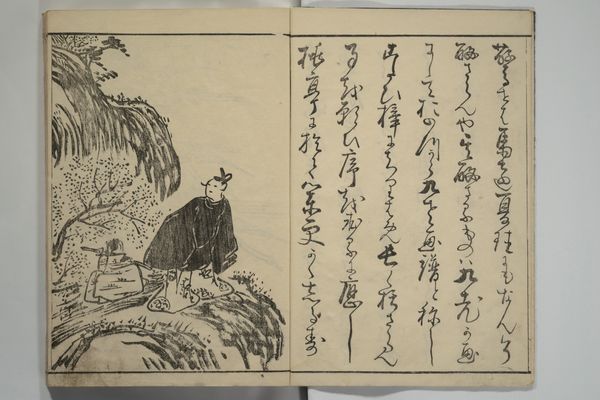
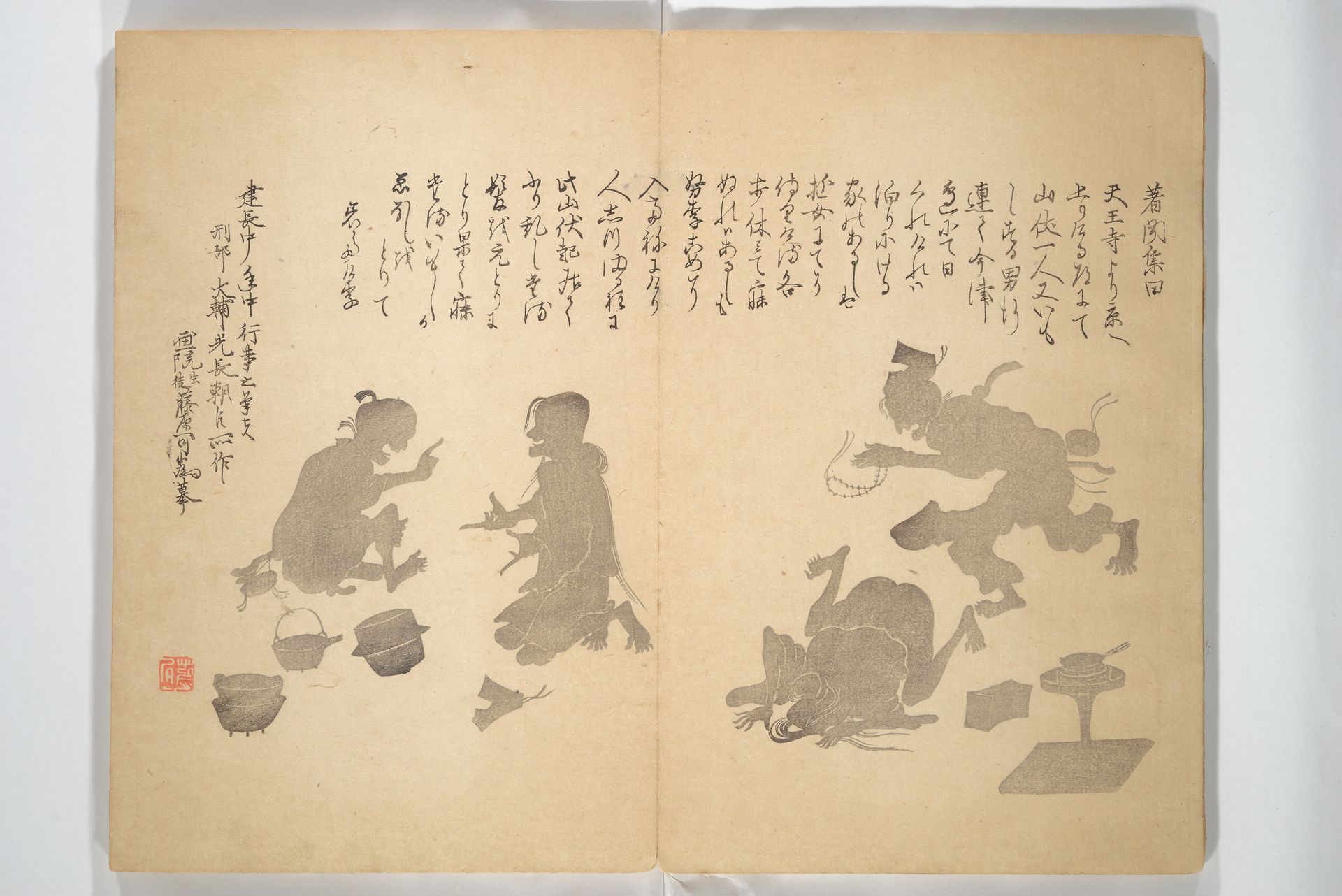
Editor: This is a page from *Album of Flowers and the Moon (Kagetsu jō 花月帖)*, dating from 1875 to 1899, by Mori Tetsuzan. It's an ink and woodblock print on paper. The silhouetted figures give it a rather dreamlike, ambiguous quality. How do you interpret this work? Curator: Indeed. It is a powerful image, imbued with the evocative symbols that point towards broader cultural understanding. Look at the figures themselves – we see what appears to be a Yama-bushi, a mountain ascetic, almost silhouetted on the right. Consider the weight this image carried in Meiji-era Japan. These wandering ascetics embodied a certain freedom but also marginality. Does that contrast tell us anything about this time? Editor: The mountain ascetic figure does create a powerful sense of spiritual yearning…but what are the others doing? Curator: Look closely, there's a child with what appears to be cookware... This speaks to folklore and storytelling in Japan. What does seeing this iconography, during this era, evoke within you? The figures may represent a narrative we can't immediately access, a memory preserved through image. Editor: So, you are saying this is not merely decorative, but potentially a deeper reflection on societal changes in the Meiji period through culturally symbolic imagery? Curator: Precisely. The image acts as a carrier of cultural memory, sparking conversations and introspection long after its creation. Editor: I'm beginning to understand how these seemingly simple prints are actually layered with historical and cultural significance. Curator: The lasting power of visual symbols can sometimes unlock greater knowledge through imagery than text can contain. Editor: This has opened my eyes to looking for narrative in visual objects that previously felt abstract or simply aesthetic.
Album of Flowers and the Moon (Kagetsu jō 花月帖)
1875 - 1899


Artwork details
- Medium
- drawing, print, paper, ink, woodblock-print
- Dimensions
- 10 1/8 × 6 1/2 in. (25.7 × 16.5 cm)
- Location
- Metropolitan Museum of Art, New York, NY
- Copyright
- Public Domain
Tags
Comments
Share your thoughts
About this artwork
Editor: This is a page from *Album of Flowers and the Moon (Kagetsu jō 花月帖)*, dating from 1875 to 1899, by Mori Tetsuzan. It's an ink and woodblock print on paper. The silhouetted figures give it a rather dreamlike, ambiguous quality. How do you interpret this work? Curator: Indeed. It is a powerful image, imbued with the evocative symbols that point towards broader cultural understanding. Look at the figures themselves – we see what appears to be a Yama-bushi, a mountain ascetic, almost silhouetted on the right. Consider the weight this image carried in Meiji-era Japan. These wandering ascetics embodied a certain freedom but also marginality. Does that contrast tell us anything about this time? Editor: The mountain ascetic figure does create a powerful sense of spiritual yearning…but what are the others doing? Curator: Look closely, there's a child with what appears to be cookware... This speaks to folklore and storytelling in Japan. What does seeing this iconography, during this era, evoke within you? The figures may represent a narrative we can't immediately access, a memory preserved through image. Editor: So, you are saying this is not merely decorative, but potentially a deeper reflection on societal changes in the Meiji period through culturally symbolic imagery? Curator: Precisely. The image acts as a carrier of cultural memory, sparking conversations and introspection long after its creation. Editor: I'm beginning to understand how these seemingly simple prints are actually layered with historical and cultural significance. Curator: The lasting power of visual symbols can sometimes unlock greater knowledge through imagery than text can contain. Editor: This has opened my eyes to looking for narrative in visual objects that previously felt abstract or simply aesthetic.
Comments
Share your thoughts