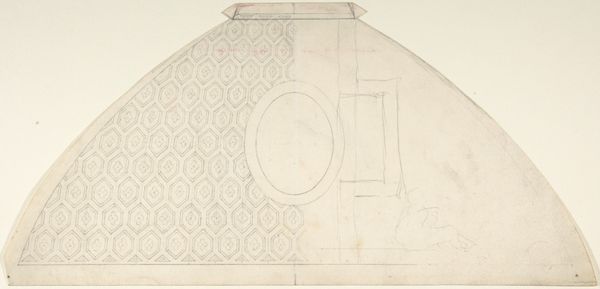
drawing, coloured-pencil, pencil, architecture
#
drawing
#
art-nouveau
#
coloured-pencil
#
pencil
#
line
#
architecture
Dimensions: 26.7 x 41.4 cm
Copyright: Public domain
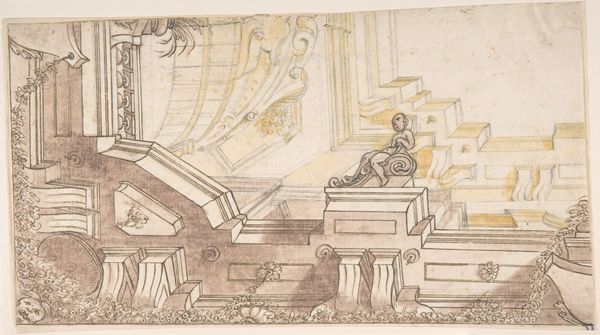
Editor: This is Koloman Moser's "Stage design for 'The minutes of love' by Edward Bauersfeld," created in 1908. It’s a drawing using colored pencil and pencil. There’s something about the starkness of the architecture combined with the softness of the colored pencil that really intrigues me. What do you see in this piece? Curator: It's crucial to understand the materials and their deployment within the context of Moser's era. He’s challenging the very idea of "high art" by employing drawing - traditionally seen as preparatory – for a stage design. Colored pencils were becoming more widely available, which democratized artistic expression. The availability of materials shapes artistic output. Editor: So the *choice* of colored pencil is as important as the design itself? Curator: Precisely! Consider the social context: theater design was collaborative, involving carpenters, painters, and stagehands. Moser’s drawing becomes a plan, a tool of communication and organization of labor. This is not some romantic, solitary artistic act, but a blueprint for collective production. And we must consider who has access to which materials, how these impact distribution networks, which dictates artistic availability. Editor: I never considered the collaborative aspect so explicitly connected to the materials. How the materials available dictate the outcome! Curator: Think about the diamonds on the back wall and bench, as another interesting case: mass production and commercial consumption. What the drawing lacks, the physical production can make up for. Editor: Right. The physical creation of this production becomes the actualized product, rather than just the colored pencil design! This makes so much more sense, especially considering the time it was created in. I think this context gave me more clarity and understanding of the time. Curator: Indeed, it’s a move beyond surface aesthetics. Focusing on production exposes the interplay of material, labor, and design in shaping our cultural landscape.
Comments
No comments
Be the first to comment and join the conversation on the ultimate creative platform.
 Collect
 React
React Comment
More like this