About this artwork
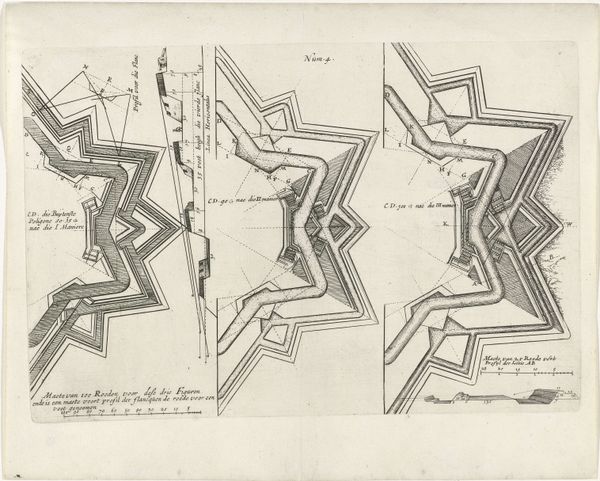
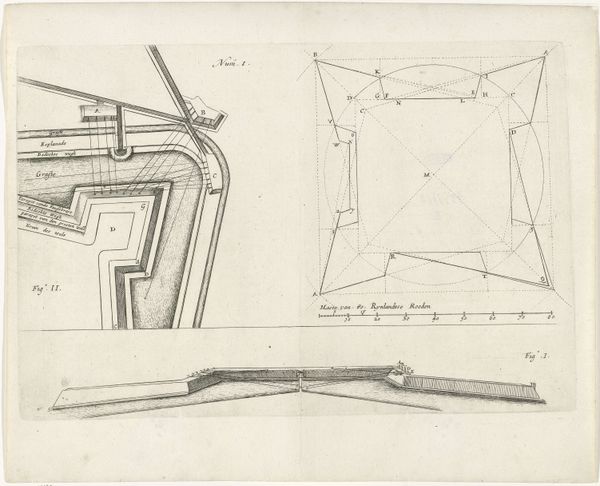
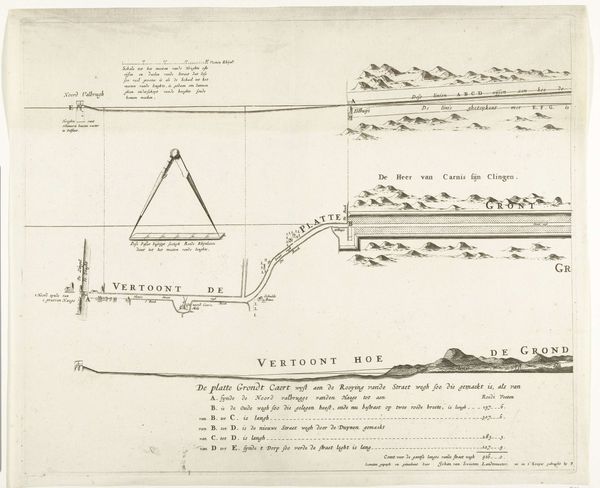
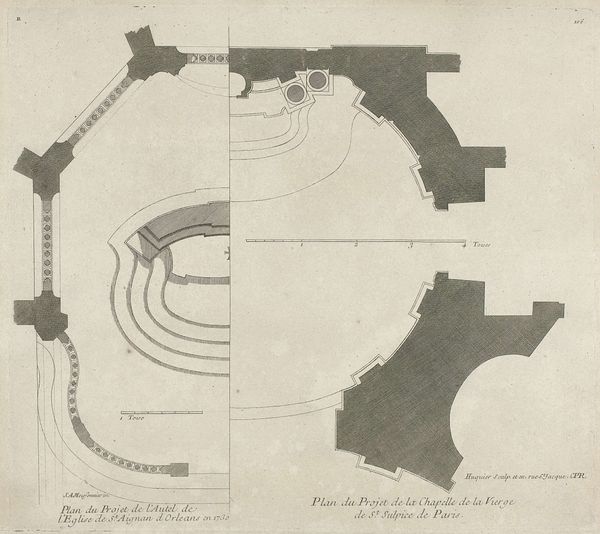
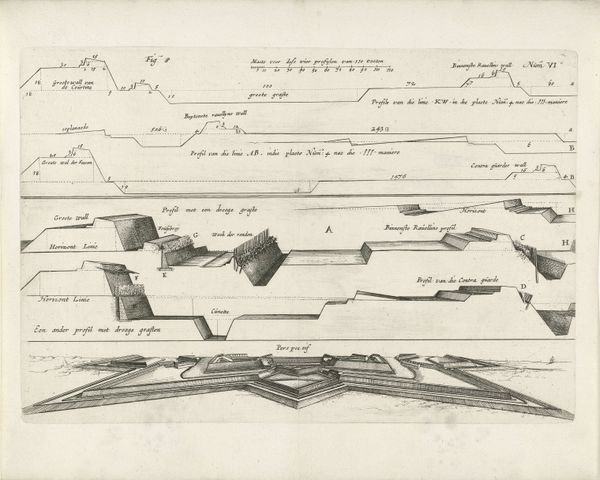
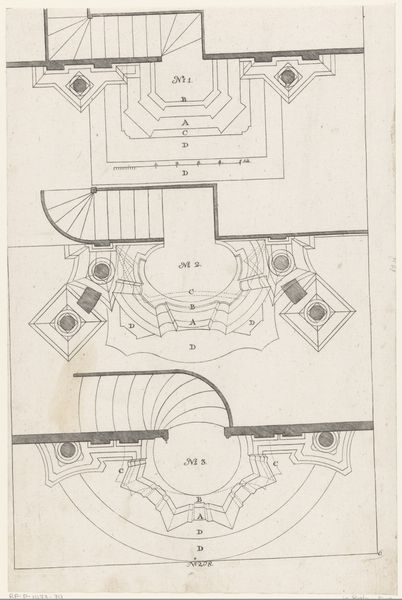
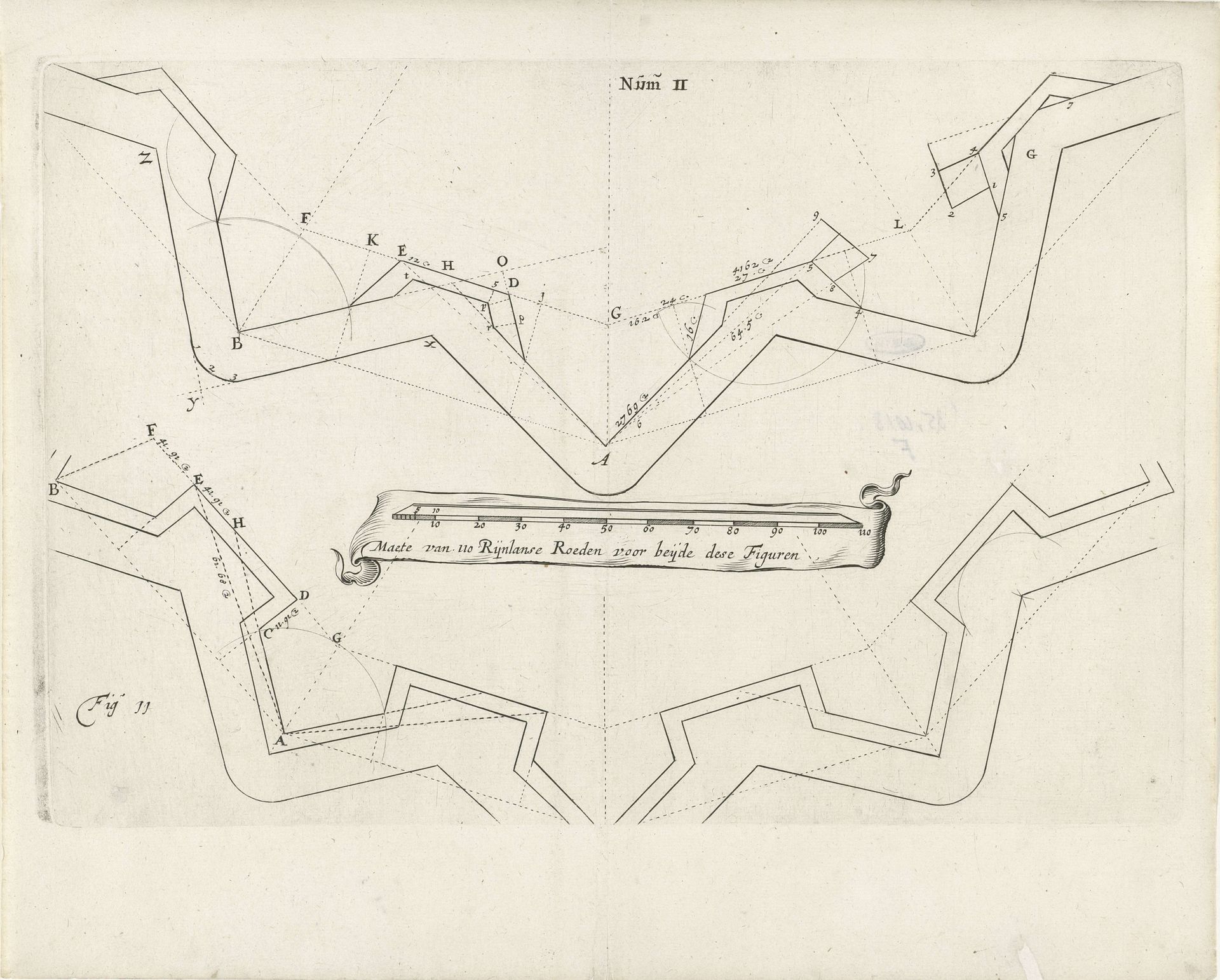
Curator: This is “Plattegrond van versterkte vestingmuur,” or “Plan of a fortified city wall,” dating to 1654, by Hendrick baron van Ruse van Rysensteen. It appears to be an engraving, part of a larger study. What’s your immediate response? Editor: Stark. Precise. It gives the sense of order and planning—cold comfort, perhaps, intended to create safety, though there’s something unnerving in the geometric rigidity. Curator: The line work is striking, isn’t it? Notice the use of dashed lines overlaid upon solid forms to give shape to implied structures. The starkness derives from a limited tonal palette, emphasizing line and shape as the dominant compositional elements. It really invites close visual study. Editor: Indeed. The linear construction, along with the angles forming the bastions…they evoke a sense of impenetrable defense, a response to conflict perhaps deeply rooted in collective anxiety of the 17th Century. There are, after all, so many historic images of sieges. What are your thoughts? Curator: Precisely! Semiotically, each line is significant: solid lines declare what is, while dashed lines indicate potential. The angles formed at each corner don’t merely represent physical space, they symbolize calculated military strategy. Editor: I see an aspiration towards invincibility, certainly. And these city walls, visually, were crucial. Cities project power, control...these zig-zagging walls, they physically embodied these ideals of protection for those inside and a clear, intimidating message to those outside. It’s like a psychological imprint, isn't it? Curator: Yes, as an aesthetic object it is quite intellectual, yet somewhat detached from everyday life. Consider how the use of negative space emphasizes the geometric perfection. Editor: Well, examining these symbols has given me a new understanding of 17th century society. A world constantly attempting to build defenses, both physical and psychological. Curator: For me, it has reinforced how the purely formal can still elicit strong emotional responses.

Artwork details
- Medium
- drawing, print, engraving
- Dimensions
- height 230 mm, width 340 mm
- Copyright
- Rijks Museum: Open Domain
Tags
drawing
light pencil work
quirky sketch
dutch-golden-age
hand drawn type
landscape
personal sketchbook
idea generation sketch
sketchwork
geometric
line
sketchbook drawing
storyboard and sketchbook work
academic-art
sketchbook art
engraving
initial sketch
Comments
Be the first to share your thoughts about this work.
About this artwork
Curator: This is “Plattegrond van versterkte vestingmuur,” or “Plan of a fortified city wall,” dating to 1654, by Hendrick baron van Ruse van Rysensteen. It appears to be an engraving, part of a larger study. What’s your immediate response? Editor: Stark. Precise. It gives the sense of order and planning—cold comfort, perhaps, intended to create safety, though there’s something unnerving in the geometric rigidity. Curator: The line work is striking, isn’t it? Notice the use of dashed lines overlaid upon solid forms to give shape to implied structures. The starkness derives from a limited tonal palette, emphasizing line and shape as the dominant compositional elements. It really invites close visual study. Editor: Indeed. The linear construction, along with the angles forming the bastions…they evoke a sense of impenetrable defense, a response to conflict perhaps deeply rooted in collective anxiety of the 17th Century. There are, after all, so many historic images of sieges. What are your thoughts? Curator: Precisely! Semiotically, each line is significant: solid lines declare what is, while dashed lines indicate potential. The angles formed at each corner don’t merely represent physical space, they symbolize calculated military strategy. Editor: I see an aspiration towards invincibility, certainly. And these city walls, visually, were crucial. Cities project power, control...these zig-zagging walls, they physically embodied these ideals of protection for those inside and a clear, intimidating message to those outside. It’s like a psychological imprint, isn't it? Curator: Yes, as an aesthetic object it is quite intellectual, yet somewhat detached from everyday life. Consider how the use of negative space emphasizes the geometric perfection. Editor: Well, examining these symbols has given me a new understanding of 17th century society. A world constantly attempting to build defenses, both physical and psychological. Curator: For me, it has reinforced how the purely formal can still elicit strong emotional responses.
Comments
Be the first to share your thoughts about this work.