About this artwork
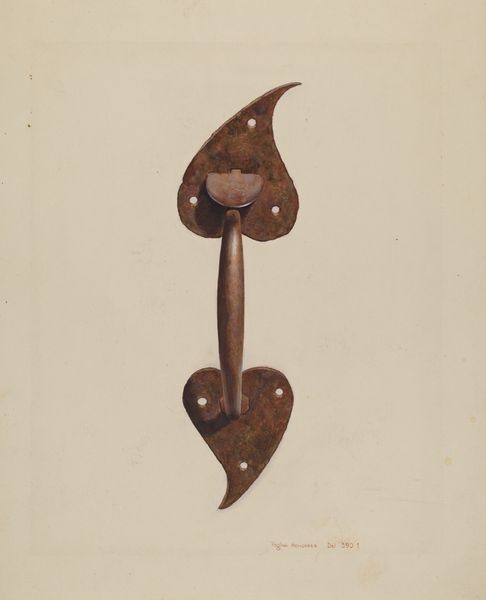
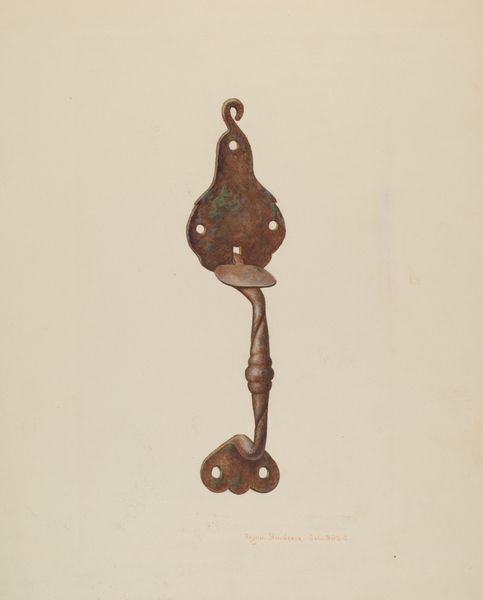
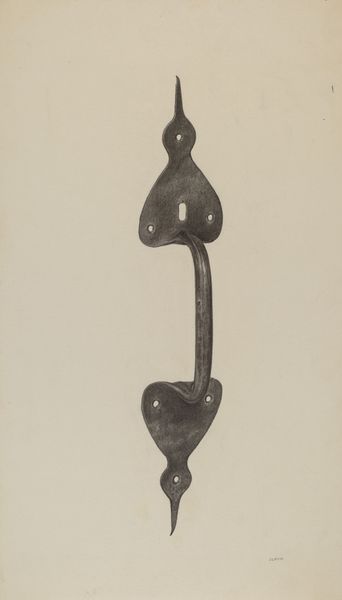
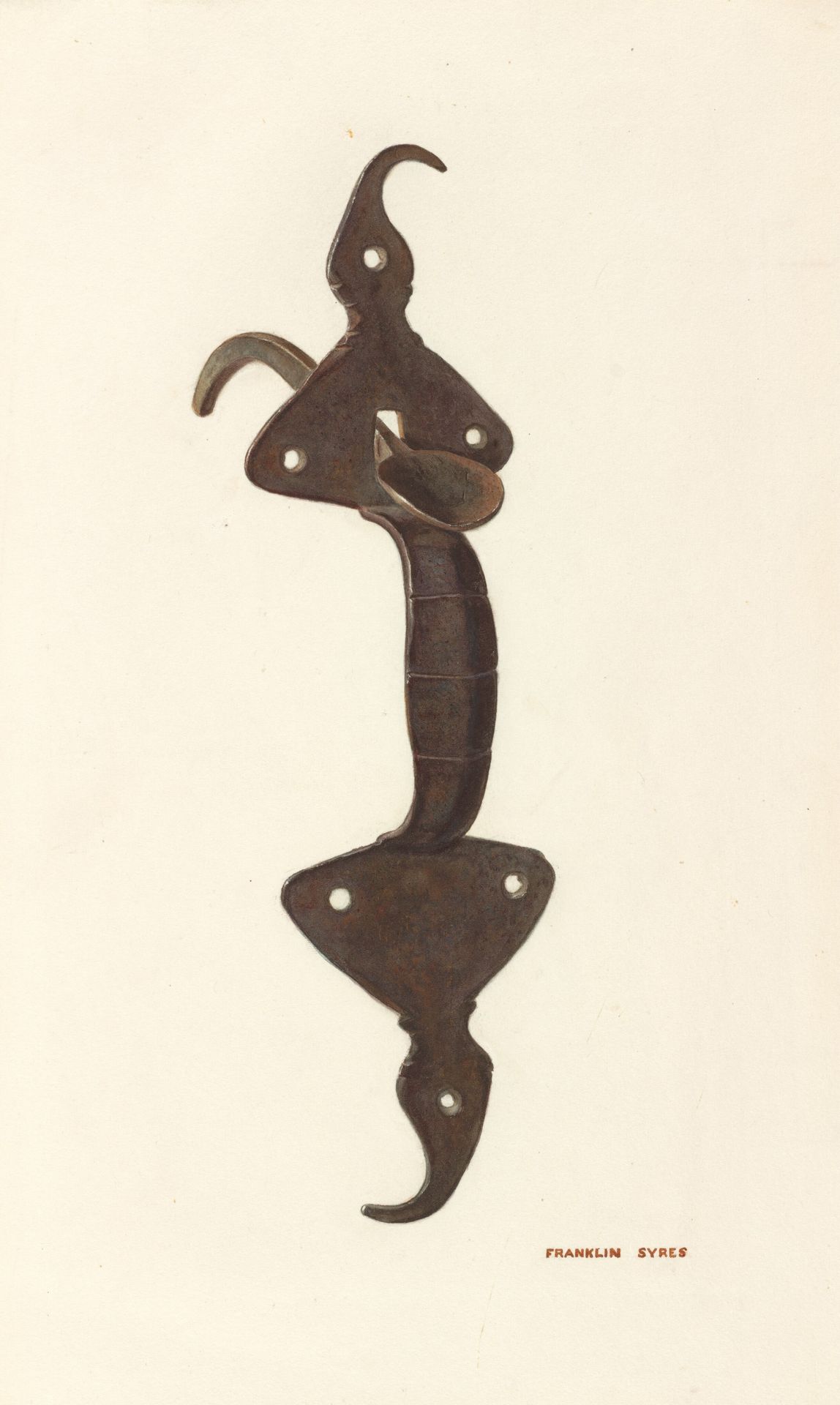
Editor: Here we have Franklyn Syres’s "Door Latch," created sometime between 1935 and 1942. It’s a pencil drawing that feels very precise, almost technical in its execution. It’s like a blueprint. What stands out to you in this piece? Curator: The careful rendering of the object’s form is certainly striking. Notice how Syres uses subtle variations in shading to define the three-dimensionality of the latch. The lines themselves seem to trace and contain volume in space. This focus on delineating form recalls academic drawing traditions and classical principles of proportion. Editor: So, the focus isn’t necessarily on the latch as a functional object but more on its aesthetic form? Curator: Precisely. The subject matter is almost secondary to the exercise of drawing itself. Observe the almost geometrical shapes – the triangles at the top and bottom of the piece – that are offset by the more organic curves of the latch mechanism. What effect does this opposition achieve? Editor: It creates a nice tension, a balance between rigidity and fluidity. The shading almost softens the hardness of the metal. Curator: Exactly. It suggests a sensitivity toward the medium, which contrasts against the inherent coldness of metal and an engineer's precision. In focusing on the careful, formal rendering, Syres transcends the utilitarian object to create an aesthetic object. Editor: That’s a helpful way to understand it. I was getting stuck on thinking about its original purpose, but focusing on the artistic elements clarifies things. Curator: Agreed. The formal approach gives this simple subject new possibilities for visual expression.


Artwork details
- Medium
- drawing, pencil
- Dimensions
- overall: 38.8 x 22.8 cm (15 1/4 x 9 in.) Original IAD Object: 10 1/2" long; 2 3/4" wide
- Copyright
- National Gallery of Art: CC0 1.0
Tags
drawing
pencil drawing
pencil
watercolour illustration
Comments
Be the first to share your thoughts about this work.
About this artwork
Editor: Here we have Franklyn Syres’s "Door Latch," created sometime between 1935 and 1942. It’s a pencil drawing that feels very precise, almost technical in its execution. It’s like a blueprint. What stands out to you in this piece? Curator: The careful rendering of the object’s form is certainly striking. Notice how Syres uses subtle variations in shading to define the three-dimensionality of the latch. The lines themselves seem to trace and contain volume in space. This focus on delineating form recalls academic drawing traditions and classical principles of proportion. Editor: So, the focus isn’t necessarily on the latch as a functional object but more on its aesthetic form? Curator: Precisely. The subject matter is almost secondary to the exercise of drawing itself. Observe the almost geometrical shapes – the triangles at the top and bottom of the piece – that are offset by the more organic curves of the latch mechanism. What effect does this opposition achieve? Editor: It creates a nice tension, a balance between rigidity and fluidity. The shading almost softens the hardness of the metal. Curator: Exactly. It suggests a sensitivity toward the medium, which contrasts against the inherent coldness of metal and an engineer's precision. In focusing on the careful, formal rendering, Syres transcends the utilitarian object to create an aesthetic object. Editor: That’s a helpful way to understand it. I was getting stuck on thinking about its original purpose, but focusing on the artistic elements clarifies things. Curator: Agreed. The formal approach gives this simple subject new possibilities for visual expression.
Comments
Be the first to share your thoughts about this work.