About this artwork
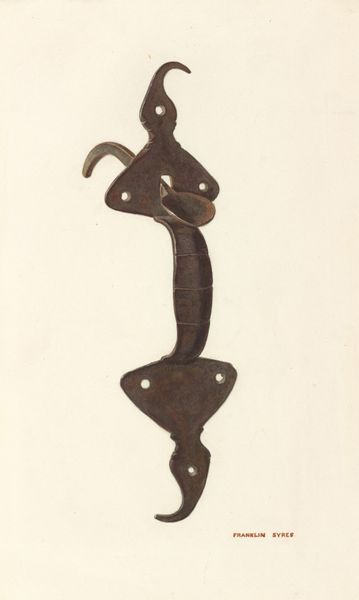
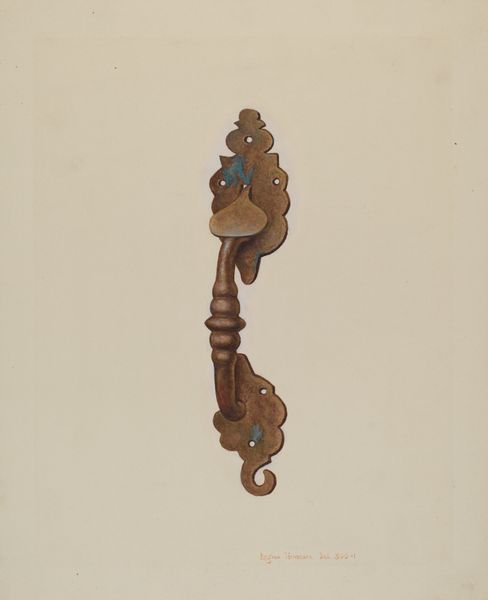
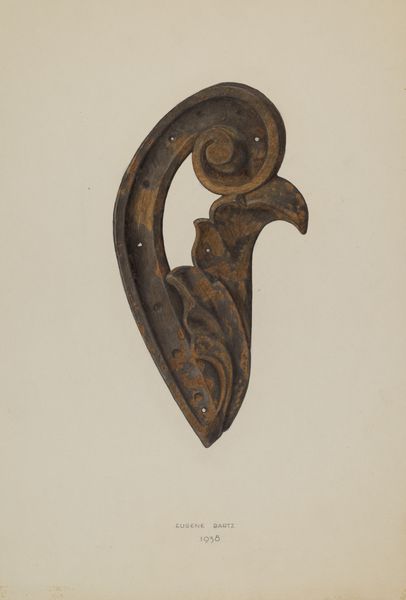
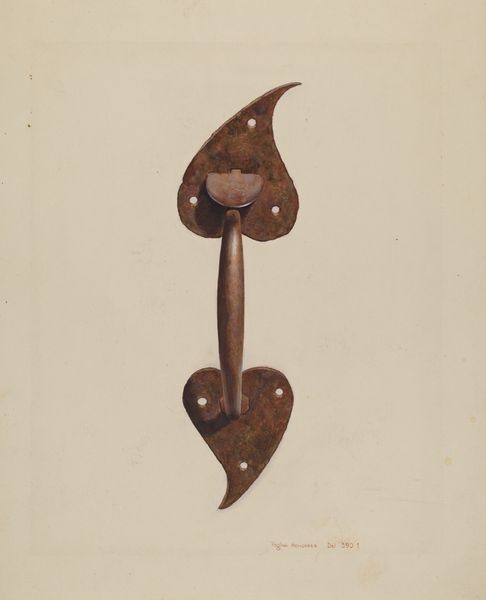
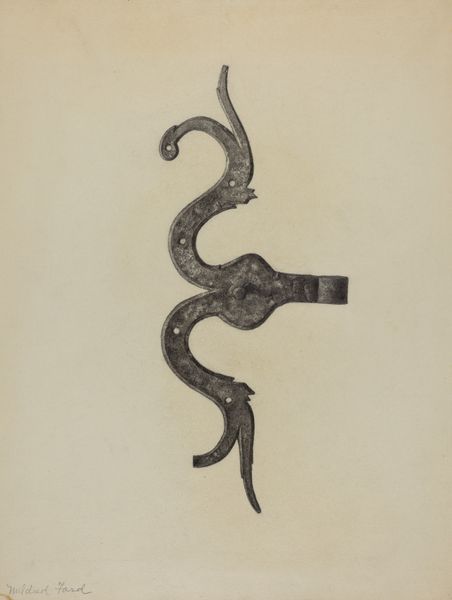
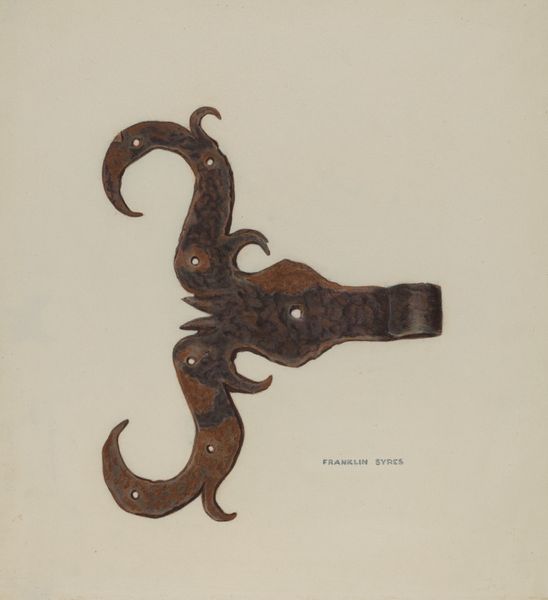
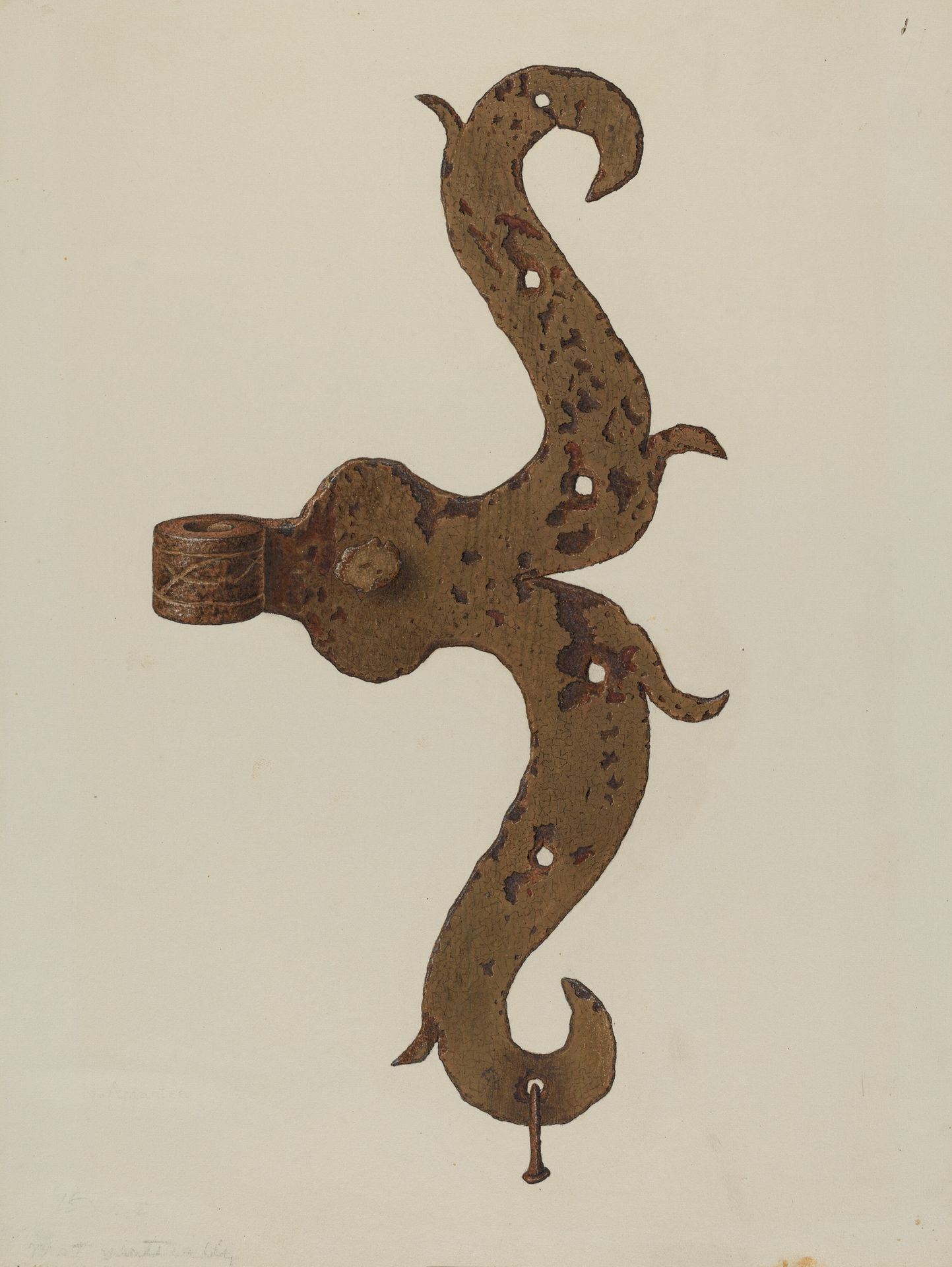
Editor: Here we have Nicholas Amantea's "Hinge Butt," dating from around 1940, done with watercolor and drawing on paper. It's such a detailed rendering of something so mundane, almost elevating it to this icon-like status. What are your initial thoughts on it? Curator: It’s interesting how Amantea focuses so intently on this utilitarian object. Consider the social context of the 1940s. With the rise of industrialization, everyday objects became increasingly mass-produced and often devoid of aesthetic consideration. By carefully depicting this particular hinge, possibly hand-forged, is Amantea perhaps making a comment on craftsmanship and the loss of individuality in a rapidly changing world? Editor: That’s a really interesting angle. I was mostly seeing it as a celebration of form, but your point about industrialization… How do you think its presentation, as a drawing displayed perhaps in a museum, impacts our understanding of its meaning? Curator: That’s the key question, isn't it? The act of placing it within a museum context immediately elevates it. It asks the viewer to see beyond its function as a hinge and consider it as a representation of a past way of life, or perhaps a commentary on our relationship with objects in general. Are we meant to mourn the loss of handcraftsmanship, or simply appreciate its unique form? Editor: So the meaning isn’t inherent, but shaped by where and how we encounter it? Curator: Precisely. The museum space transforms a functional item into a cultural artifact, imbued with new layers of meaning and significance. Even the title, "Hinge Butt," has a bit of playful, subversive humor, which suggests Amantea was aware of the irony of depicting such an object. Editor: I never would have considered its role within a cultural narrative. This has totally transformed how I look at it. Thanks! Curator: My pleasure! Thinking about how art interacts with society helps us unpack all sorts of assumptions we have about beauty, utility and value.


Artwork details
- Medium
- drawing, paper, watercolor
- Dimensions
- overall: 27.6 x 36.5 cm (10 7/8 x 14 3/8 in.) Original IAD Object: 12 3/4" long; 6 3/4" wide
- Copyright
- National Gallery of Art: CC0 1.0
Tags
Comments
Share your thoughts
About this artwork
Editor: Here we have Nicholas Amantea's "Hinge Butt," dating from around 1940, done with watercolor and drawing on paper. It's such a detailed rendering of something so mundane, almost elevating it to this icon-like status. What are your initial thoughts on it? Curator: It’s interesting how Amantea focuses so intently on this utilitarian object. Consider the social context of the 1940s. With the rise of industrialization, everyday objects became increasingly mass-produced and often devoid of aesthetic consideration. By carefully depicting this particular hinge, possibly hand-forged, is Amantea perhaps making a comment on craftsmanship and the loss of individuality in a rapidly changing world? Editor: That’s a really interesting angle. I was mostly seeing it as a celebration of form, but your point about industrialization… How do you think its presentation, as a drawing displayed perhaps in a museum, impacts our understanding of its meaning? Curator: That’s the key question, isn't it? The act of placing it within a museum context immediately elevates it. It asks the viewer to see beyond its function as a hinge and consider it as a representation of a past way of life, or perhaps a commentary on our relationship with objects in general. Are we meant to mourn the loss of handcraftsmanship, or simply appreciate its unique form? Editor: So the meaning isn’t inherent, but shaped by where and how we encounter it? Curator: Precisely. The museum space transforms a functional item into a cultural artifact, imbued with new layers of meaning and significance. Even the title, "Hinge Butt," has a bit of playful, subversive humor, which suggests Amantea was aware of the irony of depicting such an object. Editor: I never would have considered its role within a cultural narrative. This has totally transformed how I look at it. Thanks! Curator: My pleasure! Thinking about how art interacts with society helps us unpack all sorts of assumptions we have about beauty, utility and value.
Comments
Share your thoughts