About this artwork
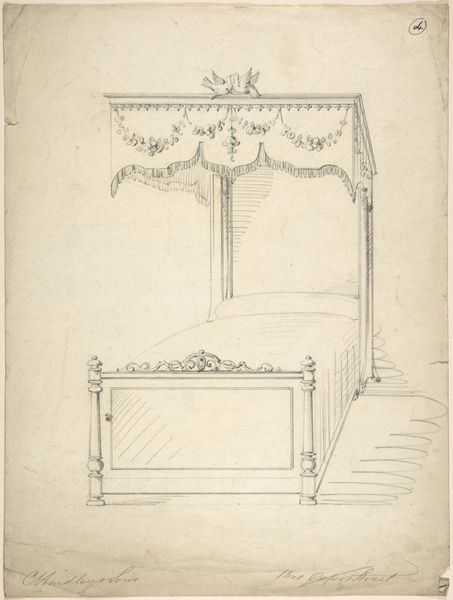
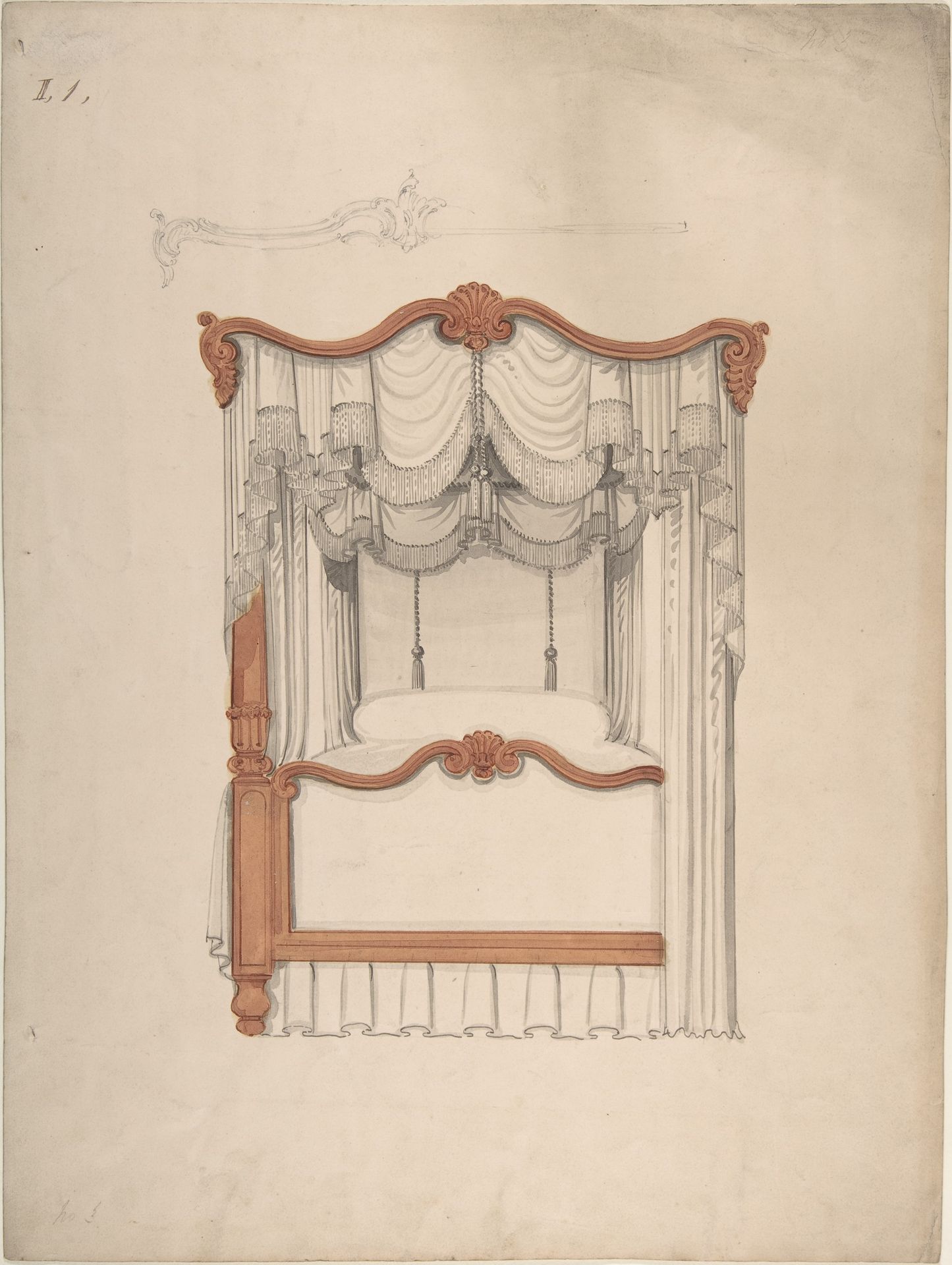
This drawing presents a design for a four-poster bed, featuring elaborate draperies and ornamentation. Note the prominent use of the shell motif, particularly on the headboard and canopy. The shell, often associated with Venus, the goddess of love, has been a symbol of fertility, rebirth, and pilgrimage since ancient times. We see this motif echoed in Botticelli’s “Birth of Venus,” where the goddess emerges from a giant scallop shell, a potent image of creation and renewal. The presence of the shell on a bed—a place of both rest and procreation—infuses the space with layers of meaning. It speaks to the cyclical nature of life, linking intimate, personal experiences with broader cultural and mythological narratives. This symbol becomes a cultural carrier, its meaning transformed and reinterpreted across time. It underscores how our collective memories, both conscious and unconscious, shape our understanding of domestic space, and how we imbue it with desire and longing.
Design for a Four-poster Bed with Draperies
1840 - 1899


Artwork details
- Medium
- drawing, print, watercolor
- Dimensions
- sheet: 16 1/4 x 13 in. (41.3 x 33 cm)
- Location
- Metropolitan Museum of Art, New York, NY
- Copyright
- Public Domain
Tags
Comments
Share your thoughts
About this artwork
This drawing presents a design for a four-poster bed, featuring elaborate draperies and ornamentation. Note the prominent use of the shell motif, particularly on the headboard and canopy. The shell, often associated with Venus, the goddess of love, has been a symbol of fertility, rebirth, and pilgrimage since ancient times. We see this motif echoed in Botticelli’s “Birth of Venus,” where the goddess emerges from a giant scallop shell, a potent image of creation and renewal. The presence of the shell on a bed—a place of both rest and procreation—infuses the space with layers of meaning. It speaks to the cyclical nature of life, linking intimate, personal experiences with broader cultural and mythological narratives. This symbol becomes a cultural carrier, its meaning transformed and reinterpreted across time. It underscores how our collective memories, both conscious and unconscious, shape our understanding of domestic space, and how we imbue it with desire and longing.
Comments
Share your thoughts