About this artwork
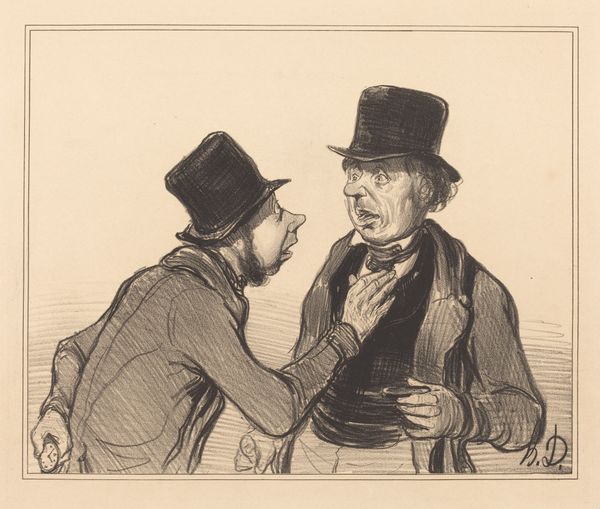
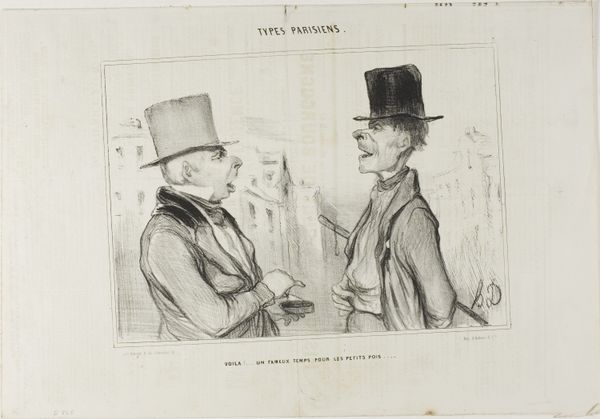
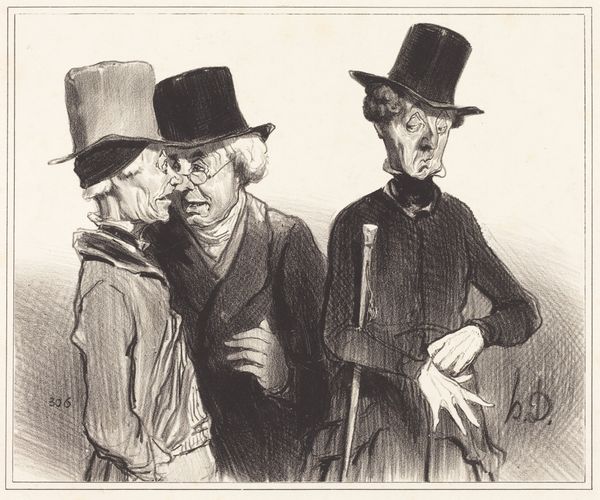
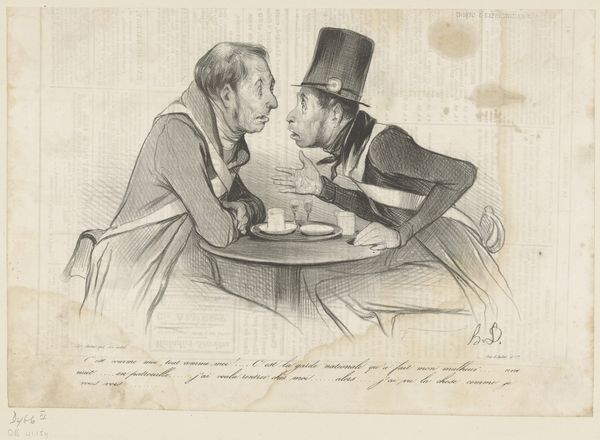
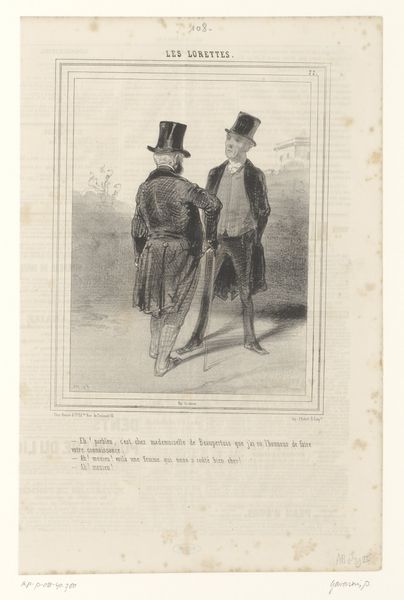
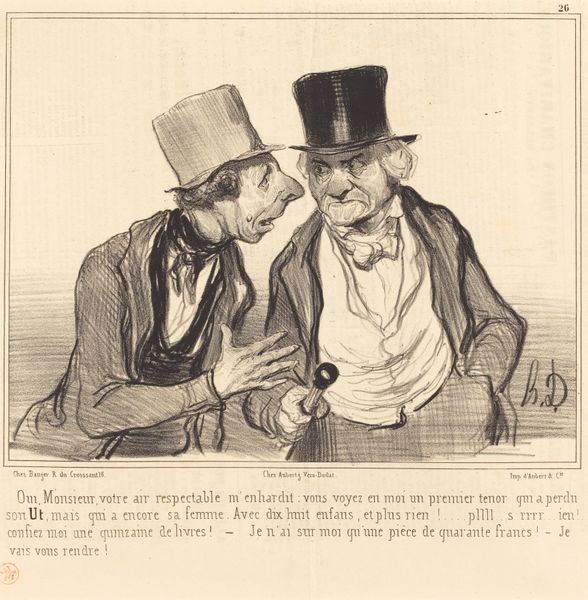
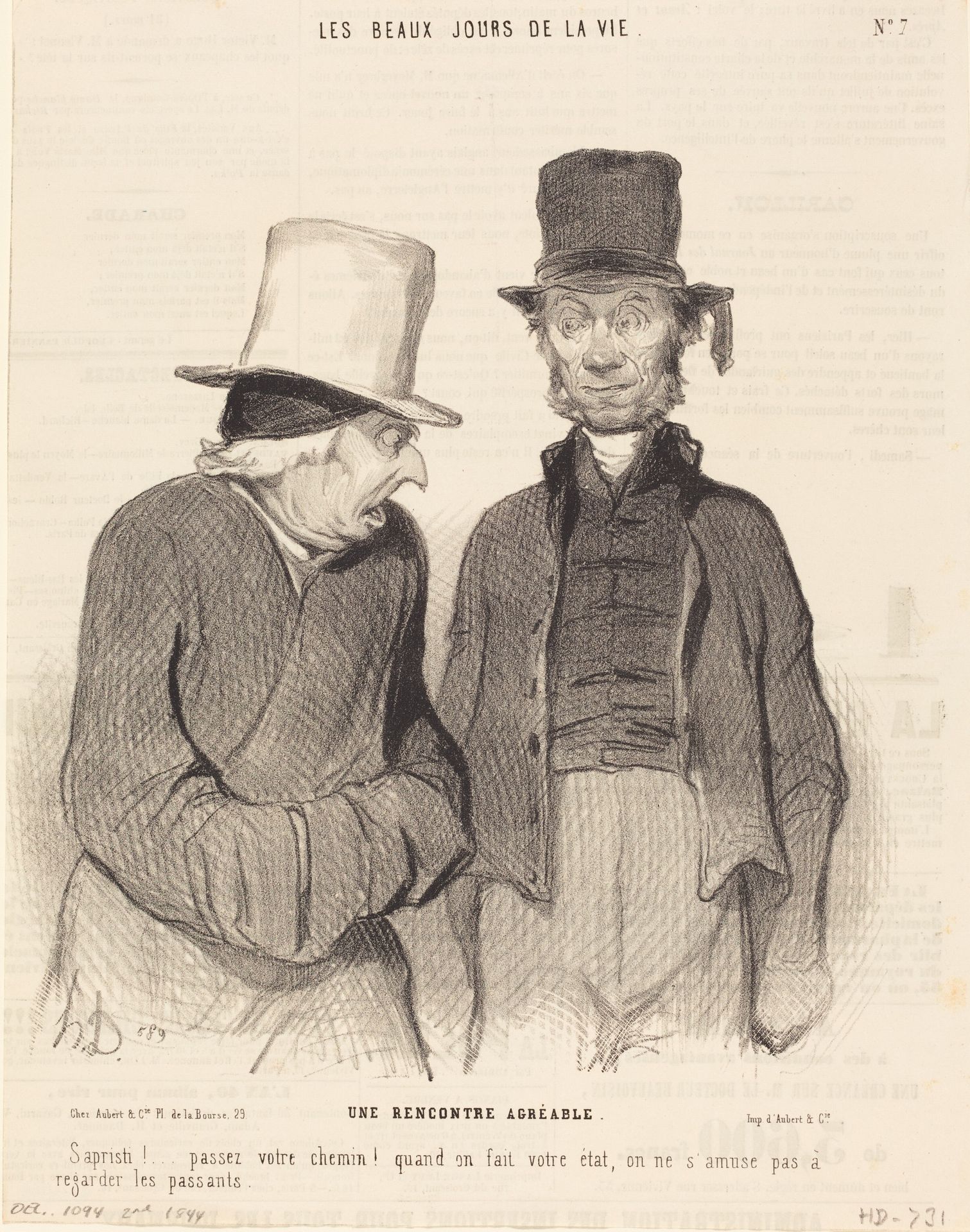
Editor: Here we have "Une Rencontre agréable," or "A Pleasant Encounter," a lithograph from 1844 by Honoré Daumier. The exaggerated features of the men really strike me. What’s your take on this print? Curator: Well, as a materialist, I immediately consider the lithographic process itself. Think about the labor involved: the drawing on the stone, the chemical processes, the printing, and distribution. This wasn't fine art for the elite; it was a product, intended for mass consumption. Editor: That's a perspective I hadn't fully considered. How does this influence how we interpret the artwork? Curator: It forces us to question the traditional art historical narratives that often elevate artistic genius above all else. Daumier was a skilled draftsman, yes, but his work here is also an act of production, reflecting the burgeoning print culture of 19th-century France. The caricature becomes a commodity. Editor: So the materials and means of production are as significant as the content itself? Curator: Precisely. These materials allowed Daumier to reach a broad audience, commenting on the social and political climate in a way that challenged the established order. Are these men powerful figures? Consider how the materiality democratized satire, questioning power through accessible, reproducible images. Editor: I never thought about a simple drawing containing so much context! Curator: See how exploring the process behind it changes the picture? Thinking about how art is made opens us up to understanding its wider societal impact.


Artwork details
- Medium
- drawing, lithograph, print, pen
- Copyright
- National Gallery of Art: CC0 1.0
Tags
drawing
lithograph
caricature
pencil drawing
romanticism
pen
genre-painting
Comments
No comments
About this artwork
Editor: Here we have "Une Rencontre agréable," or "A Pleasant Encounter," a lithograph from 1844 by Honoré Daumier. The exaggerated features of the men really strike me. What’s your take on this print? Curator: Well, as a materialist, I immediately consider the lithographic process itself. Think about the labor involved: the drawing on the stone, the chemical processes, the printing, and distribution. This wasn't fine art for the elite; it was a product, intended for mass consumption. Editor: That's a perspective I hadn't fully considered. How does this influence how we interpret the artwork? Curator: It forces us to question the traditional art historical narratives that often elevate artistic genius above all else. Daumier was a skilled draftsman, yes, but his work here is also an act of production, reflecting the burgeoning print culture of 19th-century France. The caricature becomes a commodity. Editor: So the materials and means of production are as significant as the content itself? Curator: Precisely. These materials allowed Daumier to reach a broad audience, commenting on the social and political climate in a way that challenged the established order. Are these men powerful figures? Consider how the materiality democratized satire, questioning power through accessible, reproducible images. Editor: I never thought about a simple drawing containing so much context! Curator: See how exploring the process behind it changes the picture? Thinking about how art is made opens us up to understanding its wider societal impact.
Comments
No comments