About this artwork
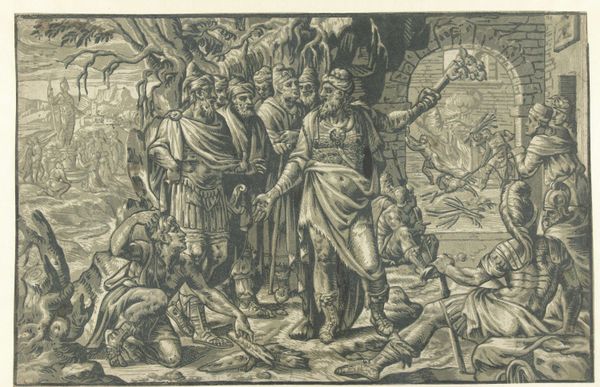
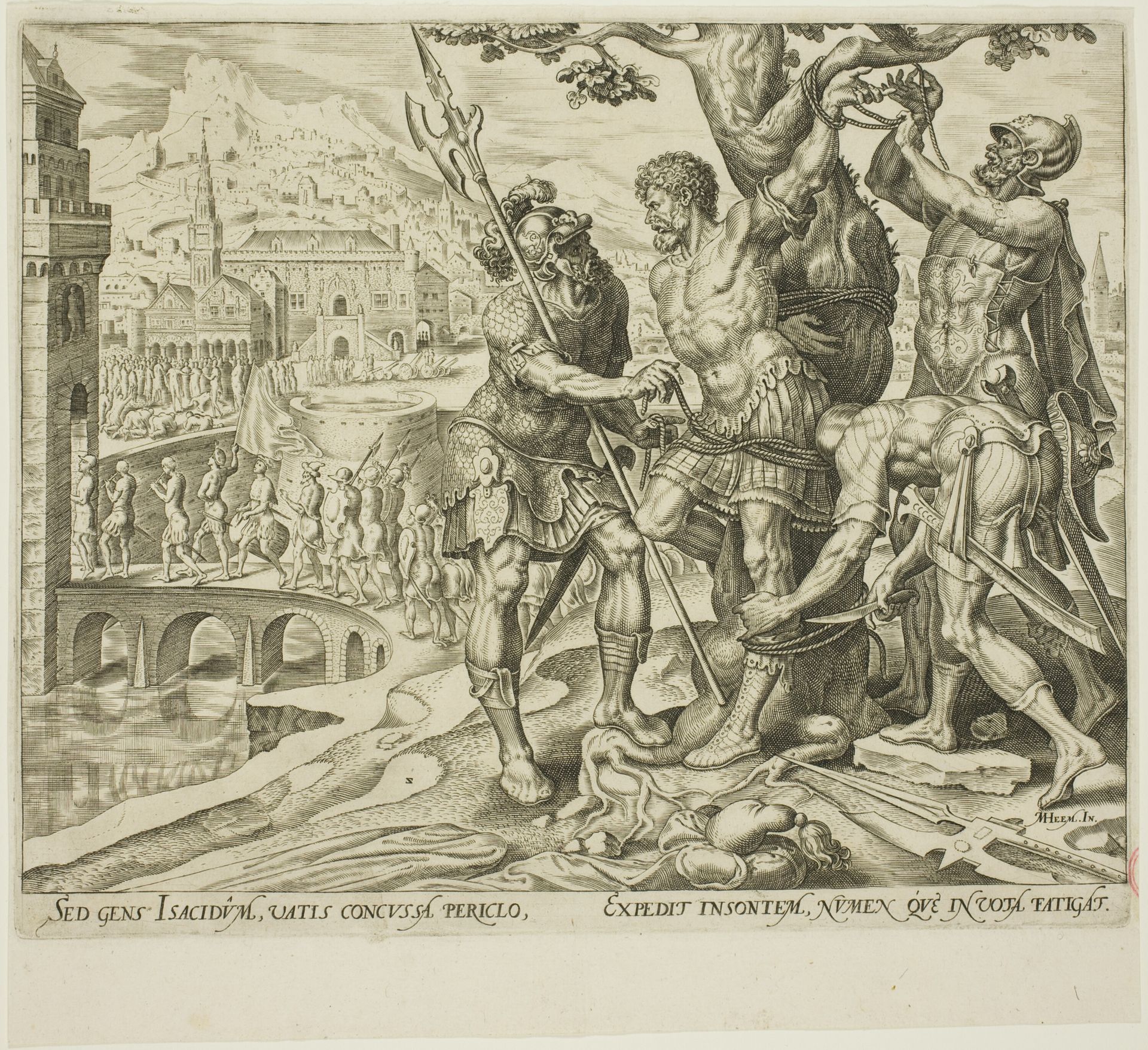
Curator: This is “The Israelites Finding Achior Tied to a Tree,” an engraving from 1564 by Philip Galle, currently residing at The Art Institute of Chicago. The precision of the line work is really striking to me. What are your first impressions? Editor: I'm immediately drawn to the level of detail and the narrative aspect, that it comes from "The Story of Judith and Holofernes." The way Galle rendered the landscape and the figures really speaks to a moment of raw exposure and vulnerability. How does the print medium influence our understanding of this particular narrative? Curator: The choice of engraving is central. Think about the labour involved: the meticulous carving into the metal plate, the multiple printings, and the accessibility that print offered to a wider audience beyond the wealthy elite. The Northern Renaissance was about production. How do you see the themes of labor and class at play? Editor: So, it’s not just depicting a story, but the artwork itself participates in the spread of knowledge and, dare I say, even challenges traditional patronage systems through its creation and distribution? I guess that’s why the level of detail is so impressive because it allowed Galle to circulate more prints. Curator: Precisely. The medium informs the message. It's a manufactured item; Galle had to think about producing the art piece to an increasingly literate and critical public. Consider, too, the social implications. Who had access to these prints? Editor: Probably religious folks, perhaps even scholars or wealthy merchants, maybe used as didactic tools. This wasn't confined to a church, that’s a huge impact on social practices of this artwork. It really makes me reconsider the print's historical weight. Curator: The value of this image really extends from how it was produced. Editor: I never really thought about engravings in that way. I guess you can say I was more concerned with what I thought it was. But I’m leaving this artwork rethinking its existence.
The Israelites Finding Achior Tied to a Tree, plate two from The Story of Judith and Holofernes
1564


Artwork details
- Medium
- drawing, print, paper, ink, engraving
- Dimensions
- 203 × 246 mm (image); 204 × 249 mm (plate); 231 × 253 mm (sheet)
- Location
- The Art Institute of Chicago
- Copyright
- Public Domain
Tags
drawing
ink drawing
narrative-art
figuration
paper
ink
history-painting
northern-renaissance
engraving
Comments
Be the first to share your thoughts about this work.
About this artwork
Curator: This is “The Israelites Finding Achior Tied to a Tree,” an engraving from 1564 by Philip Galle, currently residing at The Art Institute of Chicago. The precision of the line work is really striking to me. What are your first impressions? Editor: I'm immediately drawn to the level of detail and the narrative aspect, that it comes from "The Story of Judith and Holofernes." The way Galle rendered the landscape and the figures really speaks to a moment of raw exposure and vulnerability. How does the print medium influence our understanding of this particular narrative? Curator: The choice of engraving is central. Think about the labour involved: the meticulous carving into the metal plate, the multiple printings, and the accessibility that print offered to a wider audience beyond the wealthy elite. The Northern Renaissance was about production. How do you see the themes of labor and class at play? Editor: So, it’s not just depicting a story, but the artwork itself participates in the spread of knowledge and, dare I say, even challenges traditional patronage systems through its creation and distribution? I guess that’s why the level of detail is so impressive because it allowed Galle to circulate more prints. Curator: Precisely. The medium informs the message. It's a manufactured item; Galle had to think about producing the art piece to an increasingly literate and critical public. Consider, too, the social implications. Who had access to these prints? Editor: Probably religious folks, perhaps even scholars or wealthy merchants, maybe used as didactic tools. This wasn't confined to a church, that’s a huge impact on social practices of this artwork. It really makes me reconsider the print's historical weight. Curator: The value of this image really extends from how it was produced. Editor: I never really thought about engravings in that way. I guess you can say I was more concerned with what I thought it was. But I’m leaving this artwork rethinking its existence.
Comments
Be the first to share your thoughts about this work.