About this artwork
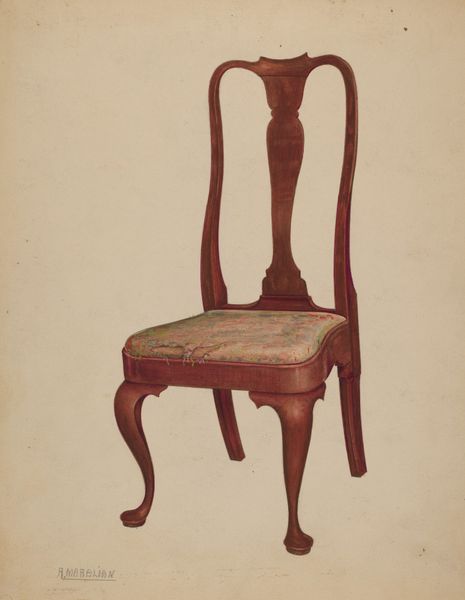
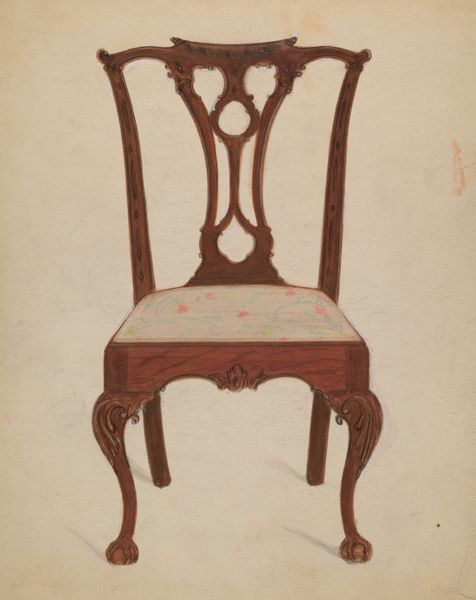
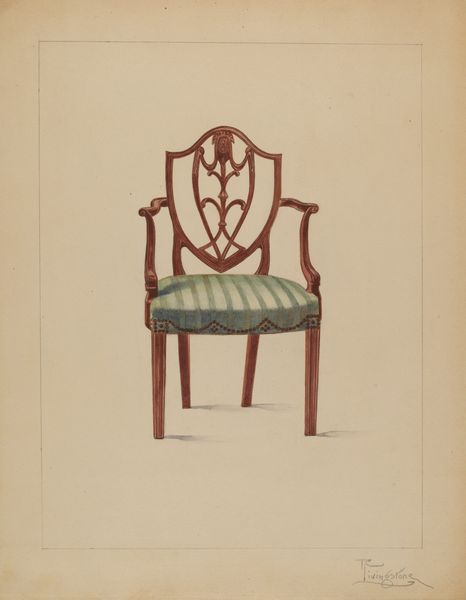
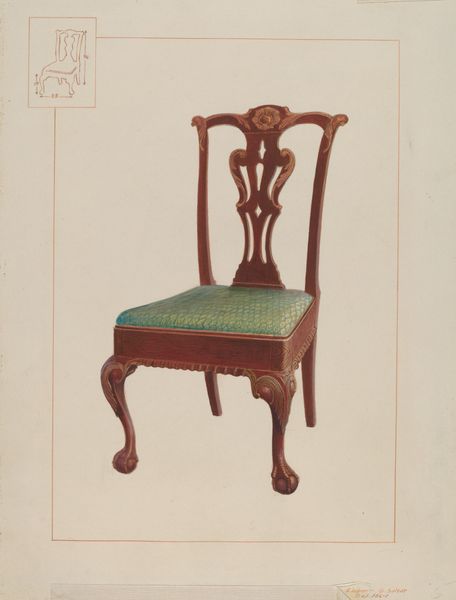
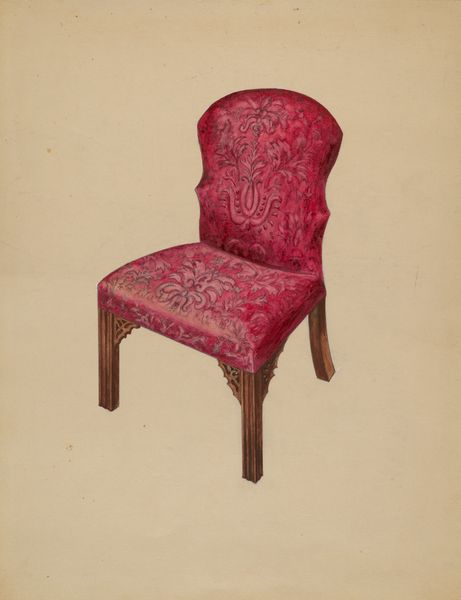
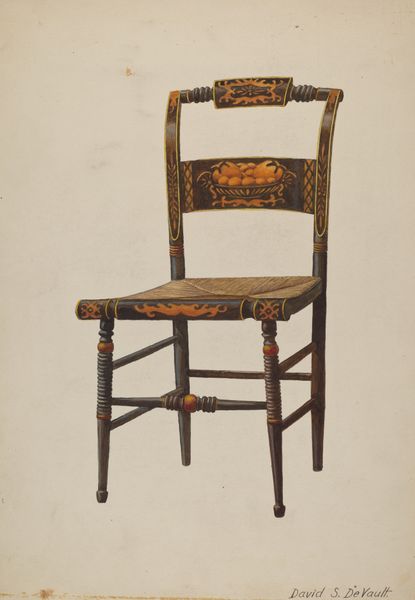
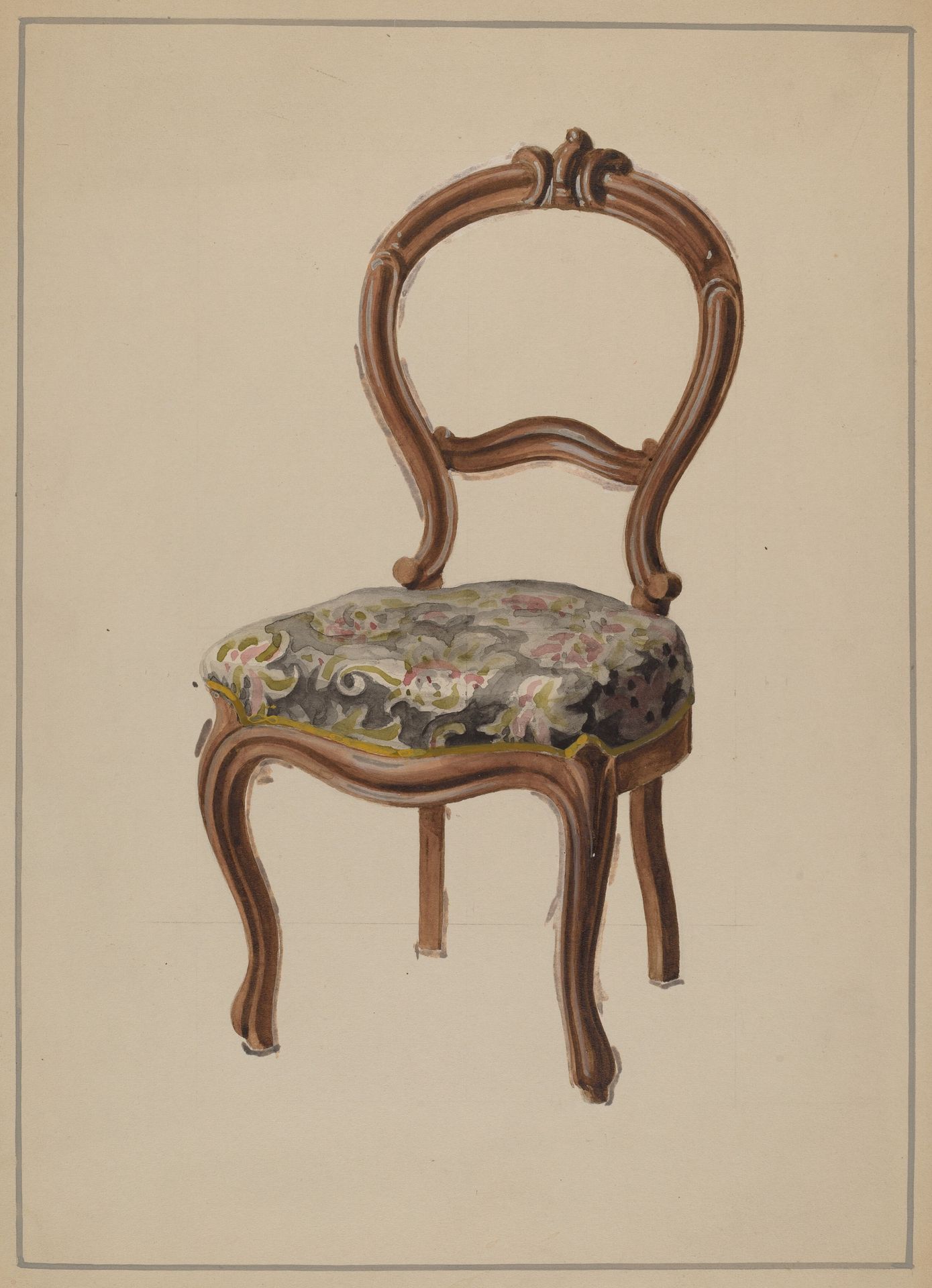
Curator: Here we have a watercolor drawing from around 1936 entitled, simply, "Chair." Editor: It feels like an artifact of studied refinement, but simultaneously quite ephemeral, wouldn't you agree? The light washes of color lend an air of delicate transience. Curator: Precisely. Observe how the artist masterfully employs layering of watercolors to build form, imbuing a sense of volume to an object seemingly rendered for representational purposes alone. The curvilinear construction of the chair—the cabriole legs, the serpentine back—it all contributes to a flowing visual rhythm. Editor: Do you believe, given the timing, that there might be something in its intention that's socio-economic? I find the detailed seat fabric oddly unsettling against the muted, almost skeletal framework, like the artist attempts a statement of social tensions around domestic comfort during the pre-war period. The delicate, slightly faded coloring suggests a premonition of hard times. Curator: I would posit instead that the palette speaks more directly to inter-war design trends, an evolution, shall we say, from earlier art deco sensibilities towards more simplified modes of representation. Notice, furthermore, the stark absence of detail in the negative space; our attention is meant to be acutely focused on the object itself. Editor: Fair enough. Still, such detailed renderings were often commissioned pieces. I can't help wonder, where would a patron situate such a fanciful design? Surely it makes more sense as a signifier for some aspiration that many could not reach in the given context? Curator: Well, without knowing precisely what Marcus Moran's motives might have been, it's difficult to claim historical context without contextual documentation to prove that this piece could carry social, ideological content from a potential patron of his. Nevertheless, this exercise has helped unveil subtle elements in our understanding of this relatively simple work, at a time of relative simplicity as well. Editor: A stimulating exchange, indeed. Considering the intricacies in an ostensibly simple composition enriches the art historical canon overall.
Artwork details
- Medium
- drawing, watercolor
- Dimensions
- overall: 35.5 x 24.1 cm (14 x 9 1/2 in.) Original IAD Object: 32"high, height of seat, 18", 16"wide
- Copyright
- National Gallery of Art: CC0 1.0
Tags
Comments
Share your thoughts
About this artwork
Curator: Here we have a watercolor drawing from around 1936 entitled, simply, "Chair." Editor: It feels like an artifact of studied refinement, but simultaneously quite ephemeral, wouldn't you agree? The light washes of color lend an air of delicate transience. Curator: Precisely. Observe how the artist masterfully employs layering of watercolors to build form, imbuing a sense of volume to an object seemingly rendered for representational purposes alone. The curvilinear construction of the chair—the cabriole legs, the serpentine back—it all contributes to a flowing visual rhythm. Editor: Do you believe, given the timing, that there might be something in its intention that's socio-economic? I find the detailed seat fabric oddly unsettling against the muted, almost skeletal framework, like the artist attempts a statement of social tensions around domestic comfort during the pre-war period. The delicate, slightly faded coloring suggests a premonition of hard times. Curator: I would posit instead that the palette speaks more directly to inter-war design trends, an evolution, shall we say, from earlier art deco sensibilities towards more simplified modes of representation. Notice, furthermore, the stark absence of detail in the negative space; our attention is meant to be acutely focused on the object itself. Editor: Fair enough. Still, such detailed renderings were often commissioned pieces. I can't help wonder, where would a patron situate such a fanciful design? Surely it makes more sense as a signifier for some aspiration that many could not reach in the given context? Curator: Well, without knowing precisely what Marcus Moran's motives might have been, it's difficult to claim historical context without contextual documentation to prove that this piece could carry social, ideological content from a potential patron of his. Nevertheless, this exercise has helped unveil subtle elements in our understanding of this relatively simple work, at a time of relative simplicity as well. Editor: A stimulating exchange, indeed. Considering the intricacies in an ostensibly simple composition enriches the art historical canon overall.
Comments
Share your thoughts