About this artwork
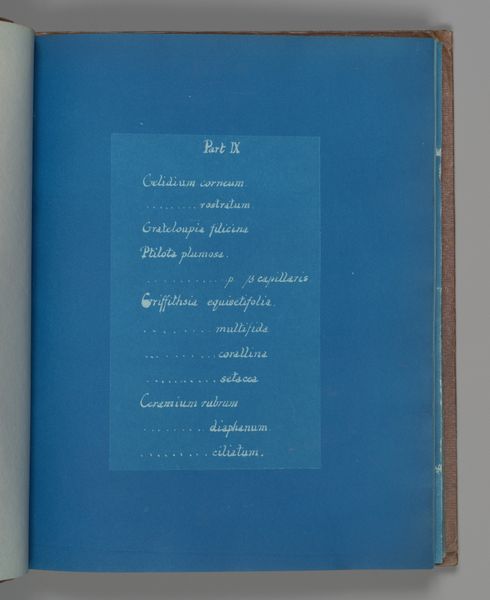
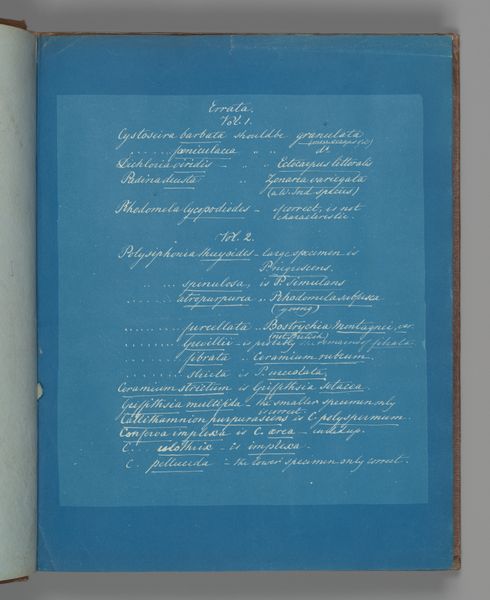
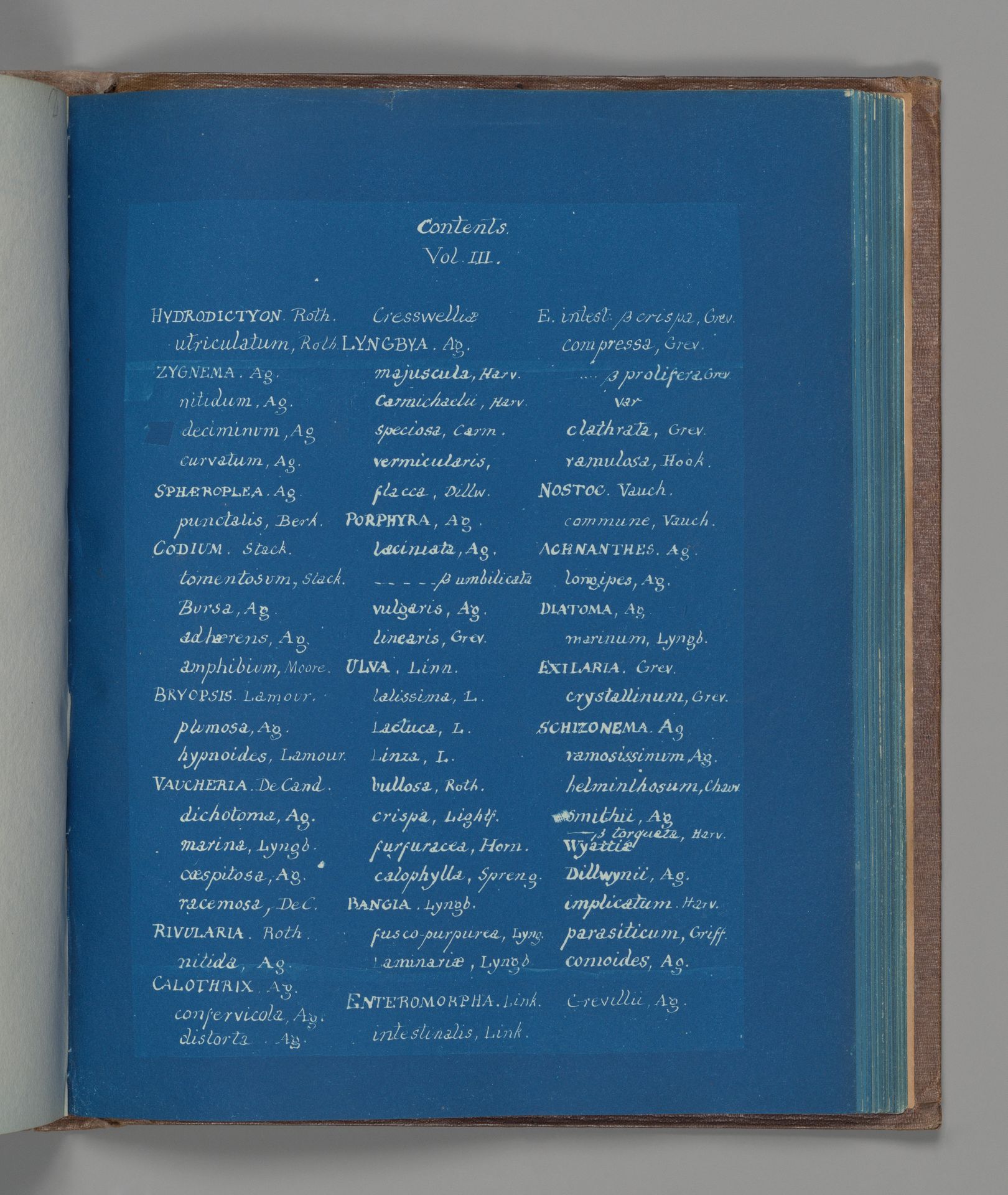
This cyanotype titled "Contents, Vol. III" was made by Anna Atkins in the mid-19th century. The Prussian blue ground immediately draws the eye, providing a stark, almost otherworldly backdrop for the crisp white text. Atkins meticulously lists various algae species, transforming a scientific index into a work of art. Atkins' choice of cyanotype—a photographic printing process that yields a distinctive blue—is pivotal here. Beyond its aesthetic appeal, it underscores the intersection of art and science, reflecting the period's fascination with cataloging and understanding the natural world. The composition, dominated by text, challenges traditional notions of artistic representation. It prompts us to consider how information itself can become a form of visual expression. The intense blue saturates the image and acts as both ground and signifier, hinting at the depths of the ocean from which these specimens originate. In this merging of scientific precision with artistic technique, Atkins invites us to reconsider our relationship with nature and the ways we classify and perceive it.
Contents, Vol. III
1851 - 1855


Artwork details
- Medium
- print, textile, paper, cyanotype, photography
- Dimensions
- Image: 25.3 x 20 cm (9 15/16 x 7 7/8 in.)
- Location
- Metropolitan Museum of Art, New York, NY
- Copyright
- Public Domain
Tags
Comments
Share your thoughts
About this artwork
This cyanotype titled "Contents, Vol. III" was made by Anna Atkins in the mid-19th century. The Prussian blue ground immediately draws the eye, providing a stark, almost otherworldly backdrop for the crisp white text. Atkins meticulously lists various algae species, transforming a scientific index into a work of art. Atkins' choice of cyanotype—a photographic printing process that yields a distinctive blue—is pivotal here. Beyond its aesthetic appeal, it underscores the intersection of art and science, reflecting the period's fascination with cataloging and understanding the natural world. The composition, dominated by text, challenges traditional notions of artistic representation. It prompts us to consider how information itself can become a form of visual expression. The intense blue saturates the image and acts as both ground and signifier, hinting at the depths of the ocean from which these specimens originate. In this merging of scientific precision with artistic technique, Atkins invites us to reconsider our relationship with nature and the ways we classify and perceive it.
Comments
Share your thoughts