About this artwork
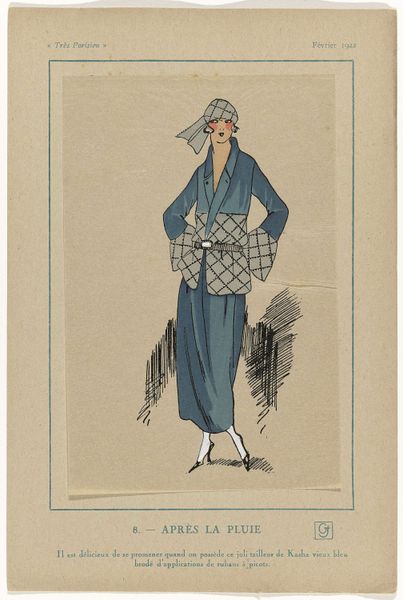
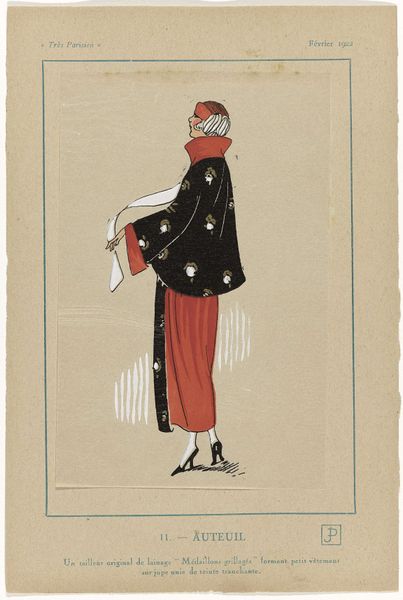
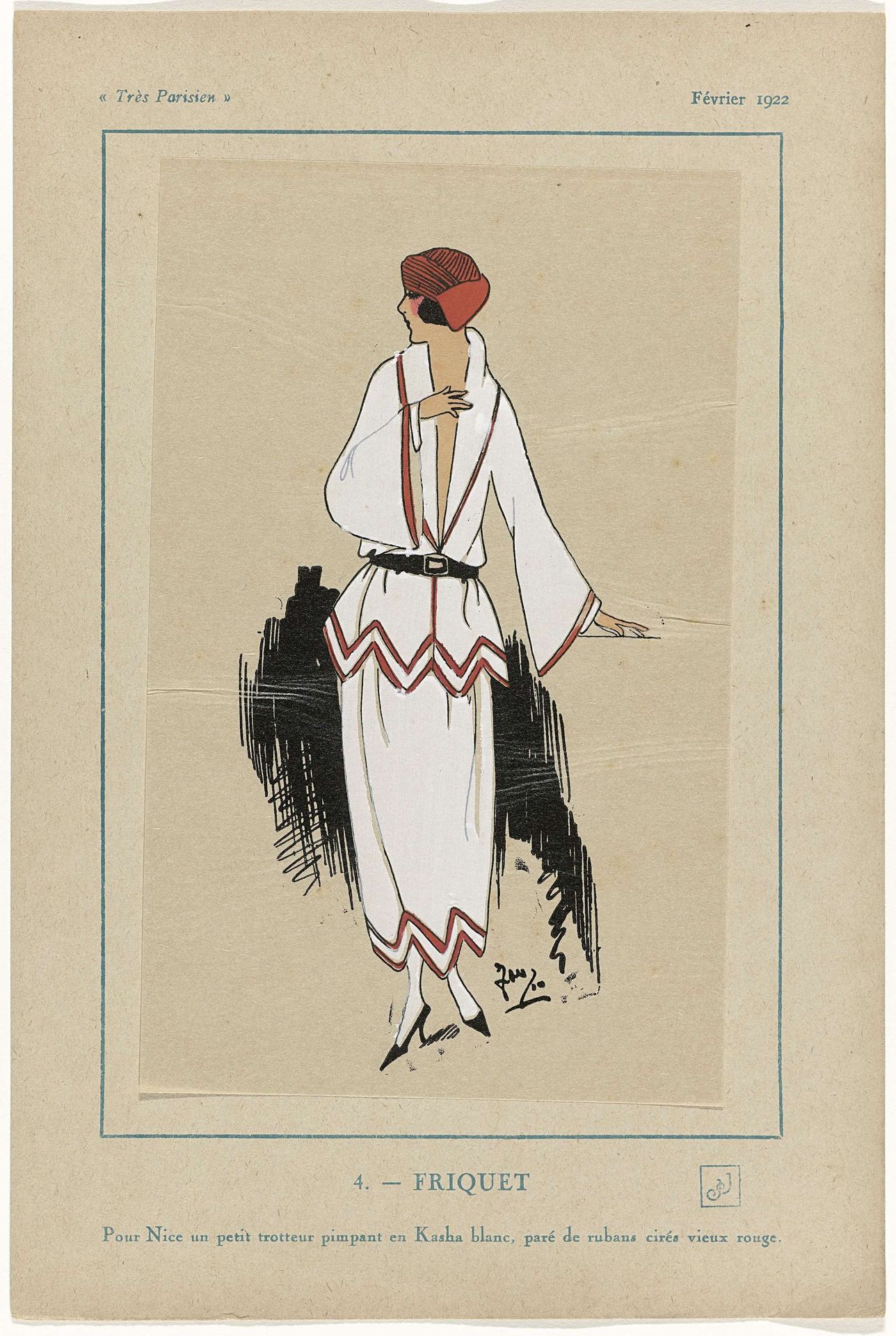
Curator: Today, we are observing a piece entitled “Très Parisien, Février 1922: 4.- FRIQUET,” created in 1922 by G-P. Joumard. This pen drawing is currently held at the Rijksmuseum. Editor: I’m struck immediately by the angularity of the design—the zigzag hem, the severe lines of the silhouette, contrasted with those billowy sleeves. There's a crisp, almost defiant elegance here. Curator: Absolutely. It embodies the post-war period, where fashion began reflecting a shift towards modernity and the increased freedom of women. Consider that a publication named “Very Parisian” might indicate how ideals of femininity were being negotiated, especially as urban centers experienced so many radical shifts in lifestyle. Editor: It is a rather minimal colour palette—whites, reds and blacks which allows focus to fall on form and line quality. The contrast between the precisely drawn figure and that roughly sketched backdrop creates a pleasing visual tension. Curator: Indeed, this piece likely functioned as a fashion plate for marketing within the context of the booming Parisian fashion industry. It highlights a style marketed to those seeking chic items as luxury goods, and how women are placed as the primary subject. Editor: Notice how Joumard uses hatching to create depth and shadow—it is not simply descriptive. Observe particularly those rough strokes underneath her skirt; this adds an edgy contrast against her clean dress, which almost looks flat on the picture plane because there's little volume otherwise. Curator: It's fascinating how the figure embodies both restraint and exuberance—the austere color scheme offset by those almost clownish, oversized sleeves and red accents. I see this resisting tradition, reflecting changing social roles and an increasingly avant-garde culture in Paris. Editor: Agreed; the economy of line and carefully planned color creates a visual harmony that elevates this beyond mere function, transcending its fashion context to become something undeniably…beautiful. Curator: A beautiful example, indeed, of how art becomes so deeply woven with the trends and changes of a time and place. Editor: Right—showing us how form always shapes content to tell stories beyond what we might see at first glance.

Artwork details
- Dimensions
- height 269 mm, width 180 mm
- Location
- Rijksmuseum
- Copyright
- Rijks Museum: Open Domain
Comments
Share your thoughts
About this artwork
Curator: Today, we are observing a piece entitled “Très Parisien, Février 1922: 4.- FRIQUET,” created in 1922 by G-P. Joumard. This pen drawing is currently held at the Rijksmuseum. Editor: I’m struck immediately by the angularity of the design—the zigzag hem, the severe lines of the silhouette, contrasted with those billowy sleeves. There's a crisp, almost defiant elegance here. Curator: Absolutely. It embodies the post-war period, where fashion began reflecting a shift towards modernity and the increased freedom of women. Consider that a publication named “Very Parisian” might indicate how ideals of femininity were being negotiated, especially as urban centers experienced so many radical shifts in lifestyle. Editor: It is a rather minimal colour palette—whites, reds and blacks which allows focus to fall on form and line quality. The contrast between the precisely drawn figure and that roughly sketched backdrop creates a pleasing visual tension. Curator: Indeed, this piece likely functioned as a fashion plate for marketing within the context of the booming Parisian fashion industry. It highlights a style marketed to those seeking chic items as luxury goods, and how women are placed as the primary subject. Editor: Notice how Joumard uses hatching to create depth and shadow—it is not simply descriptive. Observe particularly those rough strokes underneath her skirt; this adds an edgy contrast against her clean dress, which almost looks flat on the picture plane because there's little volume otherwise. Curator: It's fascinating how the figure embodies both restraint and exuberance—the austere color scheme offset by those almost clownish, oversized sleeves and red accents. I see this resisting tradition, reflecting changing social roles and an increasingly avant-garde culture in Paris. Editor: Agreed; the economy of line and carefully planned color creates a visual harmony that elevates this beyond mere function, transcending its fashion context to become something undeniably…beautiful. Curator: A beautiful example, indeed, of how art becomes so deeply woven with the trends and changes of a time and place. Editor: Right—showing us how form always shapes content to tell stories beyond what we might see at first glance.
Comments
Share your thoughts