About this artwork
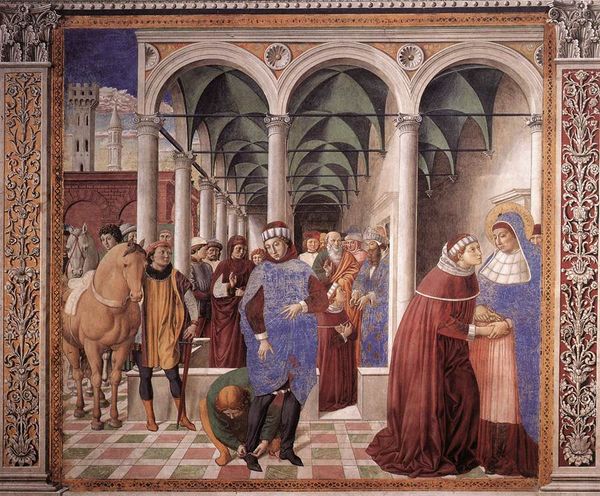
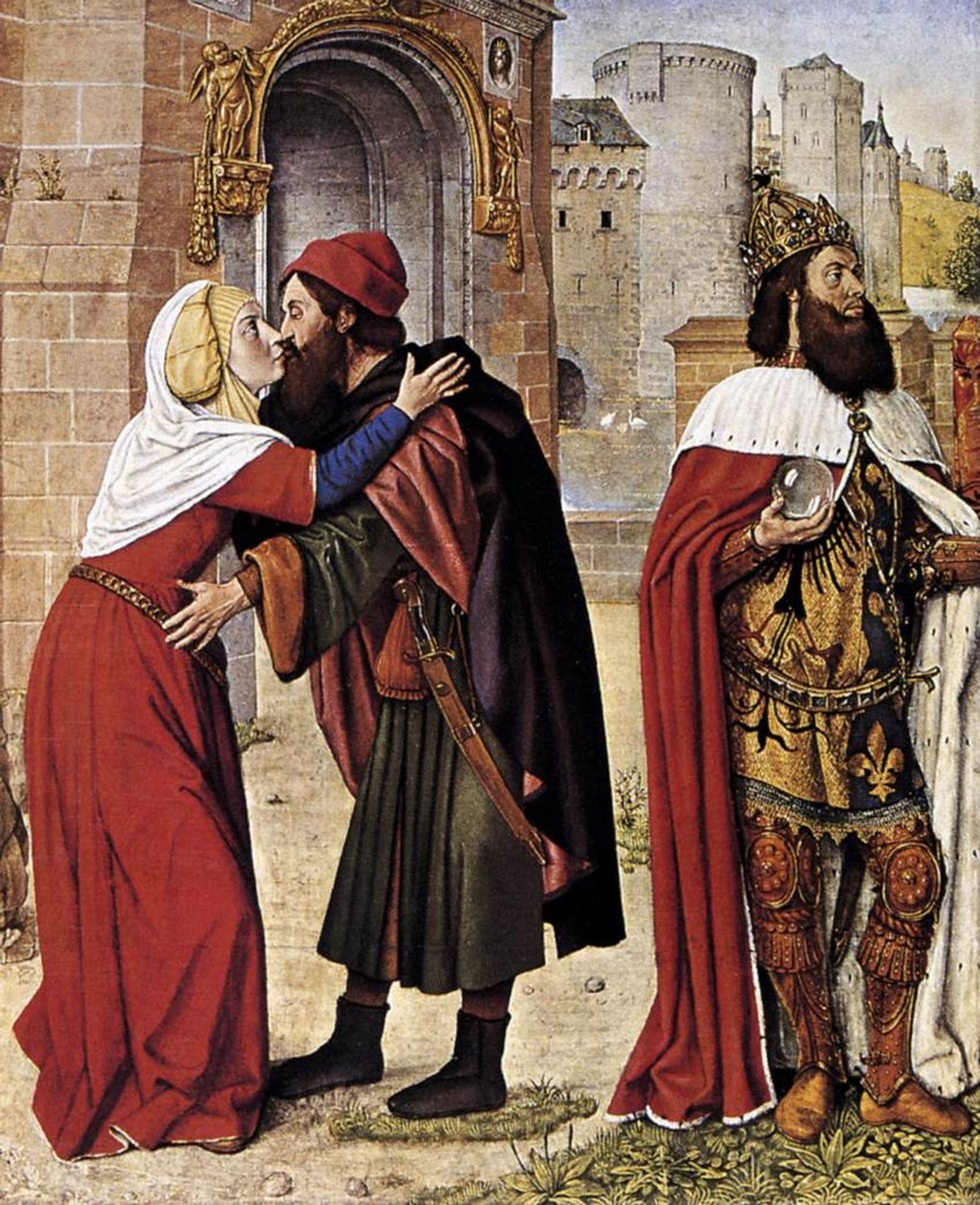
Editor: Here we have Jean Hey's "Meeting at the Golden Gate," painted around 1488. The oil paint gives it a beautiful texture, and it strikes me as quite theatrical with its careful composition. What jumps out at you? Curator: Primarily, the arrangement of the figures—their precise placement—dictates the viewing experience. Notice the spatial relationship established through their staggered positioning and varying scales. How do the figures interact spatially? Editor: Well, the embracing couple dominates the left side, while the king stands rigidly on the right, seemingly isolated despite his grandeur. Curator: Precisely. The figures exist within clearly defined planes and shapes and this creates visual interest. What about the relationship of light and shadow to convey meaning? Editor: I see, the figures are lit so sharply which causes the colors to stand out more distinctly against one another. The contrast emphasizes their individual presence. Curator: Consider also how Hey uses symmetry and asymmetry. The doorway acts as a dividing line and establishes an unbalanced composition; can this reveal anything about the theme? Editor: It's as if Hey is contrasting themes: the intimacy of the couple against the King’s isolation. I hadn’t considered that. Curator: Indeed. Reflect upon how each element, from the architectural backdrop to the drapery folds, functions to create the artwork's symbolic impact. Every element contributes to the overall impact. Editor: Thanks. Focusing on these pictorial aspects makes the image incredibly engaging, even beyond the historical context.
Meeting at the Golden Gate 1488


Artwork details
- Medium
- painting, oil-paint
- Dimensions
- 72 x 59 cm
- Location
- National Gallery, London, UK
- Copyright
- Public domain
Tags
medieval
painting
prophet
oil-paint
sculpture
holy-places
figuration
oil painting
christianity
genre-painting
history-painting
northern-renaissance
christ
Comments
No comments
About this artwork
Editor: Here we have Jean Hey's "Meeting at the Golden Gate," painted around 1488. The oil paint gives it a beautiful texture, and it strikes me as quite theatrical with its careful composition. What jumps out at you? Curator: Primarily, the arrangement of the figures—their precise placement—dictates the viewing experience. Notice the spatial relationship established through their staggered positioning and varying scales. How do the figures interact spatially? Editor: Well, the embracing couple dominates the left side, while the king stands rigidly on the right, seemingly isolated despite his grandeur. Curator: Precisely. The figures exist within clearly defined planes and shapes and this creates visual interest. What about the relationship of light and shadow to convey meaning? Editor: I see, the figures are lit so sharply which causes the colors to stand out more distinctly against one another. The contrast emphasizes their individual presence. Curator: Consider also how Hey uses symmetry and asymmetry. The doorway acts as a dividing line and establishes an unbalanced composition; can this reveal anything about the theme? Editor: It's as if Hey is contrasting themes: the intimacy of the couple against the King’s isolation. I hadn’t considered that. Curator: Indeed. Reflect upon how each element, from the architectural backdrop to the drapery folds, functions to create the artwork's symbolic impact. Every element contributes to the overall impact. Editor: Thanks. Focusing on these pictorial aspects makes the image incredibly engaging, even beyond the historical context.
Comments
No comments