About this artwork
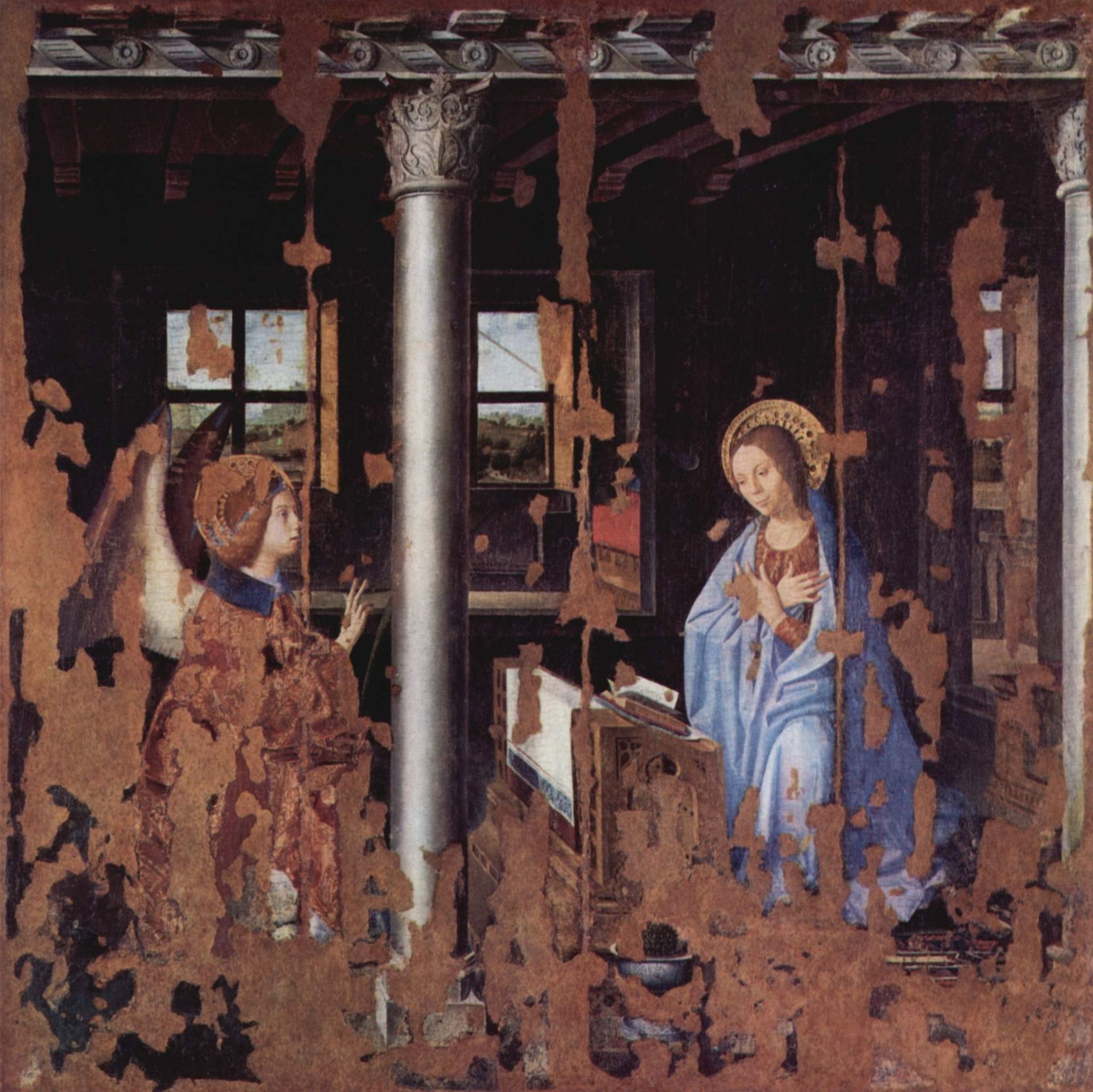
Antonello da Messina painted this Annunciation in Sicily in the 15th century. At the time, the Church was the most powerful institution and its iconography dominated art. Here, the Virgin Mary is interrupted by the Angel Gabriel, who is bringing her the news that she will bear the son of God. But Messina has made an unusual choice: he has dispensed with many of the common visual cues of earlier Annunciations. Most obviously, Gabriel has no wings. There’s no dove, representing the Holy Spirit. Instead, Messina gives us a very human encounter set in a bourgeois domestic space. To understand Messina’s choices, we can look at the social changes that were happening in Sicily at the time. As a busy port, it had a lot of contact with the rest of Europe and new ideas were spreading fast. Scholars are interested in how artists like Messina both served and challenged the Church and the social structures it upheld. They explore this through careful study of the period’s visual culture and history.
Annunciation
1474

Antonello da Messina
1430 - 1479Location
Galleria Regionale di Palazzo Bellomo, Siracusa, Italy, Bellomo Palace Museum, Syracuse, ItalyArtwork details
- Medium
- tempera, painting
- Dimensions
- 180 x 180 cm
- Location
- Galleria Regionale di Palazzo Bellomo, Siracusa, Italy, Bellomo Palace Museum, Syracuse, Italy
- Copyright
- Public domain
Tags
Comments
Share your thoughts
About this artwork
Antonello da Messina painted this Annunciation in Sicily in the 15th century. At the time, the Church was the most powerful institution and its iconography dominated art. Here, the Virgin Mary is interrupted by the Angel Gabriel, who is bringing her the news that she will bear the son of God. But Messina has made an unusual choice: he has dispensed with many of the common visual cues of earlier Annunciations. Most obviously, Gabriel has no wings. There’s no dove, representing the Holy Spirit. Instead, Messina gives us a very human encounter set in a bourgeois domestic space. To understand Messina’s choices, we can look at the social changes that were happening in Sicily at the time. As a busy port, it had a lot of contact with the rest of Europe and new ideas were spreading fast. Scholars are interested in how artists like Messina both served and challenged the Church and the social structures it upheld. They explore this through careful study of the period’s visual culture and history.
Comments
Share your thoughts