About this artwork
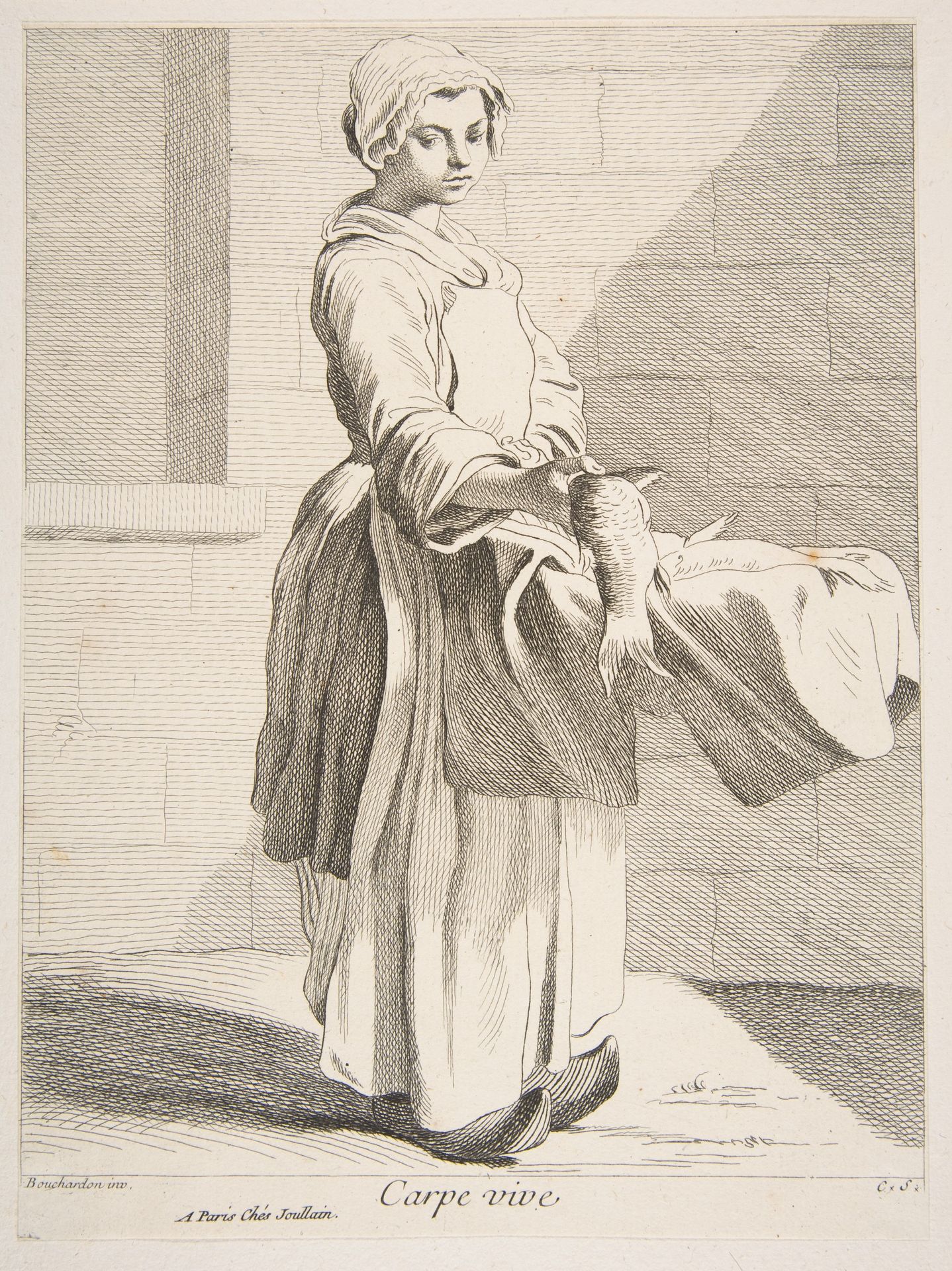
This is "Fish Vendor", a print of unknown date by Anne Claude Philippe Caylus, held at the Metropolitan Museum. Here, we observe a young woman holding a fish, the "carpe vivé," or live carp, as the inscription indicates. The fish, a symbol of abundance and fertility in many cultures, appears here in a humble, everyday context, reminding us of the sacred in the mundane. This motif of the fish has swum through the currents of time, from ancient Roman mosaics depicting bountiful feasts to Christian iconography where it symbolizes Christ himself. Note how the downward gaze of the vendor and the limpness of the fish evoke a sense of melancholy, perhaps reflecting the transient nature of life. The fish, once vibrant, is now subject to fate, mirroring our own mortality. This is the power of symbols—engaging us on a subconscious level, triggering deep-seated emotions. The symbol of the fish continues its journey, resurfacing in modern art, literature, and even our dreams. Each time, it is reinterpreted, reshaped by the cultural and personal experiences of its beholders, yet always carrying echoes of its ancient past.
Fish Vendor
1738

Anne Claude Philippe Caylus
1692 - 1765
The Metropolitan Museum of Art
Metropolitan Museum of Art, New York, NYArtwork details
- Medium
- drawing, print, engraving
- Dimensions
- Sheet: 9 3/16 x 6 7/8 in. (23.4 x 17.5 cm) Image: 8 11/16 x 6 7/8 in. (22.1 x 17.4 cm)
- Location
- Metropolitan Museum of Art, New York, NY
- Copyright
- Public Domain
Tags
Comments
Share your thoughts
About this artwork
This is "Fish Vendor", a print of unknown date by Anne Claude Philippe Caylus, held at the Metropolitan Museum. Here, we observe a young woman holding a fish, the "carpe vivé," or live carp, as the inscription indicates. The fish, a symbol of abundance and fertility in many cultures, appears here in a humble, everyday context, reminding us of the sacred in the mundane. This motif of the fish has swum through the currents of time, from ancient Roman mosaics depicting bountiful feasts to Christian iconography where it symbolizes Christ himself. Note how the downward gaze of the vendor and the limpness of the fish evoke a sense of melancholy, perhaps reflecting the transient nature of life. The fish, once vibrant, is now subject to fate, mirroring our own mortality. This is the power of symbols—engaging us on a subconscious level, triggering deep-seated emotions. The symbol of the fish continues its journey, resurfacing in modern art, literature, and even our dreams. Each time, it is reinterpreted, reshaped by the cultural and personal experiences of its beholders, yet always carrying echoes of its ancient past.
Comments
Share your thoughts