About this artwork
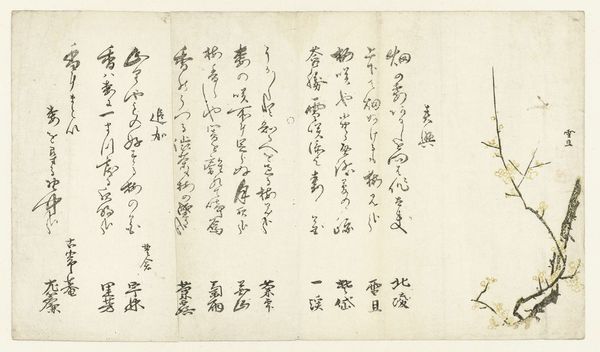
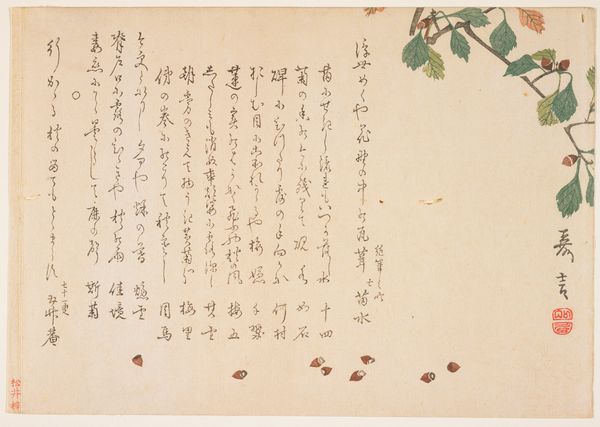
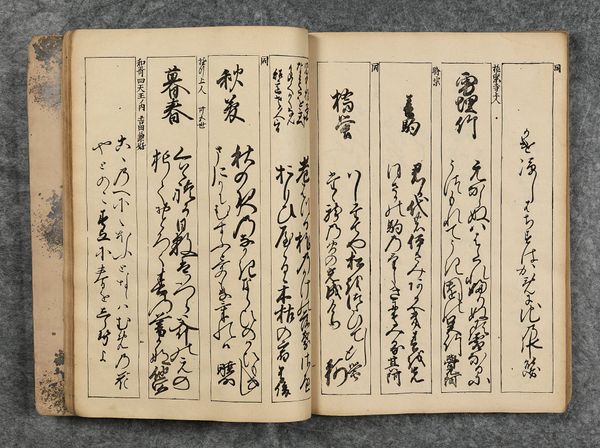
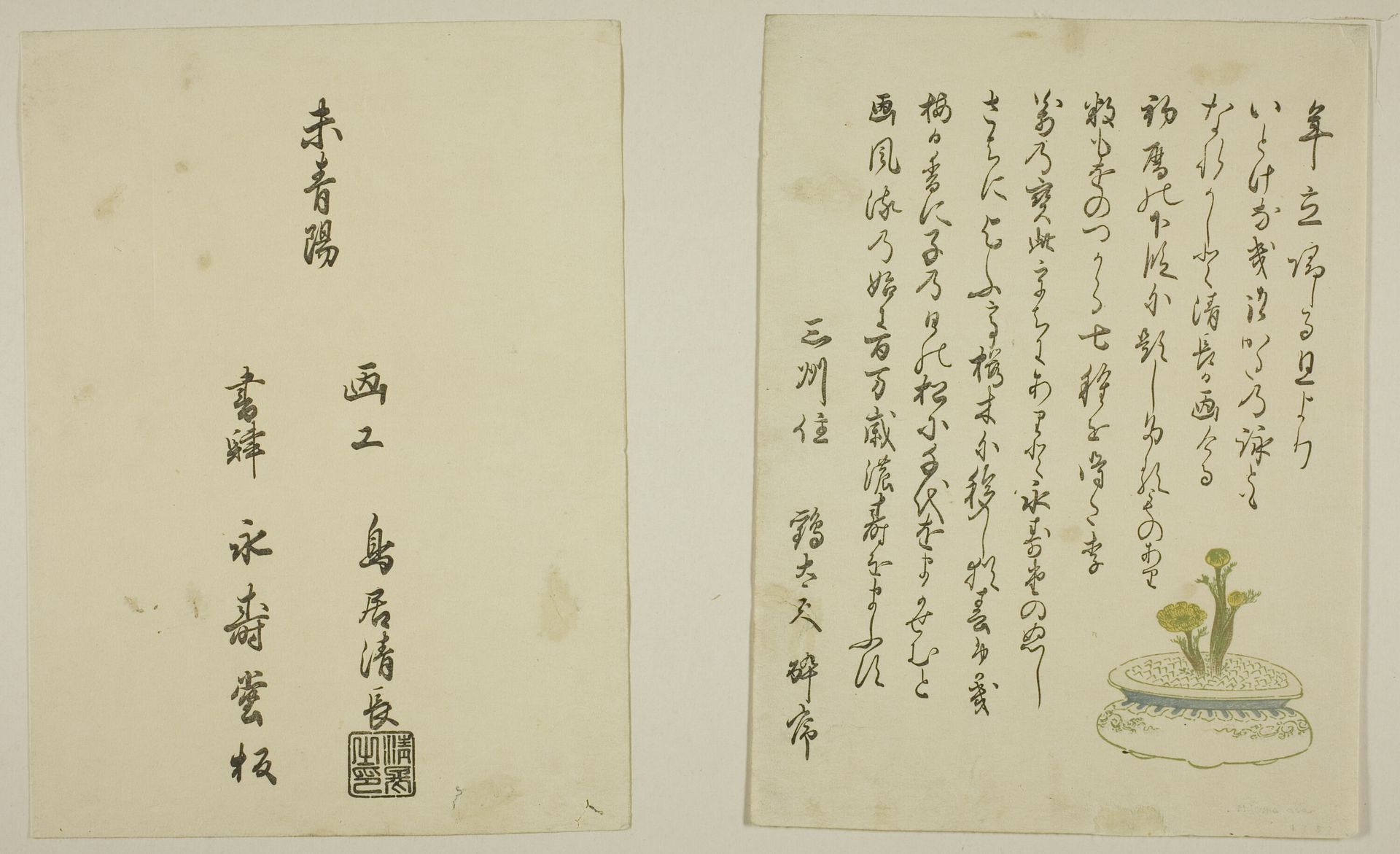
Editor: This is “The One-Page Preface and Colophon from the illustrated book "Colors of the Triple Dawn (Saishiki mitsu no asa)" created in 1787 by Torii Kiyonaga. It’s a woodblock print in ink on paper, currently at the Art Institute of Chicago. What immediately strikes me is the delicate calligraphy, almost like a dance across the page. What do you see in this piece? Curator: Beyond the visual dance, consider how calligraphy, especially in East Asian traditions, is far more than just writing. It's a direct expression of the artist's spirit, their inner landscape made visible. Notice the density of the script on the right, contrasted with the simpler marks on the left. Editor: Yes, the differing weights create a visual rhythm, but what's the meaning behind it? Curator: Look closely at the imagery. The small drawing acts as a symbolic break within the text. Ask yourself, how does this blend of text and image relate to the "Colors of the Triple Dawn?" The dawn, a symbol of renewal and beginnings. Each brushstroke embodies cultural memory. Does it convey a narrative, perhaps? Editor: Perhaps, it depicts a moment of quiet reflection before the dawn. I wonder if this piece can reveal how narratives and symbols blend. Curator: Precisely. Cultural memory resides not just in grand narratives, but in these subtle echoes, and how seemingly disparate elements find resonance. Editor: Thank you. I’ll never see calligraphy the same way. It’s so rich in historical and emotional context. Curator: And hopefully, you now recognize the lingering power and weight within the cultural echoes captured inside it.
The One-Page Preface and Colophon from the illustrated book "Colors of the Triple Dawn (Saishiki mitsu no asa)"
1787


Artwork details
- Medium
- print, paper, ink, woodblock-print
- Dimensions
- 25.3 × 18.8 cm (right sheet); 25.3 × 18.8 cm (left sheet)
- Location
- The Art Institute of Chicago
- Copyright
- Public Domain
Tags
Comments
Share your thoughts
About this artwork
Editor: This is “The One-Page Preface and Colophon from the illustrated book "Colors of the Triple Dawn (Saishiki mitsu no asa)" created in 1787 by Torii Kiyonaga. It’s a woodblock print in ink on paper, currently at the Art Institute of Chicago. What immediately strikes me is the delicate calligraphy, almost like a dance across the page. What do you see in this piece? Curator: Beyond the visual dance, consider how calligraphy, especially in East Asian traditions, is far more than just writing. It's a direct expression of the artist's spirit, their inner landscape made visible. Notice the density of the script on the right, contrasted with the simpler marks on the left. Editor: Yes, the differing weights create a visual rhythm, but what's the meaning behind it? Curator: Look closely at the imagery. The small drawing acts as a symbolic break within the text. Ask yourself, how does this blend of text and image relate to the "Colors of the Triple Dawn?" The dawn, a symbol of renewal and beginnings. Each brushstroke embodies cultural memory. Does it convey a narrative, perhaps? Editor: Perhaps, it depicts a moment of quiet reflection before the dawn. I wonder if this piece can reveal how narratives and symbols blend. Curator: Precisely. Cultural memory resides not just in grand narratives, but in these subtle echoes, and how seemingly disparate elements find resonance. Editor: Thank you. I’ll never see calligraphy the same way. It’s so rich in historical and emotional context. Curator: And hopefully, you now recognize the lingering power and weight within the cultural echoes captured inside it.
Comments
Share your thoughts