About this artwork
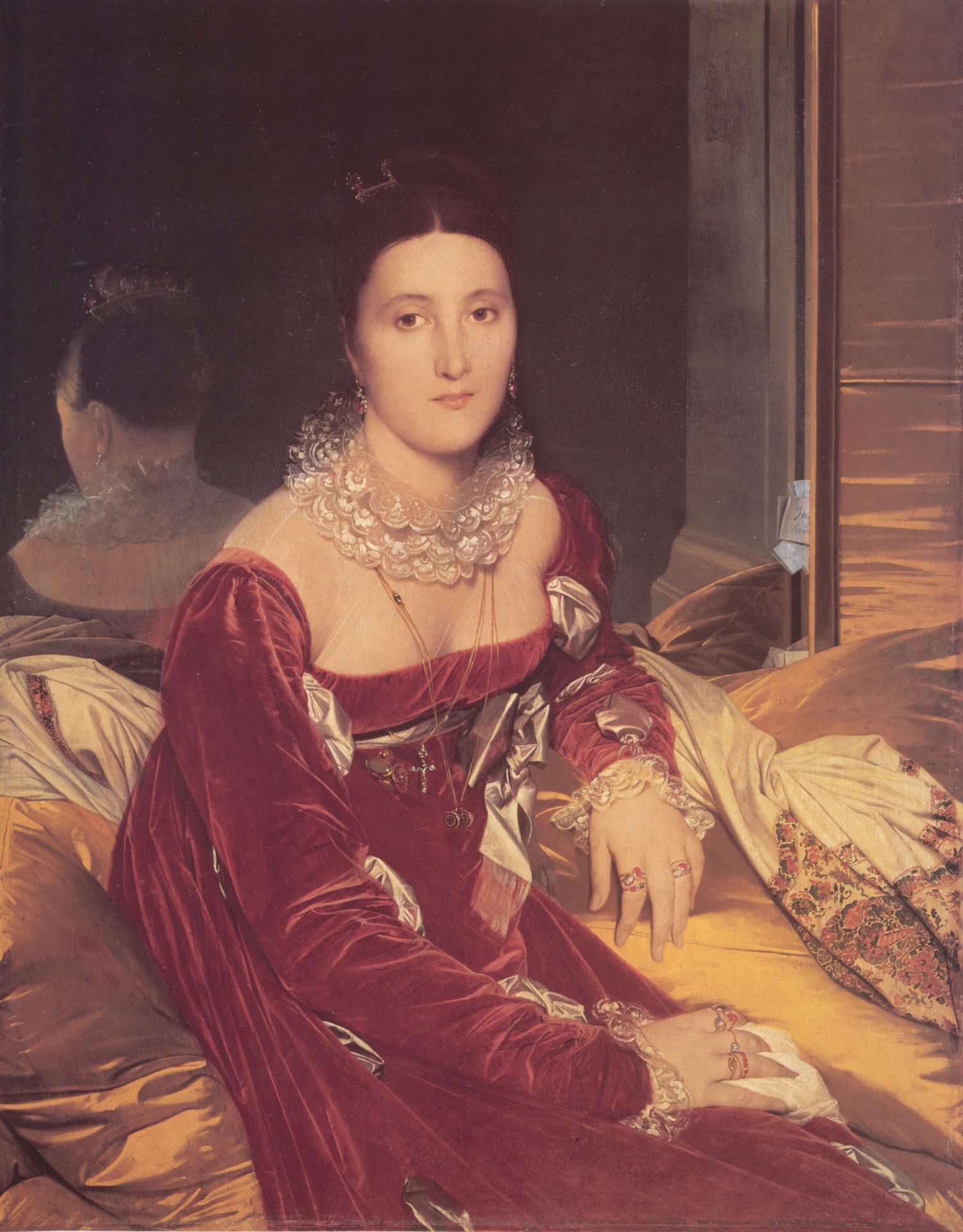
Editor: This is Jean-Auguste-Dominique Ingres' "Portrait of Madame de Senonnes," painted in 1816. It's quite striking - almost severe, yet there's something inviting in her gaze. What do you see in this piece? Curator: I see a fascinating tapestry of symbols woven into the portrait. The reflection in the mirror behind her is more than just a visual trick. The mirror itself becomes a potent symbol of self-reflection and the dual nature of identity. It suggests an awareness of societal expectations versus the inner self. Editor: That’s a great observation! The reflection really adds another dimension. Curator: Notice, too, the opulent velvet and lace. What might those details signify, beyond mere status? Each detail reinforces a narrative, consider those rings. These accessories, meticulously rendered, serve as emblems of belonging and identity, whispering stories about familial lines, social positions, and personal accomplishments. The color red signifies love and strength. Editor: So, even the folds of her dress and the details in her jewelry play a role in telling her story? Curator: Precisely! Even the neoclassical setting isn't accidental. It echoes back to a classical ideal but applied to a very specific contemporary person. It's about aligning Madame de Senonnes with enduring ideas of beauty, virtue, and historical continuity. In this sense, art perpetuates cultural memory through these visual symbols. Editor: I never thought about a portrait holding so much layered meaning. Now I understand the symbols tell their own stories. Thank you for opening my eyes! Curator: And I've enjoyed revisiting how portraiture acts as both a historical document and a work of complex artifice. It shows how individuals wished to be perceived for all time.
Portrait of Madame de Senonnes
1816

Jean Auguste Dominique Ingres
1780 - 1867Location
Musée des Beaux-Arts de Nantes, Nantes, FranceArtwork details
- Medium
- painting, oil-paint
- Dimensions
- 106 x 84 cm
- Location
- Musée des Beaux-Arts de Nantes, Nantes, France
- Copyright
- Public domain
Tags
portrait
painting
oil-paint
figuration
romanticism
history-painting
Comments
Be the first to share your thoughts about this work.
About this artwork
Editor: This is Jean-Auguste-Dominique Ingres' "Portrait of Madame de Senonnes," painted in 1816. It's quite striking - almost severe, yet there's something inviting in her gaze. What do you see in this piece? Curator: I see a fascinating tapestry of symbols woven into the portrait. The reflection in the mirror behind her is more than just a visual trick. The mirror itself becomes a potent symbol of self-reflection and the dual nature of identity. It suggests an awareness of societal expectations versus the inner self. Editor: That’s a great observation! The reflection really adds another dimension. Curator: Notice, too, the opulent velvet and lace. What might those details signify, beyond mere status? Each detail reinforces a narrative, consider those rings. These accessories, meticulously rendered, serve as emblems of belonging and identity, whispering stories about familial lines, social positions, and personal accomplishments. The color red signifies love and strength. Editor: So, even the folds of her dress and the details in her jewelry play a role in telling her story? Curator: Precisely! Even the neoclassical setting isn't accidental. It echoes back to a classical ideal but applied to a very specific contemporary person. It's about aligning Madame de Senonnes with enduring ideas of beauty, virtue, and historical continuity. In this sense, art perpetuates cultural memory through these visual symbols. Editor: I never thought about a portrait holding so much layered meaning. Now I understand the symbols tell their own stories. Thank you for opening my eyes! Curator: And I've enjoyed revisiting how portraiture acts as both a historical document and a work of complex artifice. It shows how individuals wished to be perceived for all time.
Comments
Be the first to share your thoughts about this work.