About this artwork
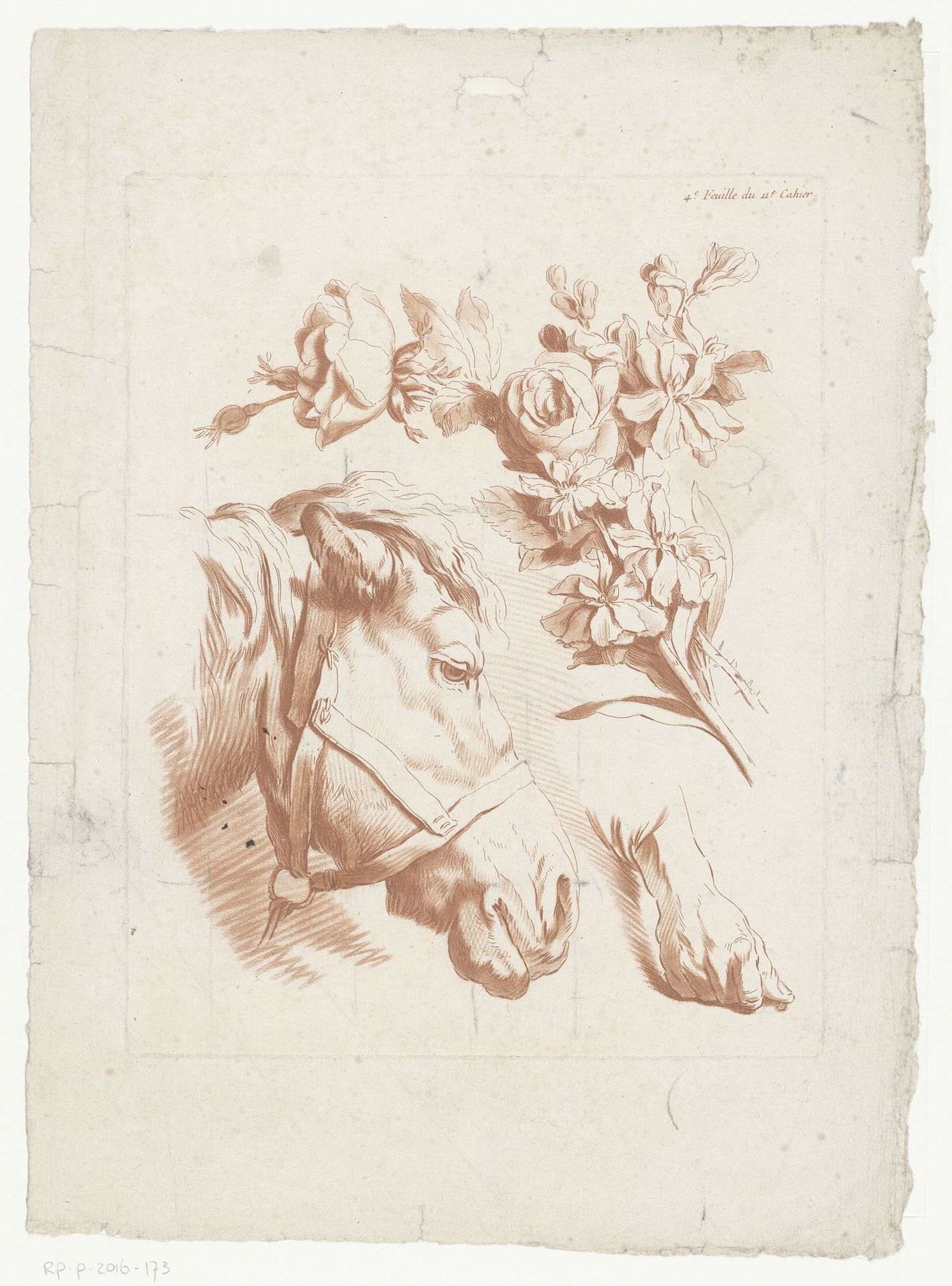
Jean François Janinet made this print, "Head of a Horse, Flowers, and a Hand," using etching and aquatint, which create a finely textured surface through careful applications of acid. The sepia ink gives a warm tone that softens the contrasts between the lines and the blank paper. It shows Janinet's technical skill and the level of control printmaking demands. The hatching and cross-hatching techniques visible here, are crucial, defining the forms and suggesting volume. The choice of printmaking as a medium is significant, placing this work within a tradition deeply connected to reproduction and distribution. Unlike a unique painting or drawing, a print can be multiplied, reaching a broader audience, and fitting into the social context of enlightenment-era France where new ideas were circulating widely. This piece shows that even what seems like a simple study of forms is embedded in a web of artistic choices and historical forces.
Hoofd van een paard, bloemen en een hand
1762 - 1793

Jean François Janinet
1752 - 1814Location
RijksmuseumArtwork details
- Dimensions
- height 257 mm, width 203 mm
- Location
- Rijksmuseum
- Copyright
- Rijks Museum: Open Domain
Comments
Share your thoughts
About this artwork
Jean François Janinet made this print, "Head of a Horse, Flowers, and a Hand," using etching and aquatint, which create a finely textured surface through careful applications of acid. The sepia ink gives a warm tone that softens the contrasts between the lines and the blank paper. It shows Janinet's technical skill and the level of control printmaking demands. The hatching and cross-hatching techniques visible here, are crucial, defining the forms and suggesting volume. The choice of printmaking as a medium is significant, placing this work within a tradition deeply connected to reproduction and distribution. Unlike a unique painting or drawing, a print can be multiplied, reaching a broader audience, and fitting into the social context of enlightenment-era France where new ideas were circulating widely. This piece shows that even what seems like a simple study of forms is embedded in a web of artistic choices and historical forces.
Comments
Share your thoughts