drawing, print, paper, engraving
#
drawing
#
neoclacissism
# print
#
paper
#
charcoal art
#
group-portraits
#
history-painting
#
engraving
Dimensions: 630 × 917 mm (image); 630 × 918 mm (plate); 644 × 937 mm (sheet)
Copyright: Public Domain
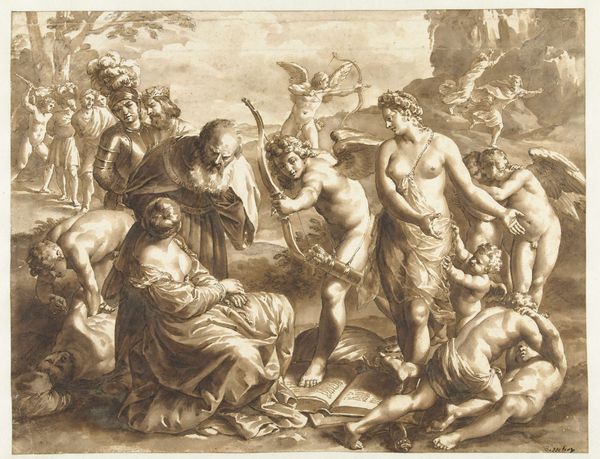
Curator: What an incredibly intricate print! This is James Barry’s “Pandora,” created between 1804 and 1805. It's currently held at The Art Institute of Chicago. Editor: It’s a dense composition. The textures feel so tactile despite being an engraving. My eye immediately goes to the sheer volume of bodies, almost spilling out of the frame, yet there is also an ordered neoclassical presentation to the arrangement. Curator: Absolutely. The layering is quite masterful considering it is rendered through engraving and, potentially, some charcoal drawing. Barry was really pushing the boundaries of printmaking here. The labour involved must have been intense – all those fine lines! And consider the accessibility he creates for those unable to access his large-scale history paintings. Editor: Indeed. Pandora’s myth is ripe for unpacking. The patriarchy’s creation of the first woman is always charged with political implications about female power and perceived flaws, and her placement here amongst a male-dominated mythological assembly highlights the tensions around her identity and agency. Are we meant to see her as a victim or an agent of change? Curator: It's interesting how the artist plays with light and shadow to give the figures form, almost like a sculpture, but within this relatively flat medium. Also, I'm interested in the paper itself – where it was produced and how its production might be tied into the larger political economy of the time. The means of dissemination are themselves a core part of understanding how Barry's radical politics were expressed. Editor: Precisely. Looking at the details, I find the variety in depictions remarkable. You have the seated Zeus and Hera so prominently displayed, and yet look at the marginal figures - perhaps hints at Barry's republicanism seeping through despite his neoclassical leanings and commissioned work. We must ask, whom is Barry implicating in this act of unleashing ills upon the world? Curator: Barry was such a fascinating and complex figure, driven by ambition, as well as frustration with the established art world. This print certainly testifies to his technical skills, but the context and purpose that shaped it provide just as interesting a perspective, given that so much history painting was in service of Empire. Editor: This piece allows us to confront a familiar myth and encourages further scrutiny, as to the manufacturing of cultural stories and biases through the lenses of history, gender and power.
Comments
No comments
Be the first to comment and join the conversation on the ultimate creative platform.
 Collect
 React
React Comment
More like this