About this artwork
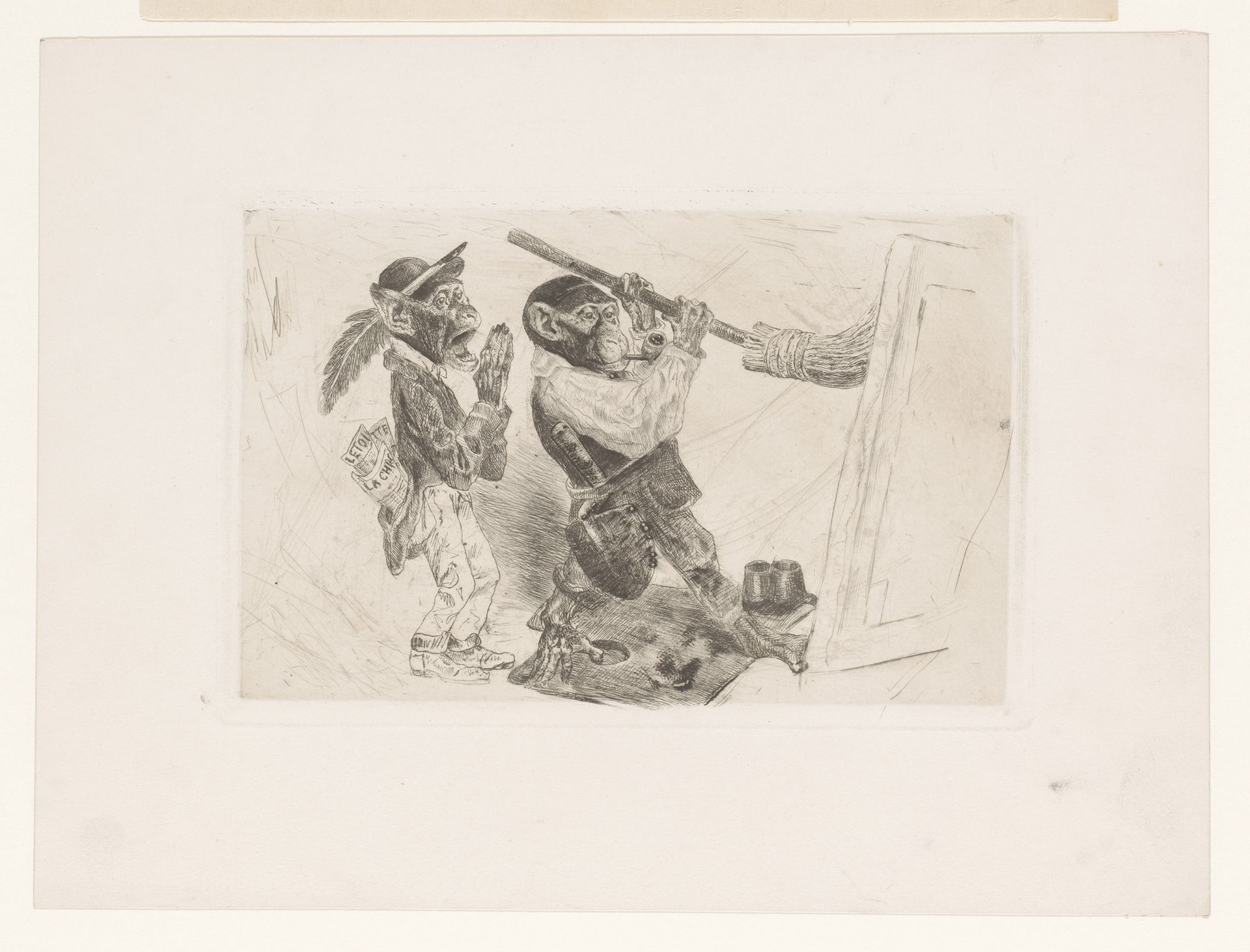
Charles Verlat created this etching titled 'Schilderende aap,' or 'Painting Ape,' sometime in the 19th century. It depicts two monkeys, one acting as the artist, clumsily wielding a broom-like brush, while the other, dressed in human clothing, looks on with its hands clasped in prayer. The image invites a dialogue on colonialism, representation, and the societal gaze. The artist casts the monkeys in roles mimicking human behaviors and professions. Such representations reflect a broader societal tendency to project human characteristics onto animals, often reinforcing hierarchical power structures. These depictions, which were common in the colonial era, can also reflect the colonizer's view of the colonized. Verlat's print makes us think about how we assign value and dignity, and the emotional weight of seeing oneself—or another—through a lens of assumed inferiority. The image is a reminder of the power dynamics inherent in representation, and the subtle ways in which art can shape and reflect societal attitudes.

Artwork details
- Medium
- drawing, print, etching
- Dimensions
- height 157 mm, width 238 mm
- Copyright
- Rijks Museum: Open Domain
Tags
pencil drawn
drawing
etching
caricature
pencil sketch
figuration
pencil drawing
genre-painting
Comments
No comments
About this artwork
Charles Verlat created this etching titled 'Schilderende aap,' or 'Painting Ape,' sometime in the 19th century. It depicts two monkeys, one acting as the artist, clumsily wielding a broom-like brush, while the other, dressed in human clothing, looks on with its hands clasped in prayer. The image invites a dialogue on colonialism, representation, and the societal gaze. The artist casts the monkeys in roles mimicking human behaviors and professions. Such representations reflect a broader societal tendency to project human characteristics onto animals, often reinforcing hierarchical power structures. These depictions, which were common in the colonial era, can also reflect the colonizer's view of the colonized. Verlat's print makes us think about how we assign value and dignity, and the emotional weight of seeing oneself—or another—through a lens of assumed inferiority. The image is a reminder of the power dynamics inherent in representation, and the subtle ways in which art can shape and reflect societal attitudes.
Comments
No comments