About this artwork
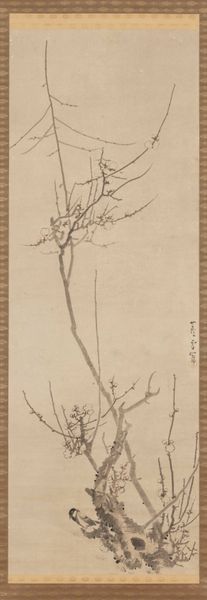
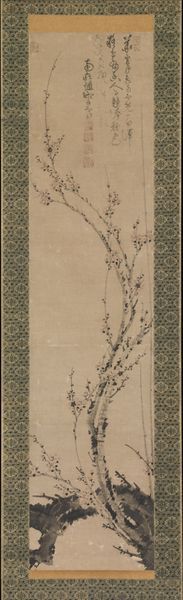
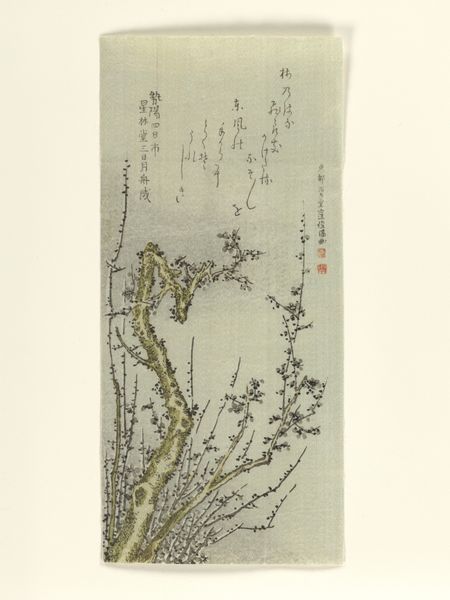
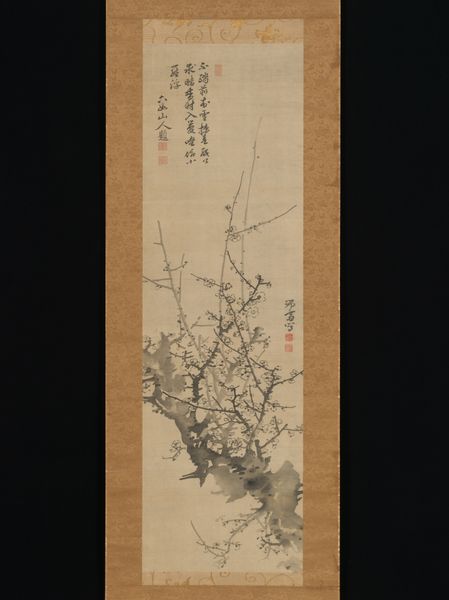
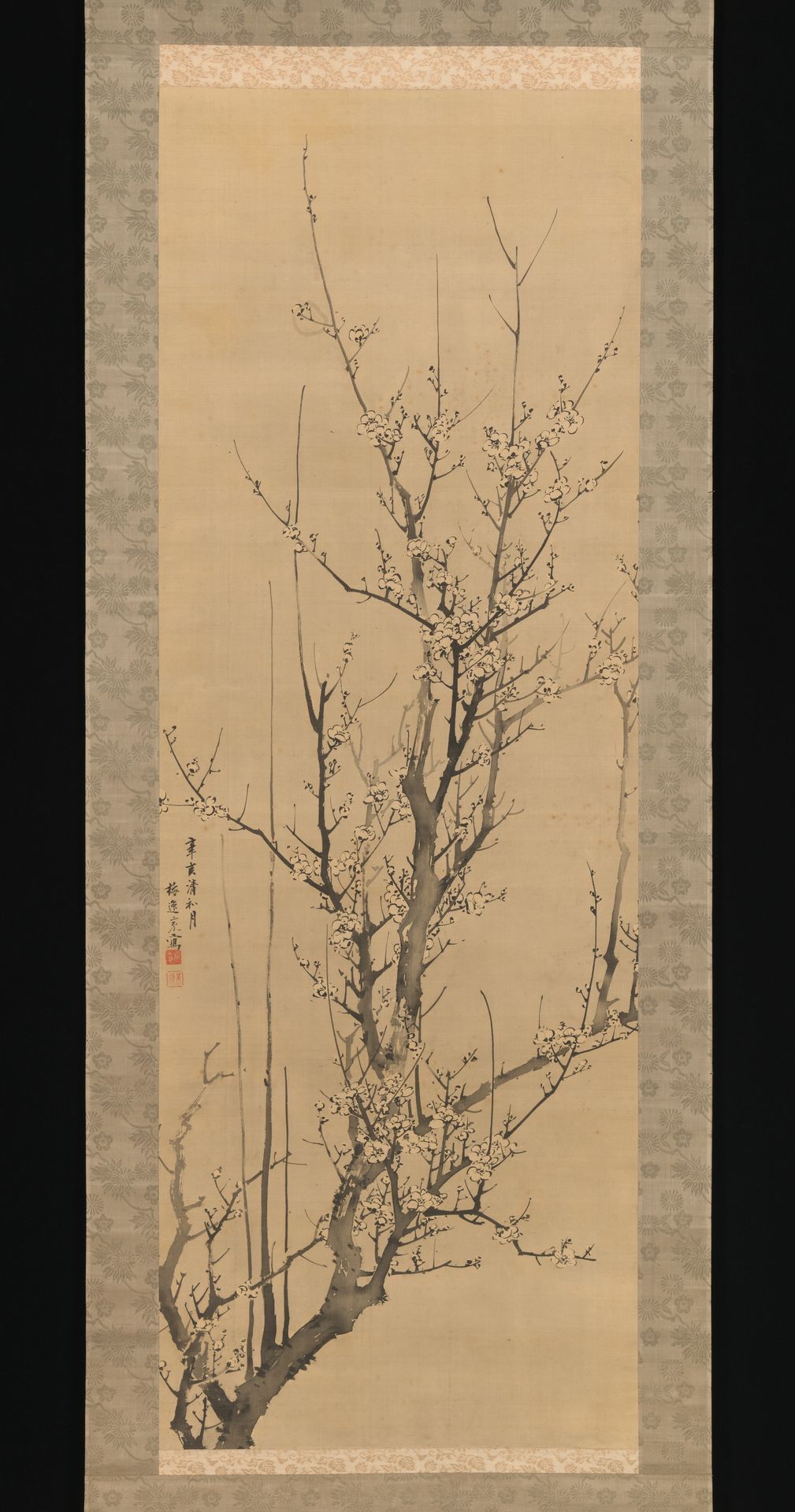
Editor: So this is Yamamoto Baiitsu's "Plum Blossoms," made with ink on paper around 1851. It feels so delicate, almost fragile, with those thin lines creating the branches and blossoms. How do you read the composition of this work? Curator: Intriguing. Formally, one observes the deliberate asymmetry—the trunk anchoring the lower portion, yielding to delicate branches reaching upwards and to the right. The empty space is not merely background, but an active element contributing to the balance. Editor: An active element? How so? Curator: Precisely. Consider the line quality – its variation and its emphasis on contour over volume. Note the near-abstract rendering of the plum blossoms; they exist primarily as shapes, not literal representations. Do you notice a pattern of positive and negative space? Editor: I see that the blossoms and branches create shapes against the plain background. It's not just about what's there, but what isn't, too. Is there a deliberate ambiguity at play here? Curator: Yes. The ink wash suggests depth and atmosphere, creating a sense of space without relying on Western perspective. Further, reflect on how the artist uses texture versus the polished paper. There is a considered play between control and accident, intentionality and chance. Editor: I’m beginning to see how each element—line, shape, texture—contributes to the overall aesthetic experience, working together. Thank you for guiding me in noticing that interplay. Curator: It is a valuable study in appreciating artistic strategies beyond mere representational accuracy, reminding us of the potent language embedded within the artwork's intrinsic elements.
Plum Blossoms 1851


Artwork details
- Medium
- painting, paper, ink
- Dimensions
- Image: 45 1/2 in. × 16 in. (115.6 × 40.6 cm) Overall with mounting: 79 1/4 × 20 7/8 in. (201.3 × 53 cm) Overall with knobs: 79 1/4 × 20 7/8 in. (201.3 × 53 cm)
- Location
- Metropolitan Museum of Art, New York, NY
- Copyright
- Public Domain
Tags
painting
asian-art
ukiyo-e
paper
ink
orientalism
line
Comments
No comments
About this artwork
Editor: So this is Yamamoto Baiitsu's "Plum Blossoms," made with ink on paper around 1851. It feels so delicate, almost fragile, with those thin lines creating the branches and blossoms. How do you read the composition of this work? Curator: Intriguing. Formally, one observes the deliberate asymmetry—the trunk anchoring the lower portion, yielding to delicate branches reaching upwards and to the right. The empty space is not merely background, but an active element contributing to the balance. Editor: An active element? How so? Curator: Precisely. Consider the line quality – its variation and its emphasis on contour over volume. Note the near-abstract rendering of the plum blossoms; they exist primarily as shapes, not literal representations. Do you notice a pattern of positive and negative space? Editor: I see that the blossoms and branches create shapes against the plain background. It's not just about what's there, but what isn't, too. Is there a deliberate ambiguity at play here? Curator: Yes. The ink wash suggests depth and atmosphere, creating a sense of space without relying on Western perspective. Further, reflect on how the artist uses texture versus the polished paper. There is a considered play between control and accident, intentionality and chance. Editor: I’m beginning to see how each element—line, shape, texture—contributes to the overall aesthetic experience, working together. Thank you for guiding me in noticing that interplay. Curator: It is a valuable study in appreciating artistic strategies beyond mere representational accuracy, reminding us of the potent language embedded within the artwork's intrinsic elements.
Comments
No comments