About this artwork
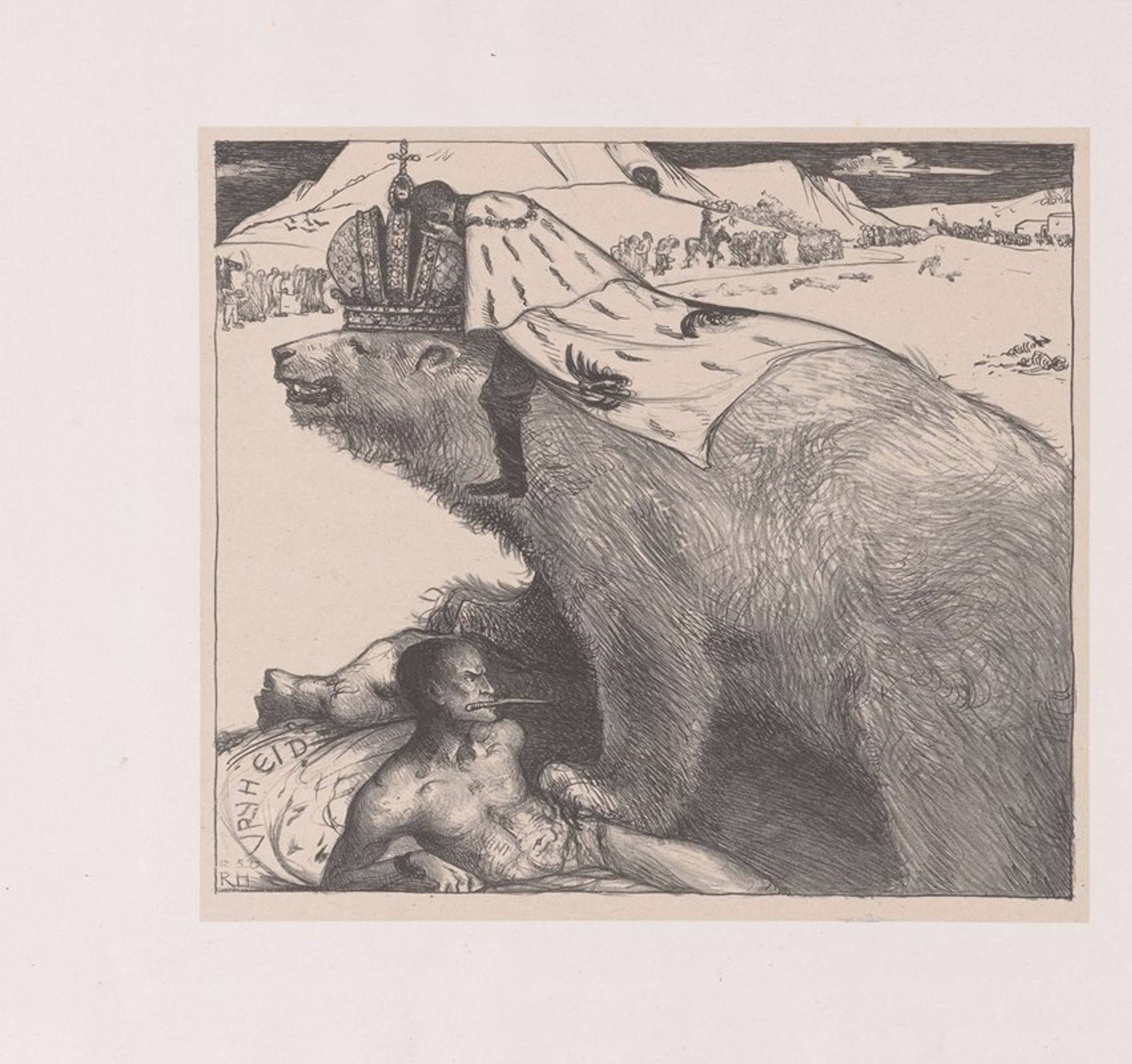
This work by Richard Roland Holst depicts Tsar Nicholas II of Russia on a Russian bear. It is made using the printmaking process of lithography, a technique that allows for detailed lines and tonal variations. The lithographic process involves drawing on a stone or metal plate with a greasy crayon, then treating the surface so that ink adheres only to the drawn areas. This print is characterized by dense crosshatching, creating a palpable sense of volume on the bear’s fur. This illustrates the weight of the political symbolism carried by the image. The choice of lithography as a medium is also significant. It's a method suited to mass production. This is apt for the print's satirical critique of Russian autocracy. It draws attention to the labor and politics involved in the production and dissemination of such images. Ultimately, understanding this artwork demands an appreciation for the materials and methods employed, as well as the social context in which it was created.
Tsaar Nicolaas II van Rusland op de Russische beer
1899

Artwork details
- Medium
- drawing, pencil
- Copyright
- Public Domain: Artvee
Tags
Comments
Share your thoughts
About this artwork
This work by Richard Roland Holst depicts Tsar Nicholas II of Russia on a Russian bear. It is made using the printmaking process of lithography, a technique that allows for detailed lines and tonal variations. The lithographic process involves drawing on a stone or metal plate with a greasy crayon, then treating the surface so that ink adheres only to the drawn areas. This print is characterized by dense crosshatching, creating a palpable sense of volume on the bear’s fur. This illustrates the weight of the political symbolism carried by the image. The choice of lithography as a medium is also significant. It's a method suited to mass production. This is apt for the print's satirical critique of Russian autocracy. It draws attention to the labor and politics involved in the production and dissemination of such images. Ultimately, understanding this artwork demands an appreciation for the materials and methods employed, as well as the social context in which it was created.
Comments
Share your thoughts