About this artwork
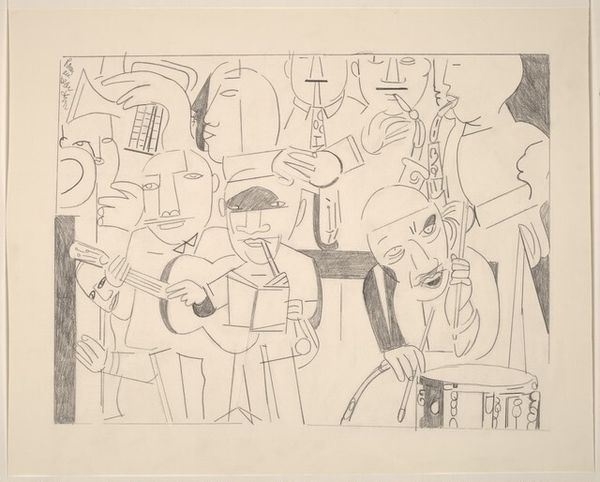
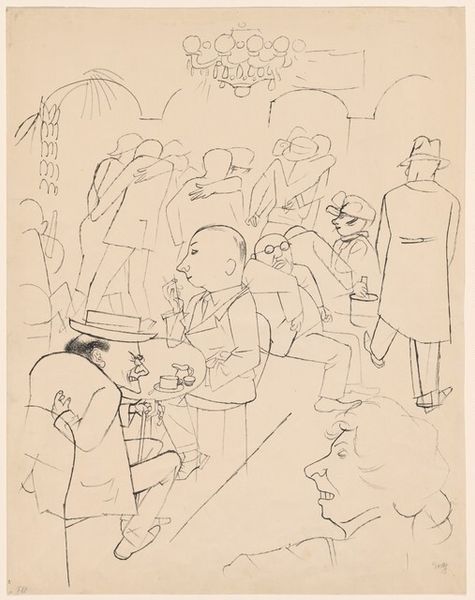
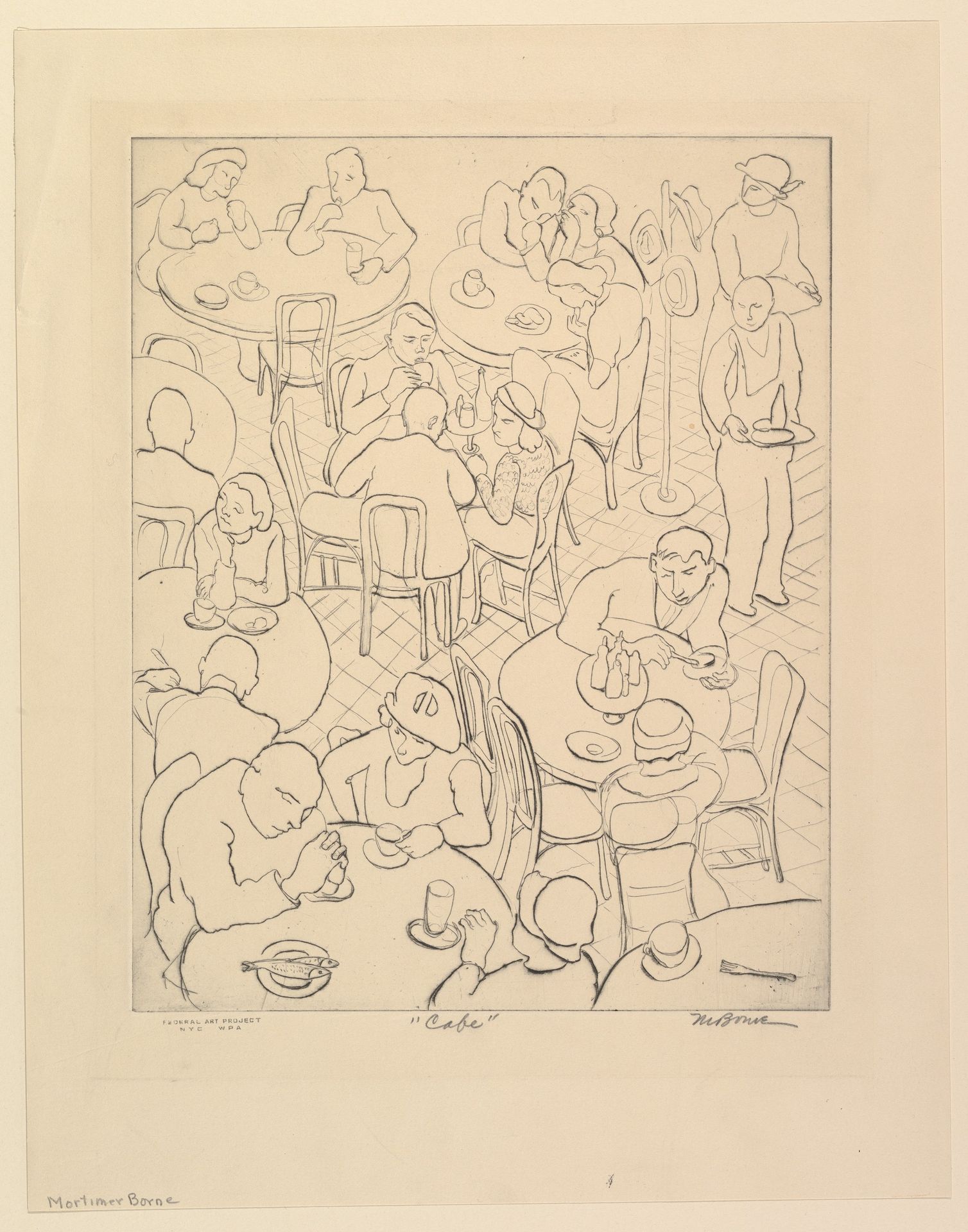
Mortimer Borne made this print of a cafe using a black line on paper, creating a busy social scene. What strikes me is how simple the marks are. Borne is not trying to give us a photo-realistic rendering of a cafe, instead, he is distilling the scene into essential lines that give us just enough information. The lines are descriptive and yet they are also raw and immediate. Notice how the tables are all circles, but each one is drawn differently, with a slightly different wobble and weight. Look at the figure in the lower part of the print, slumped over the table. You can see the simple looping line of the back, and the heavy weight of the head as it rests on the table. It's a quick gesture, but it conveys so much about the human condition. Borne's work reminds me of other social realists from the same period. There's a sense of observation and a desire to capture everyday life. I see the influence of artists like Isabel Bishop, who were also documenting urban scenes with an empathetic eye. Art is always in conversation with itself, an ongoing exchange of ideas across time.
Café 1935 - 1943


Artwork details
- Dimensions
- plate: 10 x 8 in. (25.4 x 20.3 cm) sheet: 13 1/4 x 10 1/2 in. (33.7 x 26.7 cm)
- Location
- Metropolitan Museum of Art, New York, NY
- Copyright
- Public Domain
Comments
No comments
About this artwork
Mortimer Borne made this print of a cafe using a black line on paper, creating a busy social scene. What strikes me is how simple the marks are. Borne is not trying to give us a photo-realistic rendering of a cafe, instead, he is distilling the scene into essential lines that give us just enough information. The lines are descriptive and yet they are also raw and immediate. Notice how the tables are all circles, but each one is drawn differently, with a slightly different wobble and weight. Look at the figure in the lower part of the print, slumped over the table. You can see the simple looping line of the back, and the heavy weight of the head as it rests on the table. It's a quick gesture, but it conveys so much about the human condition. Borne's work reminds me of other social realists from the same period. There's a sense of observation and a desire to capture everyday life. I see the influence of artists like Isabel Bishop, who were also documenting urban scenes with an empathetic eye. Art is always in conversation with itself, an ongoing exchange of ideas across time.
Comments
No comments