About this artwork
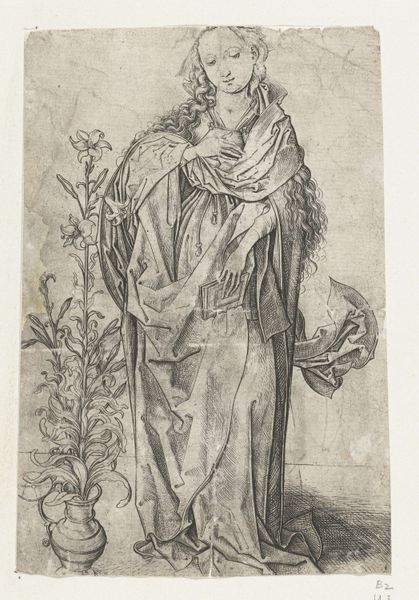
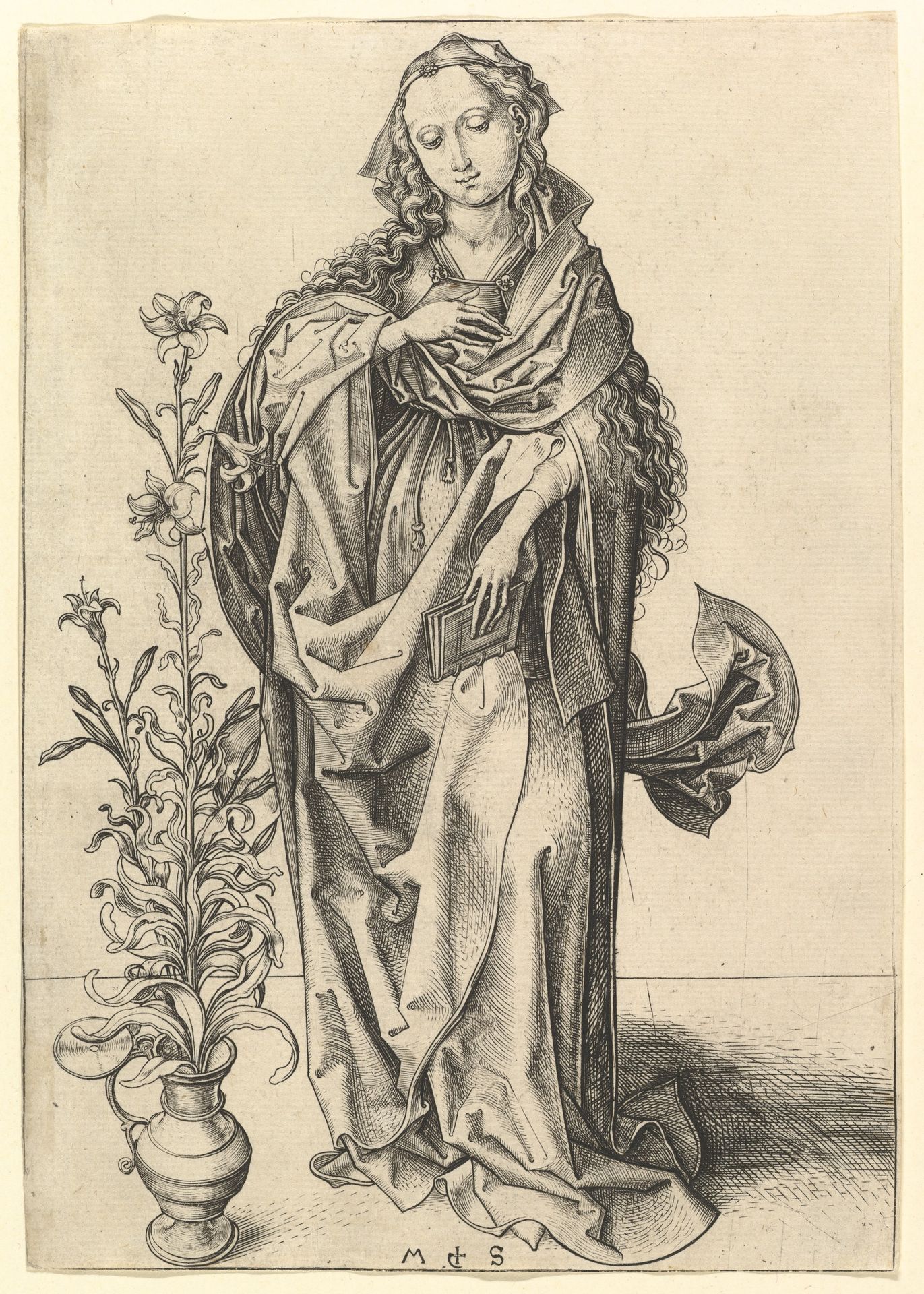
Martin Schongauer created this engraving of the Virgin Annunciate in fifteenth-century Germany, at a time when the Catholic Church was the dominant cultural institution. Schongauer depicts Mary, a book in her hand, as a model of pious receptivity. The angel Gabriel isn't present here, but the lilies in the vase beside her stand for Mary's purity. The scene of the Annunciation was a common subject for art at the time, often commissioned by the Church itself or wealthy donors. But Schongauer was an independent printmaker, and his prints were relatively affordable. This meant that religious imagery was circulating beyond the traditional confines of the church and wealthy elites. To understand this work better, we can study the history of religious imagery, the development of printmaking, and the social context in which these images circulated. By studying the cultural and institutional context, we can better understand the public role of art in fifteenth-century Germany.
The Annunciation: The Virgin 1465 - 1485


Artwork details
- Medium
- drawing, print, engraving
- Dimensions
- Sheet: 6 5/8 × 4 11/16 in. (16.9 × 11.9 cm)
- Location
- Metropolitan Museum of Art, New York, NY
- Copyright
- Public Domain
Tags
portrait
drawing
figuration
history-painting
northern-renaissance
engraving
Comments
No comments
About this artwork
Martin Schongauer created this engraving of the Virgin Annunciate in fifteenth-century Germany, at a time when the Catholic Church was the dominant cultural institution. Schongauer depicts Mary, a book in her hand, as a model of pious receptivity. The angel Gabriel isn't present here, but the lilies in the vase beside her stand for Mary's purity. The scene of the Annunciation was a common subject for art at the time, often commissioned by the Church itself or wealthy donors. But Schongauer was an independent printmaker, and his prints were relatively affordable. This meant that religious imagery was circulating beyond the traditional confines of the church and wealthy elites. To understand this work better, we can study the history of religious imagery, the development of printmaking, and the social context in which these images circulated. By studying the cultural and institutional context, we can better understand the public role of art in fifteenth-century Germany.
Comments
No comments