About this artwork
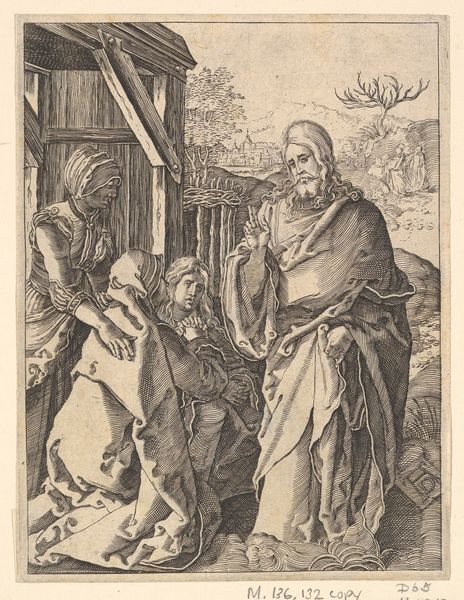
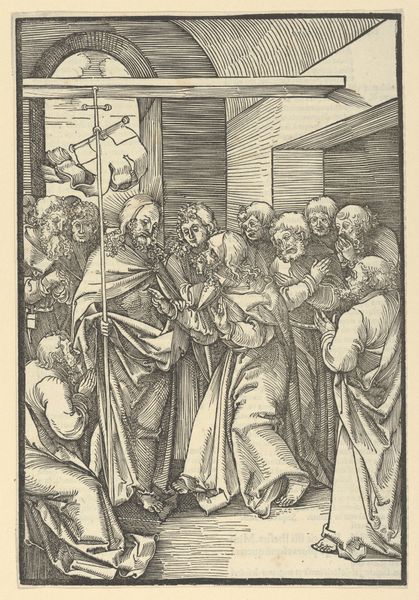
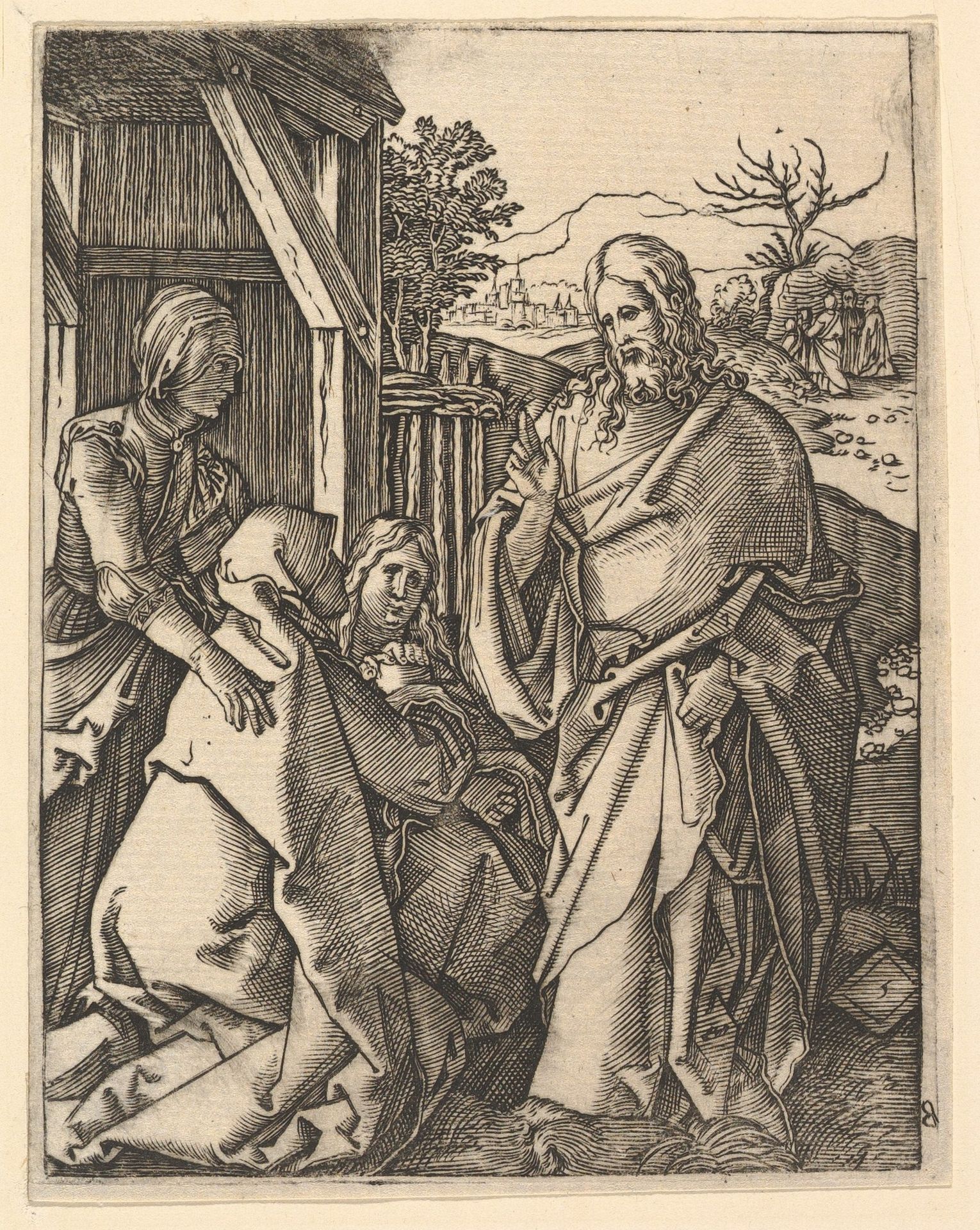
Marcantonio Raimondi created this engraving, "Christ Taking Leave of His Mother, after Dürer," around 1510-1520. The composition is structured around a central, emotionally charged moment. Notice how Raimondi uses dense, parallel lines to build form and shadow, creating a rich visual texture. The figures are arranged in a tight, almost claustrophobic grouping. Christ stands rigidly upright, gesturing towards the background with his raised hand, while his mother kneels, enveloped by two women, their drapery swirling around them. This creates a dynamic contrast between Christ's vertical stability and the swirling emotion below. The foreground is detailed and dense with lines, while the background becomes more sparse, drawing our eye to the figures clustered around Christ. The graphic lines and stark contrasts serve to heighten the emotional tension inherent in the scene of departure. Raimondi's work here showcases a mastery of line, transforming Dürer's original concept into a study of human emotion.
Christ Taking Leave of His Mother, after Dürer 1495 - 1539

Marcantonio Raimondi
1475 - 1534
The Metropolitan Museum of Art
Metropolitan Museum of Art, New York, NYArtwork details
- Medium
- drawing, print, engraving
- Dimensions
- Sheet: 5 1/16 × 3 15/16 in. (12.9 × 10 cm)
- Location
- Metropolitan Museum of Art, New York, NY
- Copyright
- Public Domain
Tags
drawing
narrative-art
pen drawing
figuration
line
history-painting
italian-renaissance
engraving
virgin-mary
Comments
No comments
About this artwork
Marcantonio Raimondi created this engraving, "Christ Taking Leave of His Mother, after Dürer," around 1510-1520. The composition is structured around a central, emotionally charged moment. Notice how Raimondi uses dense, parallel lines to build form and shadow, creating a rich visual texture. The figures are arranged in a tight, almost claustrophobic grouping. Christ stands rigidly upright, gesturing towards the background with his raised hand, while his mother kneels, enveloped by two women, their drapery swirling around them. This creates a dynamic contrast between Christ's vertical stability and the swirling emotion below. The foreground is detailed and dense with lines, while the background becomes more sparse, drawing our eye to the figures clustered around Christ. The graphic lines and stark contrasts serve to heighten the emotional tension inherent in the scene of departure. Raimondi's work here showcases a mastery of line, transforming Dürer's original concept into a study of human emotion.
Comments
No comments