About this artwork
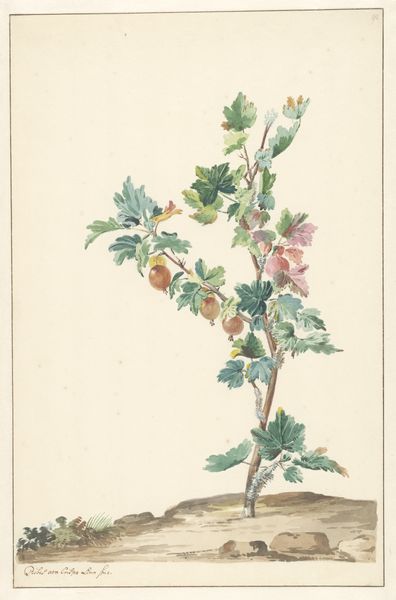
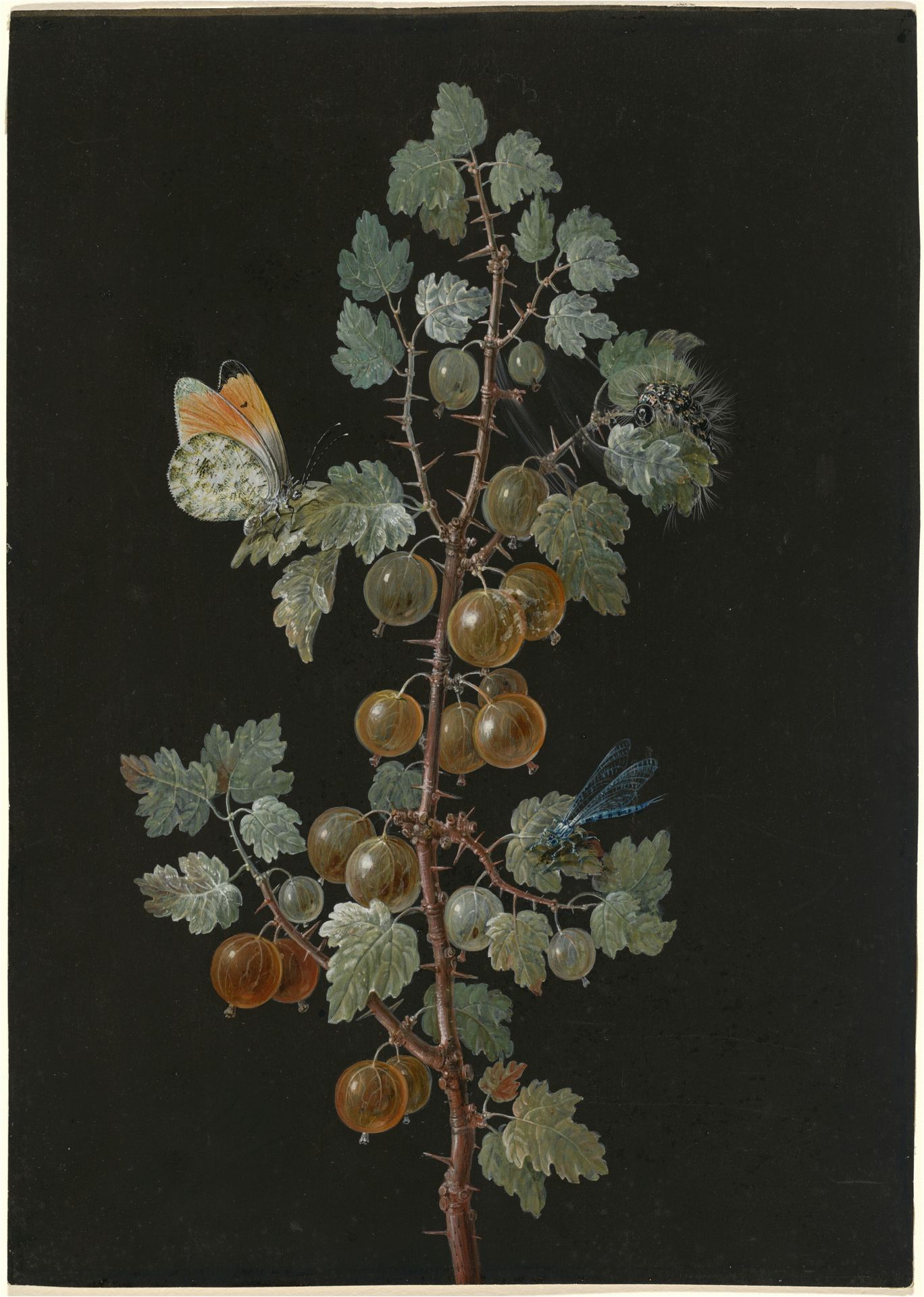
Curator: Well, look at this beauty! Here we have "A Branch of Gooseberries with a Dragonfly, an Orange-Tip Butterfly, and a Caterpillar" by Barbara Dietzsch, dating back to the 18th century. The artist uses watercolor and drawing techniques to celebrate the micro-details in nature. My first impression is just "wow" --the darkness behind it throws all those greens and browns into high relief. What a garden in a void! Editor: I am immediately drawn to the butterfly and the caterpillar positioned on opposite ends of the stem. Symbolically, they show different stages of life: one free and the other about to transform. It also makes me consider the Rococo’s embrace of fleeting beauty—an acknowledgement that even the most radiant form will fade. Curator: I think you nailed it. And what about that fierce contrast—all these tiny lives blooming in sharp detail against an absolutely limitless black background? Dietzsch draws us into an almost meditative study, each tiny detail illuminated. Editor: The dragonfly, poised elegantly, reinforces this symbolism further—a creature associated across cultures with transformation and adaptability, almost as a spirit guide to the butterfly and caterpillar. Gooseberries themselves might be symbols of anticipation—holding the potential of future sweetness, balanced with the thorns indicating challenges. Curator: Yes, you are right: There’s that dance of anticipation, right there, between pleasure and pain. Plus, who expects gooseberries in such dramatic lighting? It feels wonderfully extra and yet humble at the same time. Rococo for the win! Editor: Absolutely, Dietzsch uses natural subjects, presented theatrically, to contemplate life, change, and persistence of memory in organic forms. It goes way beyond simply replicating the observable world. Curator: It all just goes to show how much storytelling can bloom even in the tiniest, most specific corners of nature! Editor: Indeed. And these stories resonate across centuries, still offering layers of meaning and pleasure for new viewers today.
A Branch of Gooseberries with a Dragonfly, an Orange-Tip Butterfly, and a Caterpillar 1725 - 1783


Artwork details
- Medium
- drawing, watercolor
- Dimensions
- overall: 28.7 x 20.4 cm (11 5/16 x 8 1/16 in.)
- Copyright
- National Gallery of Art: CC0 1.0
Tags
drawing
landscape
watercolor
watercolour illustration
botanical art
rococo
Comments
No comments
About this artwork
Curator: Well, look at this beauty! Here we have "A Branch of Gooseberries with a Dragonfly, an Orange-Tip Butterfly, and a Caterpillar" by Barbara Dietzsch, dating back to the 18th century. The artist uses watercolor and drawing techniques to celebrate the micro-details in nature. My first impression is just "wow" --the darkness behind it throws all those greens and browns into high relief. What a garden in a void! Editor: I am immediately drawn to the butterfly and the caterpillar positioned on opposite ends of the stem. Symbolically, they show different stages of life: one free and the other about to transform. It also makes me consider the Rococo’s embrace of fleeting beauty—an acknowledgement that even the most radiant form will fade. Curator: I think you nailed it. And what about that fierce contrast—all these tiny lives blooming in sharp detail against an absolutely limitless black background? Dietzsch draws us into an almost meditative study, each tiny detail illuminated. Editor: The dragonfly, poised elegantly, reinforces this symbolism further—a creature associated across cultures with transformation and adaptability, almost as a spirit guide to the butterfly and caterpillar. Gooseberries themselves might be symbols of anticipation—holding the potential of future sweetness, balanced with the thorns indicating challenges. Curator: Yes, you are right: There’s that dance of anticipation, right there, between pleasure and pain. Plus, who expects gooseberries in such dramatic lighting? It feels wonderfully extra and yet humble at the same time. Rococo for the win! Editor: Absolutely, Dietzsch uses natural subjects, presented theatrically, to contemplate life, change, and persistence of memory in organic forms. It goes way beyond simply replicating the observable world. Curator: It all just goes to show how much storytelling can bloom even in the tiniest, most specific corners of nature! Editor: Indeed. And these stories resonate across centuries, still offering layers of meaning and pleasure for new viewers today.
Comments
No comments