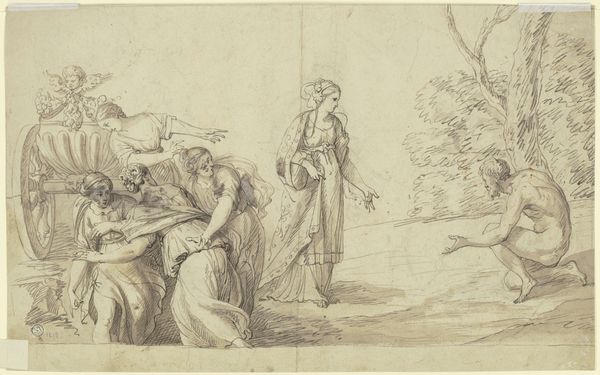
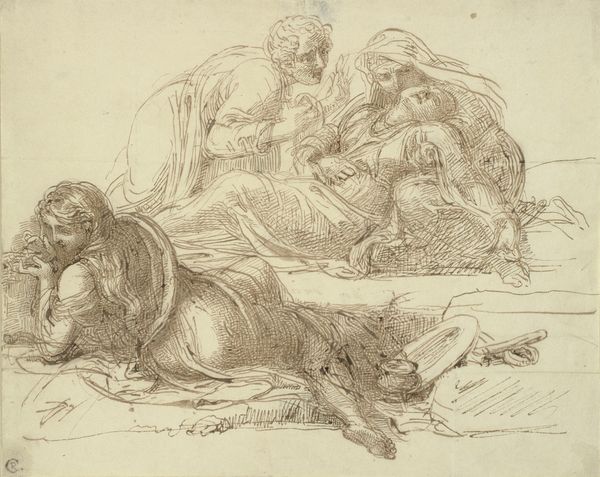
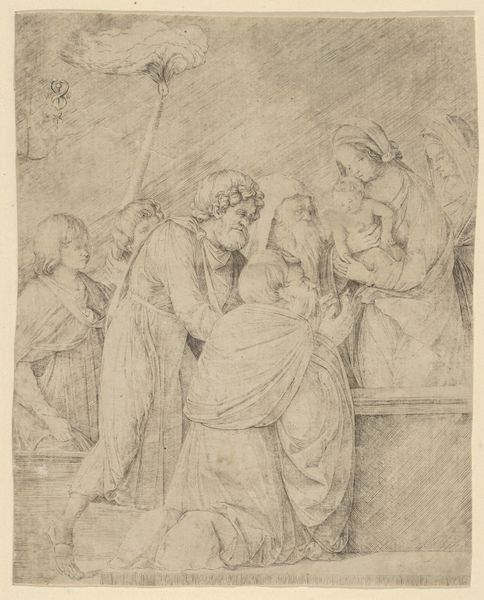
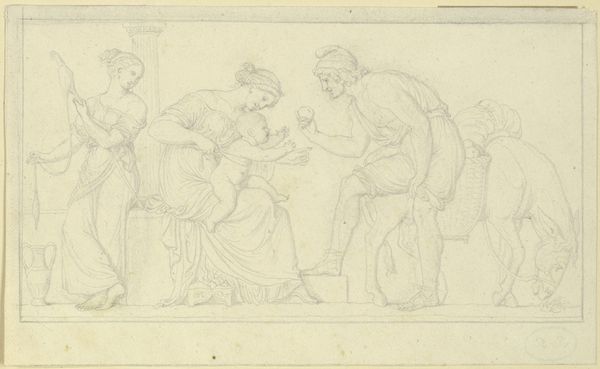
Susanna and the Elders (recto); Profile Head of Woman (verso) c. 1602


drawing, print, paper, pencil, chalk, pen, charcoal, black-chalk
drawing
narrative-art
pencil sketch
charcoal drawing
figuration
paper
11_renaissance
pencil
chalk
pen
charcoal
history-painting
black-chalk
Dimensions: 218 × 313 mm
Copyright: Public Domain
Editor: So, this is Annibale Carracci's "Susanna and the Elders," dating back to about 1602. It’s a drawing done with pen, chalk, and charcoal on paper. I find it so striking how Susanna's vulnerability is depicted, while the elders seem almost comical in their leering. What's your interpretation of this drawing? Curator: Well, considering Carracci's time, the depiction of Susanna is really interesting. Biblical narratives, especially those involving women, were often vehicles for exploring social anxieties and power dynamics. The male gaze is palpable here, but the image also circulates within a context where the power of the church, and those that represented that power like the elders, was always under examination. Editor: So, are you saying the seemingly simple depiction might actually critique the authority figures represented by the elders? Curator: Precisely! It invites us to consider who holds power, whose voices are amplified, and how artistic representation can either reinforce or question these social structures. How do you think this scene was generally received in its time? Did it spark any discussions? Editor: That's something I hadn't thought of, it does feel like it encourages the viewer to question the status quo. Now I am thinking more about the potential for art to ignite societal conversation even centuries ago. Thanks for shedding light on the historical significance of the work! Curator: It’s about understanding art as a reflection of societal tensions and power dynamics, a perspective I hope more people can gain.
Comments
No comments
Be the first to comment and join the conversation on the ultimate creative platform.
 React
React Comment