About this artwork
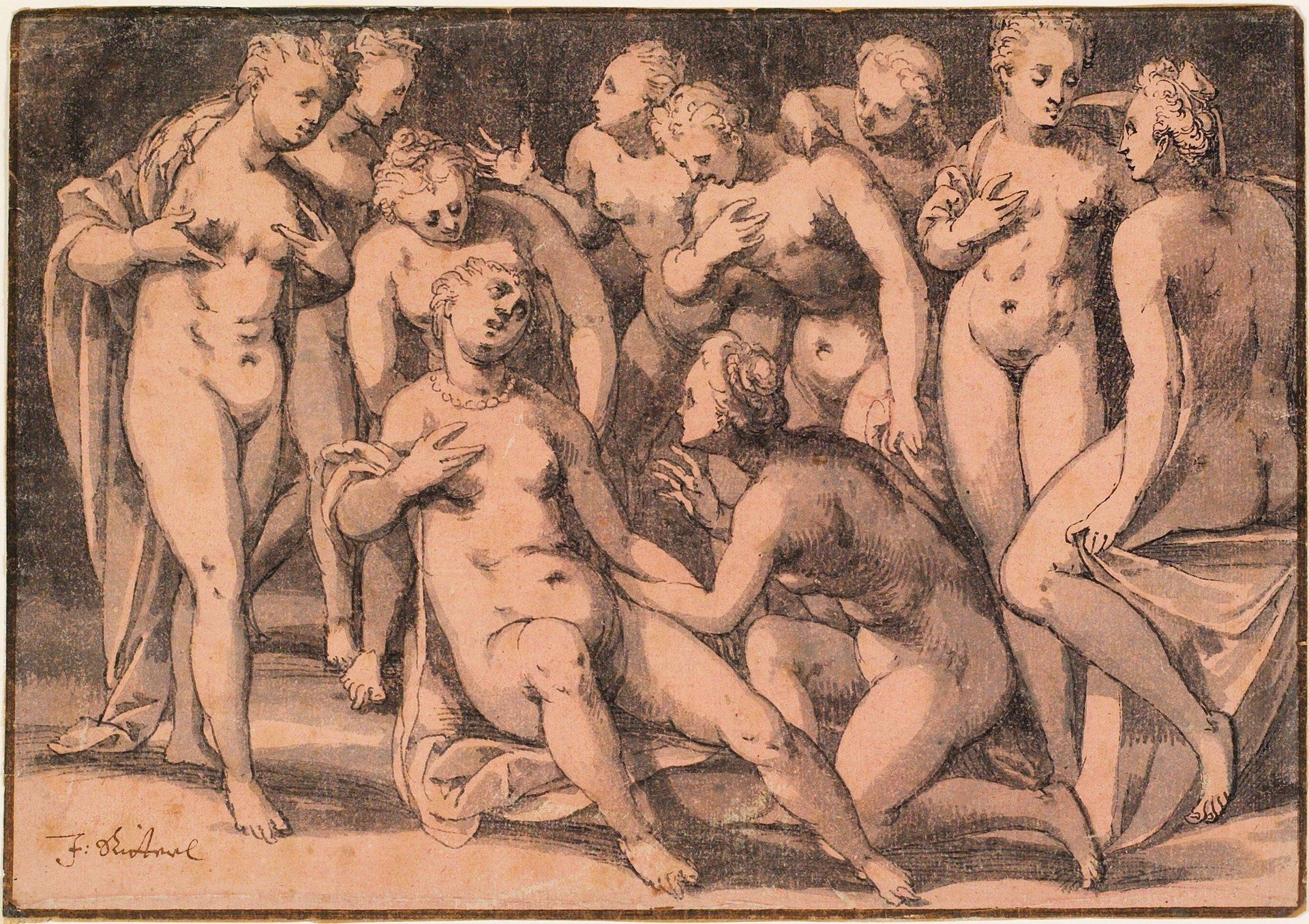
Josef Ritterl created this ink and wash drawing, ‘Diana Discovers the Pregnancy of Callisto,’ in the 17th century. The drama of the scene stems from the transgression of the oath of chastity, sworn by the nymphs who followed Diana. Callisto’s pregnancy violates that oath, a symbol of social order. Made in Austria, this work reflects the culture of the Habsburg Empire, where social rank and moral codes were strictly upheld. This can be seen in the exposed bodies of the nymphs, whose vulnerability mirrors the fragile social status of women at this time. The visual codes reinforce moral and social standards; the image suggests the consequences of stepping outside them. In the context of Counter-Reformation Europe, this tale could have also served as a cautionary narrative against earthly temptations. To understand this artwork, we can study the cultural history of 17th-century Europe. Literary sources such as Ovid’s Metamorphoses can inform our understanding of the classical allusions, and thus, the multiple social, cultural and institutional contexts through which it gains meaning.
Diana Discovers the Pregnancy of Callisto
16th-17th century


Artwork details
- Medium
- drawing, ink
- Dimensions
- 8 1/16 x 11 1/2 in. (20.48 x 29.21 cm)
- Location
- Minneapolis Institute of Art
- Copyright
- Public Domain
Tags
Comments
Share your thoughts
About this artwork
Josef Ritterl created this ink and wash drawing, ‘Diana Discovers the Pregnancy of Callisto,’ in the 17th century. The drama of the scene stems from the transgression of the oath of chastity, sworn by the nymphs who followed Diana. Callisto’s pregnancy violates that oath, a symbol of social order. Made in Austria, this work reflects the culture of the Habsburg Empire, where social rank and moral codes were strictly upheld. This can be seen in the exposed bodies of the nymphs, whose vulnerability mirrors the fragile social status of women at this time. The visual codes reinforce moral and social standards; the image suggests the consequences of stepping outside them. In the context of Counter-Reformation Europe, this tale could have also served as a cautionary narrative against earthly temptations. To understand this artwork, we can study the cultural history of 17th-century Europe. Literary sources such as Ovid’s Metamorphoses can inform our understanding of the classical allusions, and thus, the multiple social, cultural and institutional contexts through which it gains meaning.
Comments
Share your thoughts