About this artwork
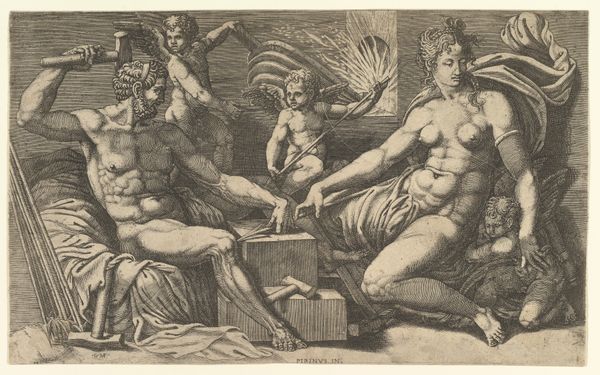
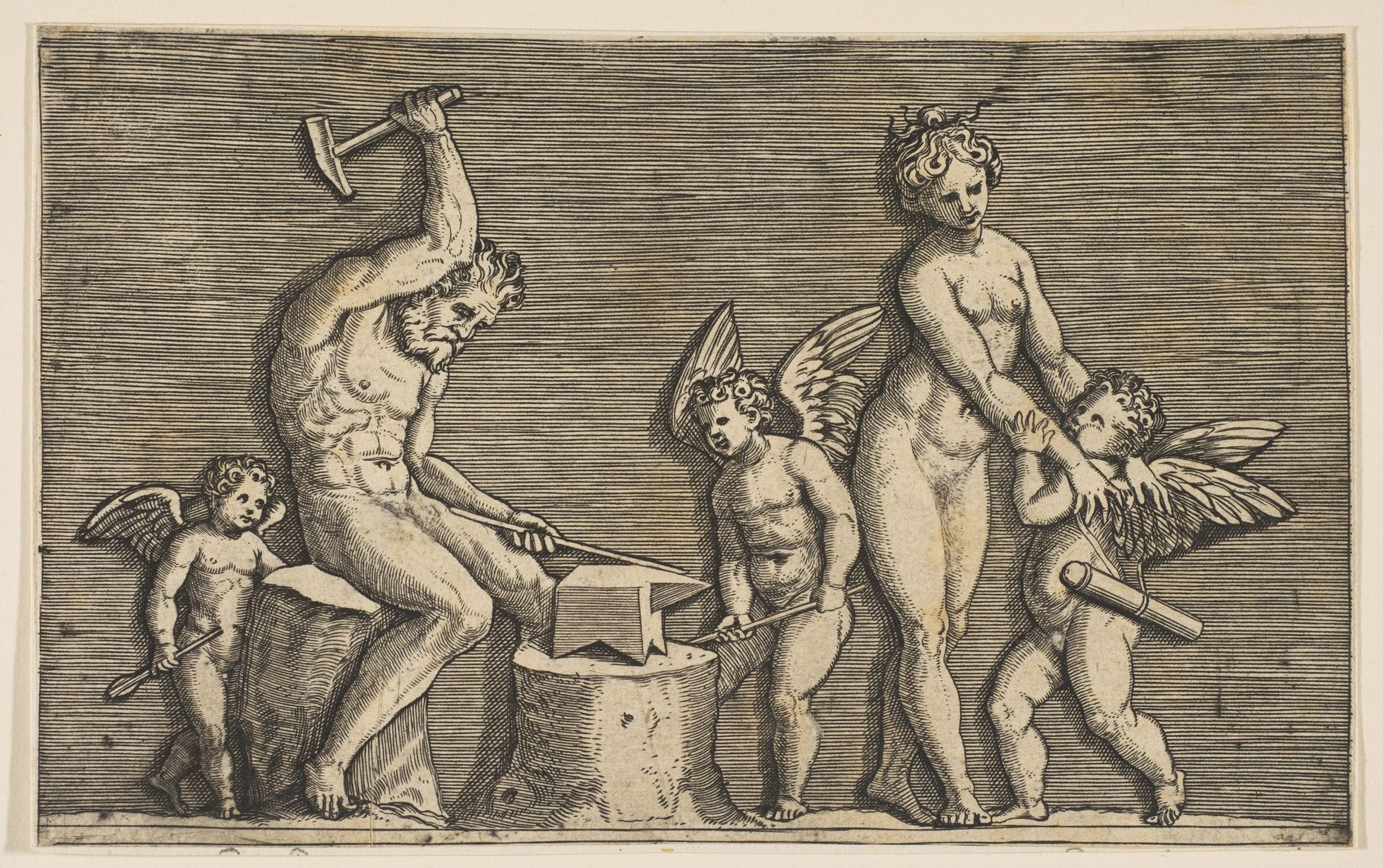
This engraving, depicting Vulcan at his forge alongside Venus and cupids, was created by Marco Dente. The strong horizontals of the background emphasize a stage-like space, setting off the figures in the foreground. Consider how the composition balances masculine and feminine forms. Vulcan, muscular and actively hammering, contrasts with Venus, whose fluid lines and gentle curves soften the image. The figures are caught in dynamic tension. Vulcan's labor is juxtaposed with Venus's passive pose, and this relationship creates a visual dialogue about the relationship between labor, beauty, and desire. The cupids act as mediating figures, their presence underscoring the themes of love and creation. Dente’s skilled handling of line and shadow models the figures through a network of hatching, giving them volume. Note also how Dente uses line to articulate musculature and drapery, bringing a classical aesthetic and philosophical ideas to the artwork. These contrasts invite us to consider how the artwork destabilizes established meanings, values, or categories.
Vulcan seated hammering on an anvil flanked by Venus and three cupids
1510 - 1532


Artwork details
- Medium
- drawing, print, engraving
- Dimensions
- Sheet (Trimmed): 4 1/4 × 6 7/8 in. (10.8 × 17.4 cm)
- Location
- Metropolitan Museum of Art, New York, NY
- Copyright
- Public Domain
Tags
Comments
Share your thoughts
About this artwork
This engraving, depicting Vulcan at his forge alongside Venus and cupids, was created by Marco Dente. The strong horizontals of the background emphasize a stage-like space, setting off the figures in the foreground. Consider how the composition balances masculine and feminine forms. Vulcan, muscular and actively hammering, contrasts with Venus, whose fluid lines and gentle curves soften the image. The figures are caught in dynamic tension. Vulcan's labor is juxtaposed with Venus's passive pose, and this relationship creates a visual dialogue about the relationship between labor, beauty, and desire. The cupids act as mediating figures, their presence underscoring the themes of love and creation. Dente’s skilled handling of line and shadow models the figures through a network of hatching, giving them volume. Note also how Dente uses line to articulate musculature and drapery, bringing a classical aesthetic and philosophical ideas to the artwork. These contrasts invite us to consider how the artwork destabilizes established meanings, values, or categories.
Comments
Share your thoughts