About this artwork
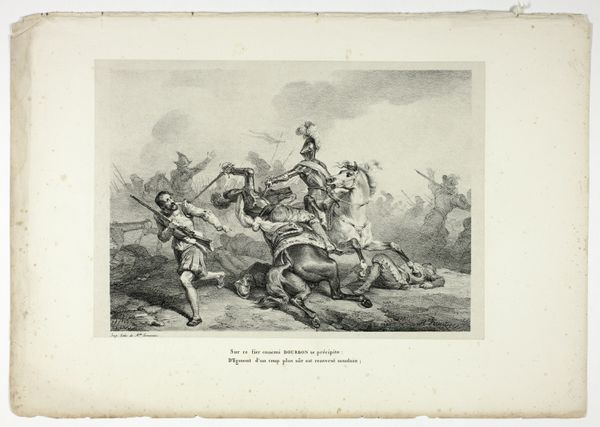
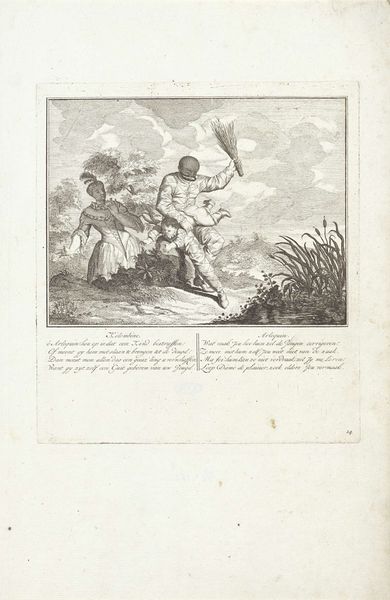
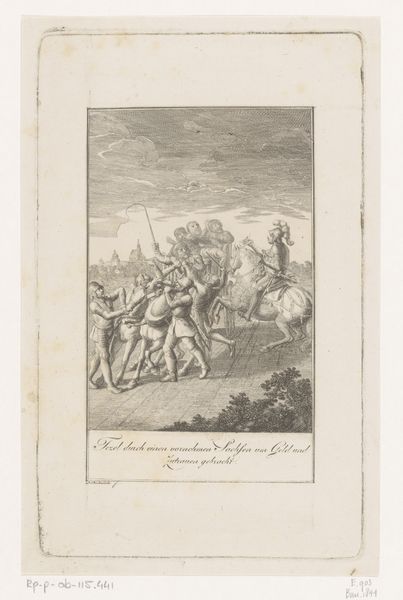
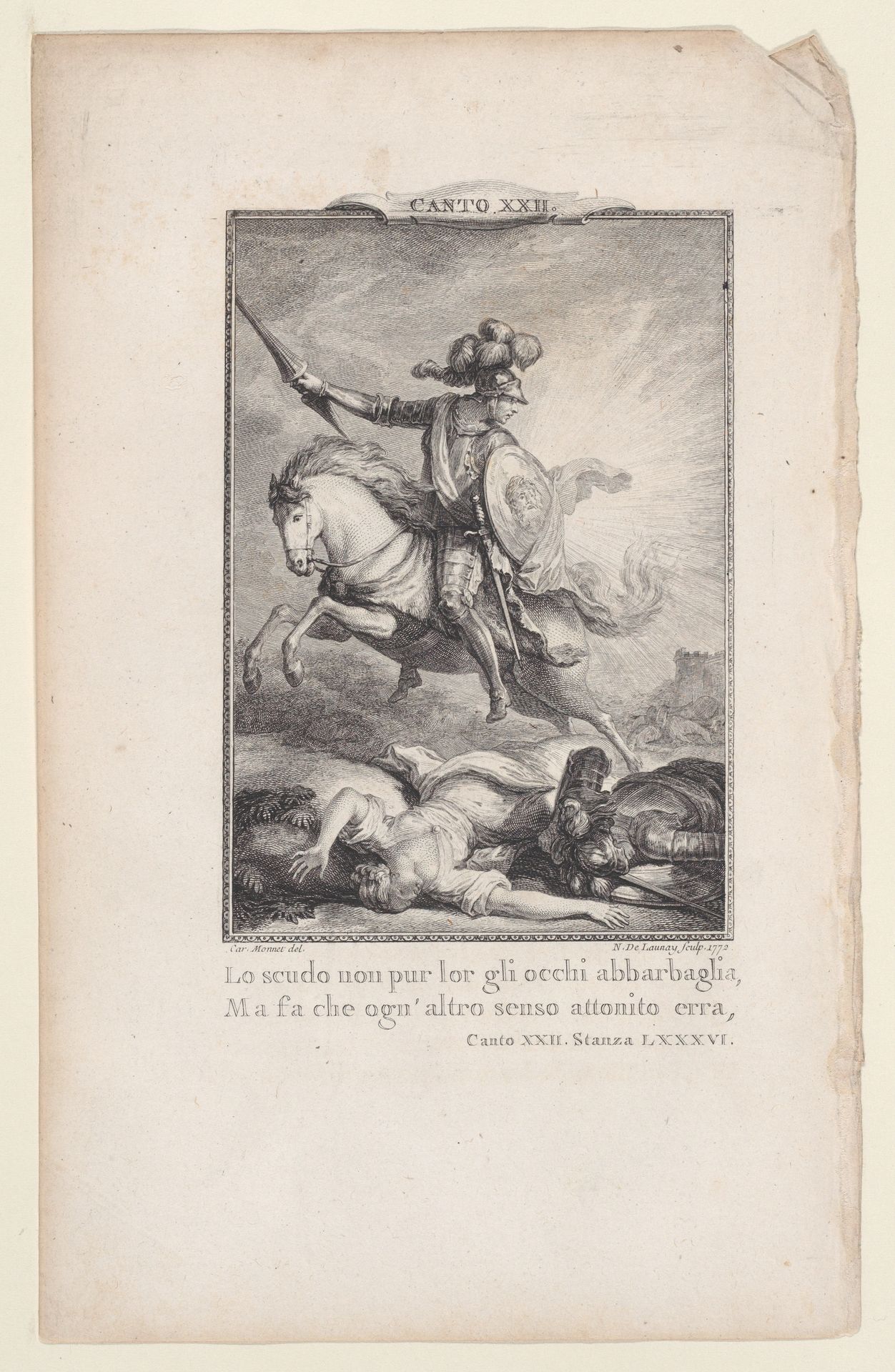
Nicolas de Launay created this engraving, "Canto 22, Stanza 86, from 'Orlando Furioso'," sometime in the 18th century. The scene is dominated by a knight on horseback, contrasted with the bodies of fallen soldiers below. The composition uses strong diagonal lines to convey movement and drama. De Launay employs the engraving technique to create a complex interplay of light and shadow. Notice how densely packed lines define darker areas, such as the foreground figures, while sparse lines suggest the bright, expansive sky. This manipulation of light serves not only to describe the scene but also to evoke an emotional response. The stark contrast between the victorious knight and the defeated figures introduces a complex tension, suggesting a critical view of heroism. Ultimately, this print challenges fixed meanings of valor by exploring the interplay between triumph and defeat. It reminds us that the meanings we derive from art are always fluid, changing with our own perspectives.
Canto 22, Stanza 86, from "Orlando Furioso"
1772


Artwork details
- Dimensions
- Image: 5 3/8 × 3 9/16 in. (13.6 × 9.1 cm) Sheet: 9 3/16 × 5 13/16 in. (23.4 × 14.7 cm)
- Location
- Metropolitan Museum of Art, New York, NY
- Copyright
- Public Domain
Comments
Share your thoughts
About this artwork
Nicolas de Launay created this engraving, "Canto 22, Stanza 86, from 'Orlando Furioso'," sometime in the 18th century. The scene is dominated by a knight on horseback, contrasted with the bodies of fallen soldiers below. The composition uses strong diagonal lines to convey movement and drama. De Launay employs the engraving technique to create a complex interplay of light and shadow. Notice how densely packed lines define darker areas, such as the foreground figures, while sparse lines suggest the bright, expansive sky. This manipulation of light serves not only to describe the scene but also to evoke an emotional response. The stark contrast between the victorious knight and the defeated figures introduces a complex tension, suggesting a critical view of heroism. Ultimately, this print challenges fixed meanings of valor by exploring the interplay between triumph and defeat. It reminds us that the meanings we derive from art are always fluid, changing with our own perspectives.
Comments
Share your thoughts