print, engraving
#
portrait
#
baroque
#
portrait image
# print
#
landscape
#
figuration
#
history-painting
#
engraving
Dimensions: 390 mm (height) x 487 mm (width) (bladmaal)
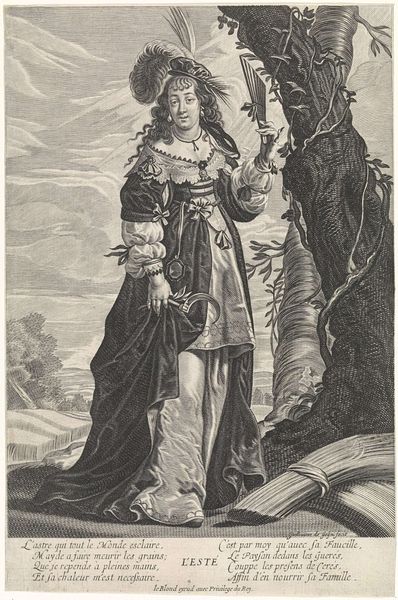
Curator: Welcome. We're standing before "Jord," an engraving dating back to somewhere between 1642 and 1665. It resides here at the SMK, Statens Museum for Kunst. Editor: Immediately, I’m struck by the contrasts. You’ve got this elegantly dressed woman right next to a rather brutal scene of a boar hunt. What's going on with those material juxtapositions? Curator: It's an allegorical portrait, framing the sitter as Jord, the personification of Earth in Norse mythology. Consider the engraving as not just an image, but as a symbolic rendering of power, specifically in its relationship with the land. It suggests the elite's domination over nature itself. Editor: Right, it's a constructed display. Look at the layers. The meticulous rendering of the fur draped around her shoulders—the value and prestige are unmistakable. This luxurious material both obscures and flaunts a specific type of consumption. The very act of engraving implies a labor-intensive process and therefore highlights societal structures. Curator: Exactly. And the active hunt taking place behind her, that shows the violent act of taking from the earth is framed within this idea of noble duty and dominance. We see that cultural narrative being constructed in the landscape as much as her attire. How is the role of woman as "nature" reinforced? Editor: Her pose—that upright spear juxtaposed with the reclining wolfskin—is staged authority, absolutely. The whole image, its production from metal plate to printed page, communicates control: of the land, of animals, and, indeed, of her own image. Even the text beneath contributes; it's an attempt to secure the image with cultural meaning. Curator: We might even ask if this construction reinforces or questions patriarchal power. How is she embodying authority, yet also confined by the era’s expectations? Editor: This brings into light what it signifies when women engage or disengage the expected societal structure and use different methods and materials as ways of defining that role and engagement. I can almost feel the textures; the labor, and intention etched into the plate— it reveals how images participate and affect how societies are formed and governed. Curator: Precisely. An engraving like this reminds us that representations are never neutral. They actively participate in shaping ideologies. I come away from this work questioning what we've inherited culturally about who "owns" nature. Editor: And it makes me consider: Who was it really "for"? The materials point to wealth, control, power, which prompts us to question and understand it in context of material making and its relationship to access.
Comments
No comments
Be the first to comment and join the conversation on the ultimate creative platform.
 Collect
 React
React Comment
More like this