About this artwork
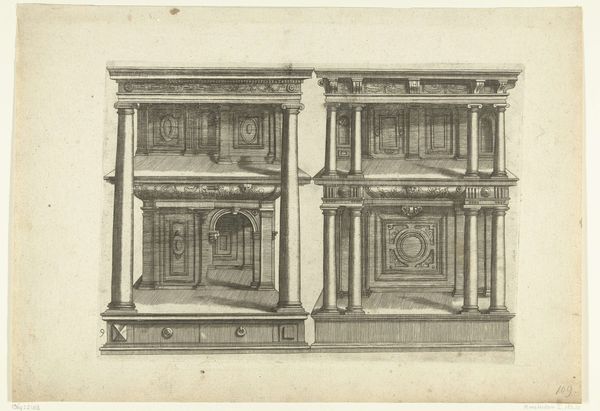
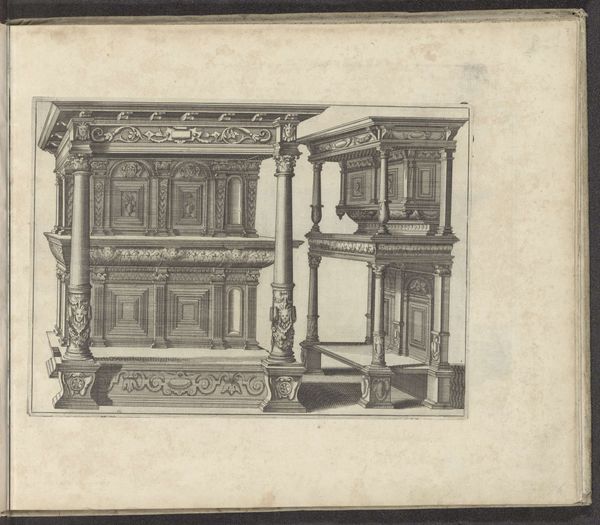
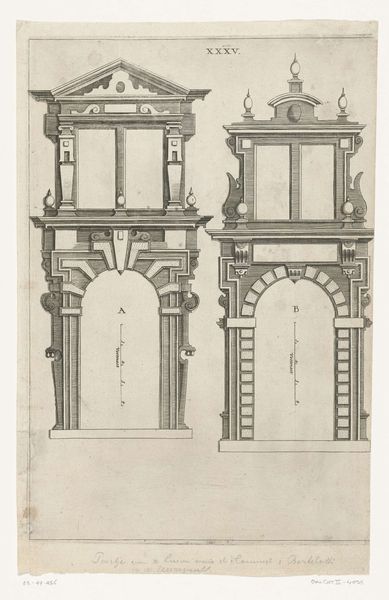
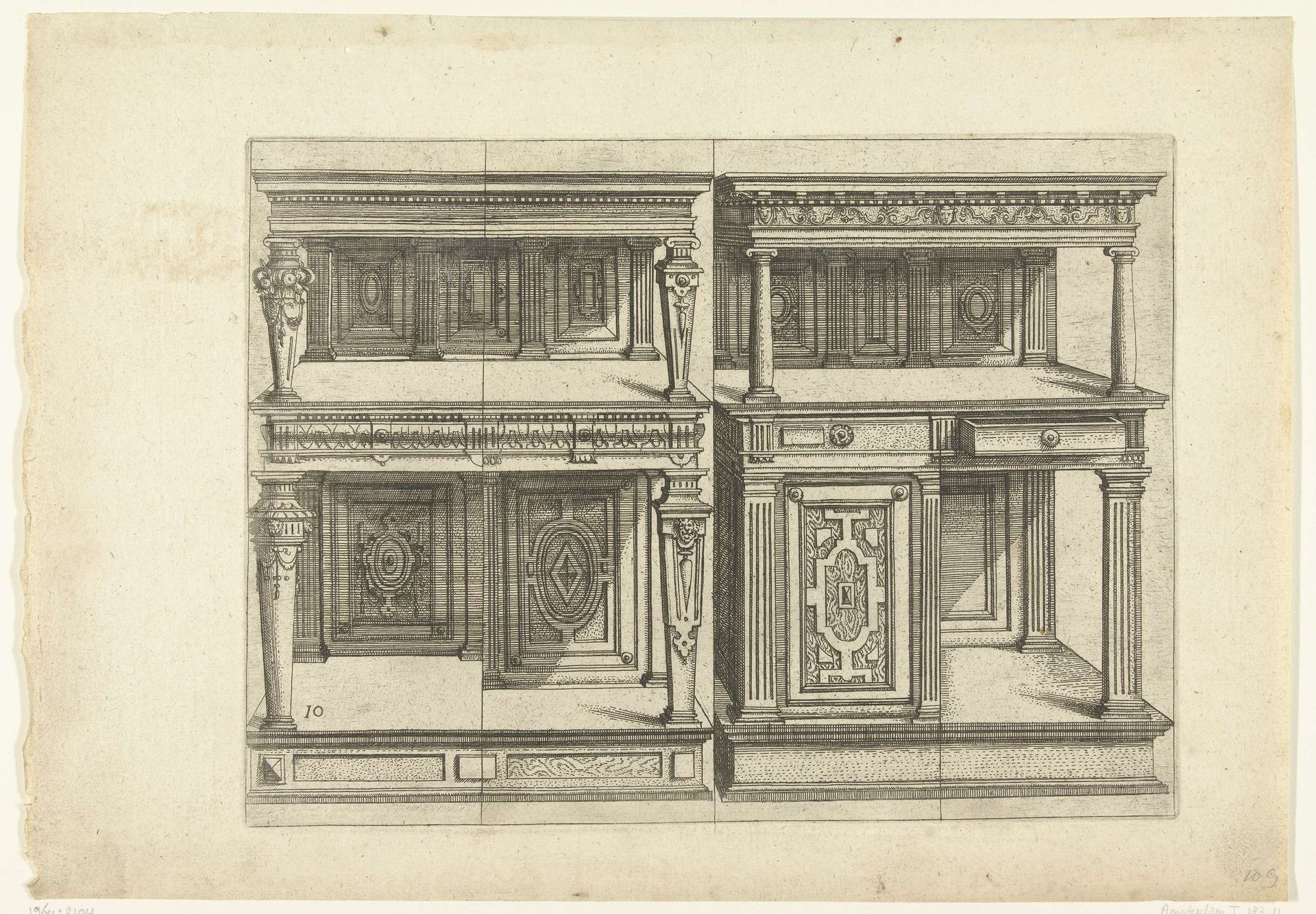
Editor: Here we have Pieter van der Borcht the Elder's "Twee buffetten" from around 1583. It’s an etching, I believe, showcasing two buffets. What strikes me is the almost mathematical precision in the rendering, especially the repeating geometric patterns. How would you interpret this piece? Curator: Precisely. We must observe how Borcht employs line and form to articulate architectural space. The rigid geometry isn't merely representational, it is a calculated arrangement of positive and negative space. The engraving allows for detailed patterns which give us visual cues, yet what does the composition ultimately convey, do you think? Editor: It feels like an exploration of symmetry and balance, but also, given it’s a design for furniture, about function and form working together. The detail feels almost overwhelming, but purposeful. Curator: Notice how the two buffets, while sharing similarities, subtly diverge. These bifurcations prompt the viewer to perform visual comparisons, thereby exposing formal nuances. This subtle disjunction invites an analytical approach; what variations do you discern between the left and the right buffet structures? Editor: The left one feels heavier, with bulkier columns. The right one has more open space underneath, feels airier because of those tall columns, and the drawer adds a practical element which draws the eye. It changes how the geometric shapes are seen. Curator: Precisely. By examining these elements in detail—the columns, panels, and overall spatial relationships—we gain insights into the underlying formal structures governing the artist’s approach. So, we see, form dictates meaning. Editor: That’s interesting. So, focusing on the structure shows us the details we wouldn't see otherwise. Thank you for sharing your expertise! Curator: Indeed. A formal reading unveils the sophisticated interplay of elements constituting artistic expression itself. Thank you for your perspicacity!

Artwork details
- Dimensions
- height 191 mm, width 259 mm
- Location
- Rijksmuseum
- Copyright
- Rijks Museum: Open Domain
Comments
Share your thoughts
About this artwork
Editor: Here we have Pieter van der Borcht the Elder's "Twee buffetten" from around 1583. It’s an etching, I believe, showcasing two buffets. What strikes me is the almost mathematical precision in the rendering, especially the repeating geometric patterns. How would you interpret this piece? Curator: Precisely. We must observe how Borcht employs line and form to articulate architectural space. The rigid geometry isn't merely representational, it is a calculated arrangement of positive and negative space. The engraving allows for detailed patterns which give us visual cues, yet what does the composition ultimately convey, do you think? Editor: It feels like an exploration of symmetry and balance, but also, given it’s a design for furniture, about function and form working together. The detail feels almost overwhelming, but purposeful. Curator: Notice how the two buffets, while sharing similarities, subtly diverge. These bifurcations prompt the viewer to perform visual comparisons, thereby exposing formal nuances. This subtle disjunction invites an analytical approach; what variations do you discern between the left and the right buffet structures? Editor: The left one feels heavier, with bulkier columns. The right one has more open space underneath, feels airier because of those tall columns, and the drawer adds a practical element which draws the eye. It changes how the geometric shapes are seen. Curator: Precisely. By examining these elements in detail—the columns, panels, and overall spatial relationships—we gain insights into the underlying formal structures governing the artist’s approach. So, we see, form dictates meaning. Editor: That’s interesting. So, focusing on the structure shows us the details we wouldn't see otherwise. Thank you for sharing your expertise! Curator: Indeed. A formal reading unveils the sophisticated interplay of elements constituting artistic expression itself. Thank you for your perspicacity!
Comments
Share your thoughts