About this artwork
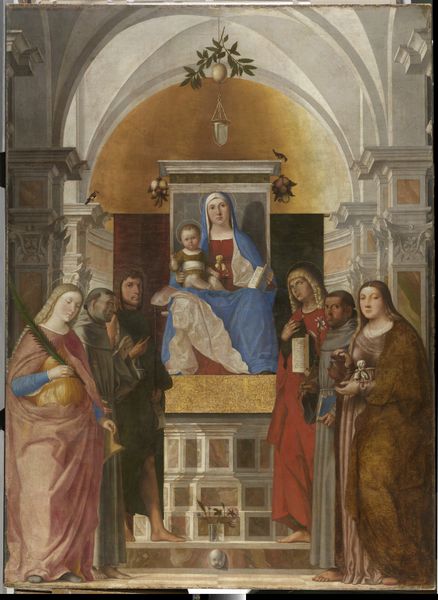
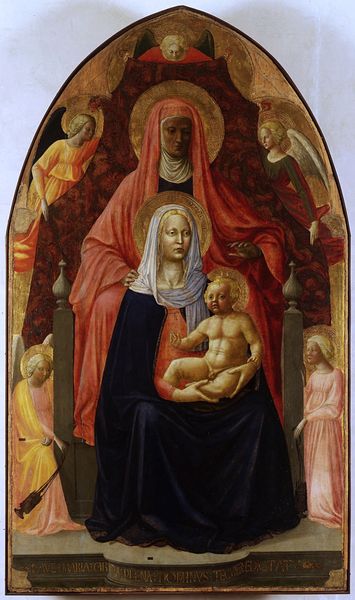
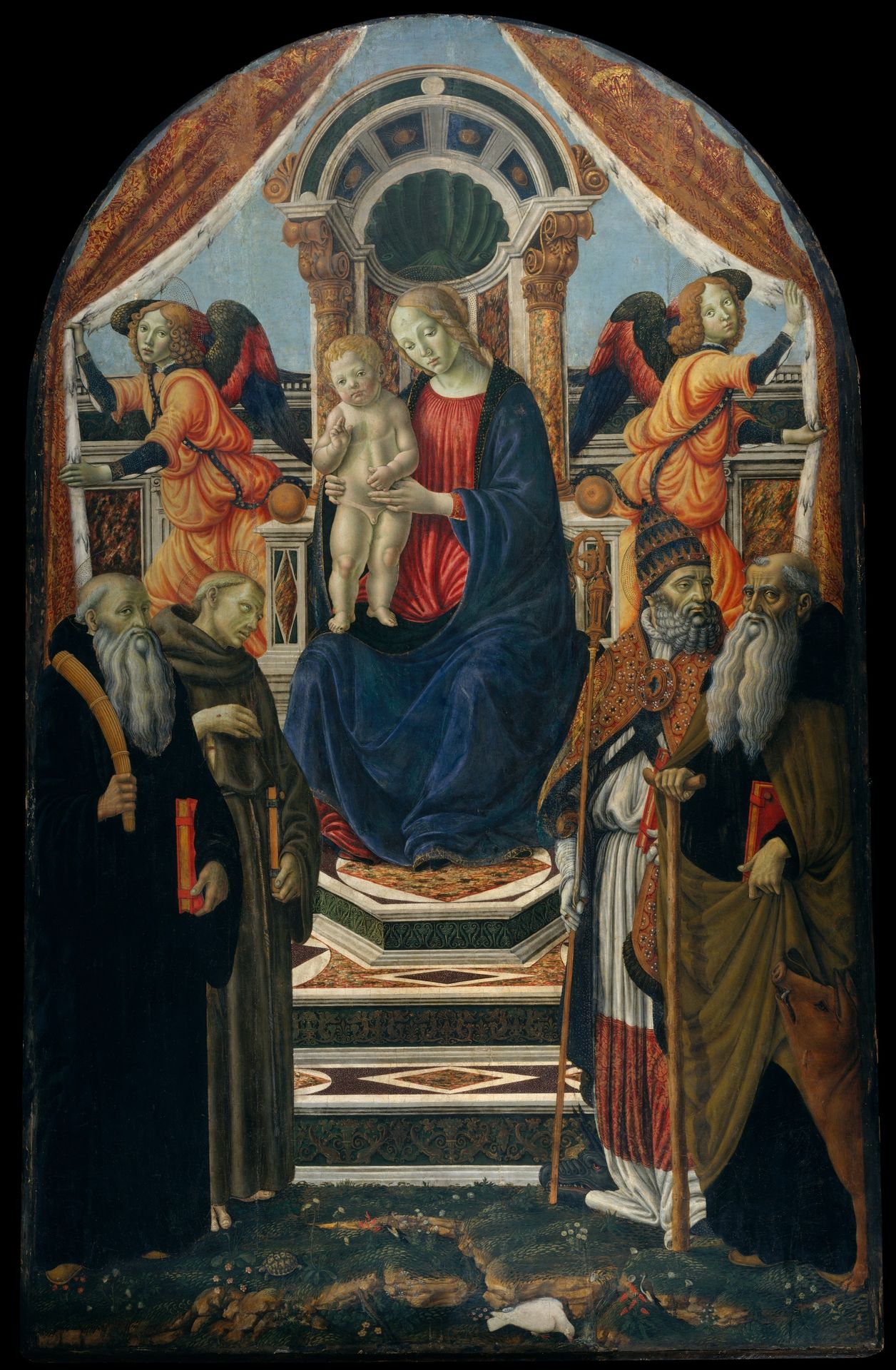
Editor: Here we have Francesco Botticini's "Madonna and Child Enthroned with Saints and Angels," an oil painting that dates back to between 1493 and 1495. The architecture surrounding the Madonna gives the piece an almost stage-like composition. I'm struck by the symmetry. What stands out to you? Curator: Indeed. Observe how the artist structures the space. The lines of the throne lead our eyes to the vanishing point somewhere behind the Virgin’s head. Notice the formal balance: Saints mirrored on either side, angels mimicking each other behind them, and how the drapery adds depth, framing the scene. What do you make of the colour palette Botticini employs? Editor: The reds and blues are so vibrant, really drawing attention to Mary and the Christ child, and contrasting with the earthier tones of the saints' robes. Is that intentional, to create a focal point? Curator: Undeniably. Colour here isn’t merely decorative; it serves a structural purpose. The cool blues of Mary’s robe offset the warmth of the flesh tones and the surrounding colours. Botticini uses colour to define forms, create spatial relationships, and guide our reading of the piece. And what about the surface texture? Does anything strike you? Editor: Now that you mention it, there’s a real attention to detail, especially in the textures of the fabrics and the saints' beards. You can almost feel them. It adds a certain gravitas. Curator: Precisely. And if we consider the relationships between these formal elements - colour, line, texture, balance - what sense can we make of Botticini's intent? Editor: I see now how everything contributes to a sense of harmony and order. It isn’t just a religious scene, but a carefully constructed arrangement of forms and colors. Thanks! Curator: My pleasure. Considering only the pure visuality illuminates how much structure this composition delivers.
Madonna and Child Enthroned with Saints and Angels
1493 - 1495

Francesco Botticini
1446 - 1498
The Metropolitan Museum of Art
Metropolitan Museum of Art, New York, NYArtwork details
- Medium
- painting, oil-paint
- Dimensions
- Arched top, 110 1/2 x 69 in. (280.7 x 175.3 cm)
- Location
- Metropolitan Museum of Art, New York, NY
- Copyright
- Public Domain
Tags
portrait
narrative-art
painting
oil-paint
figuration
madonna
oil painting
child
history-painting
italian-renaissance
early-renaissance
angel
Comments
Be the first to share your thoughts about this work.
About this artwork
Editor: Here we have Francesco Botticini's "Madonna and Child Enthroned with Saints and Angels," an oil painting that dates back to between 1493 and 1495. The architecture surrounding the Madonna gives the piece an almost stage-like composition. I'm struck by the symmetry. What stands out to you? Curator: Indeed. Observe how the artist structures the space. The lines of the throne lead our eyes to the vanishing point somewhere behind the Virgin’s head. Notice the formal balance: Saints mirrored on either side, angels mimicking each other behind them, and how the drapery adds depth, framing the scene. What do you make of the colour palette Botticini employs? Editor: The reds and blues are so vibrant, really drawing attention to Mary and the Christ child, and contrasting with the earthier tones of the saints' robes. Is that intentional, to create a focal point? Curator: Undeniably. Colour here isn’t merely decorative; it serves a structural purpose. The cool blues of Mary’s robe offset the warmth of the flesh tones and the surrounding colours. Botticini uses colour to define forms, create spatial relationships, and guide our reading of the piece. And what about the surface texture? Does anything strike you? Editor: Now that you mention it, there’s a real attention to detail, especially in the textures of the fabrics and the saints' beards. You can almost feel them. It adds a certain gravitas. Curator: Precisely. And if we consider the relationships between these formal elements - colour, line, texture, balance - what sense can we make of Botticini's intent? Editor: I see now how everything contributes to a sense of harmony and order. It isn’t just a religious scene, but a carefully constructed arrangement of forms and colors. Thanks! Curator: My pleasure. Considering only the pure visuality illuminates how much structure this composition delivers.
Comments
Be the first to share your thoughts about this work.