About this artwork
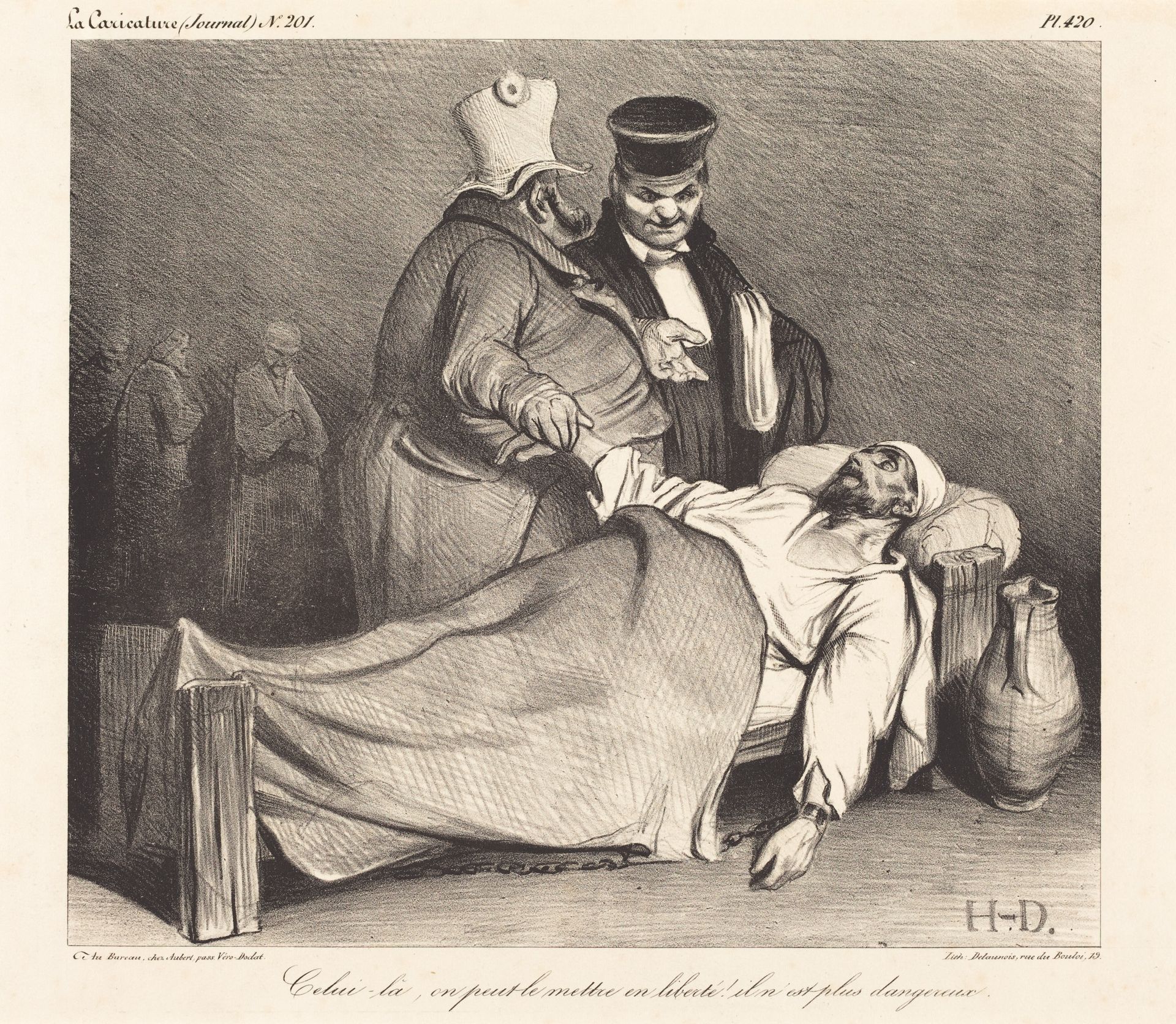
Honoré Daumier created this lithograph, "This one we can set free! He is no longer dangerous!" using ink on paper. The composition stages a stark contrast between the dark, looming figures of authority and the frail, recumbent patient. The lines are dense and cross-hatched, creating a sense of confinement. Daumier critiques societal structures through the semiotics of the image. The doctor and judge, rendered with exaggerated features, stand as symbols of a corrupt establishment, while the patient represents the marginalized. The formal arrangement, with the powerful figures overshadowing the weak, embodies an oppressive system. The lithographic medium itself allows for stark contrasts, mirroring the sharp divisions within society. Daumier's focus on the structural imbalance of the scene underscores a broader discourse on power and social justice. The work serves as a critical commentary, challenging viewers to question the status quo and consider the ethical dimensions of authority.
Celui-la, on peut le mettre en liberté! (This one we can set free! He is no longer dangerous!)
1834


Artwork details
- Medium
- drawing, lithograph, print, pen
- Dimensions
- image: 22.4 x 25.5 cm (8 13/16 x 10 1/16 in.) sheet: 27.6 x 35.9 cm (10 7/8 x 14 1/8 in.)
- Copyright
- National Gallery of Art: CC0 1.0
Tags
Comments
Share your thoughts
About this artwork
Honoré Daumier created this lithograph, "This one we can set free! He is no longer dangerous!" using ink on paper. The composition stages a stark contrast between the dark, looming figures of authority and the frail, recumbent patient. The lines are dense and cross-hatched, creating a sense of confinement. Daumier critiques societal structures through the semiotics of the image. The doctor and judge, rendered with exaggerated features, stand as symbols of a corrupt establishment, while the patient represents the marginalized. The formal arrangement, with the powerful figures overshadowing the weak, embodies an oppressive system. The lithographic medium itself allows for stark contrasts, mirroring the sharp divisions within society. Daumier's focus on the structural imbalance of the scene underscores a broader discourse on power and social justice. The work serves as a critical commentary, challenging viewers to question the status quo and consider the ethical dimensions of authority.
Comments
Share your thoughts