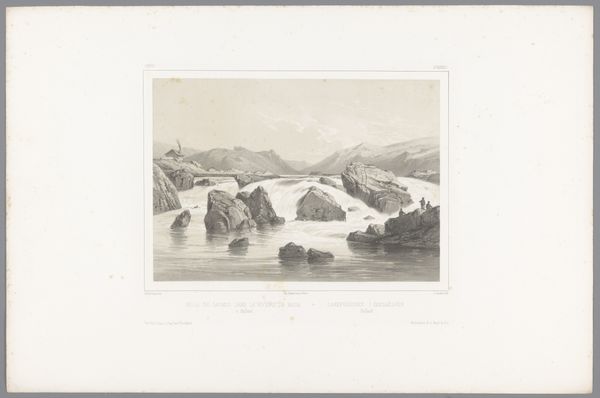
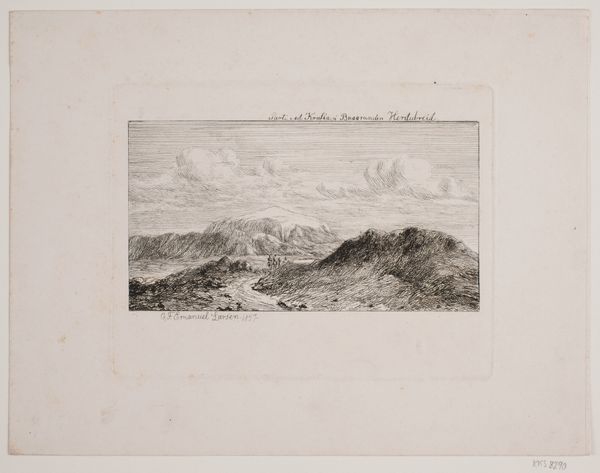
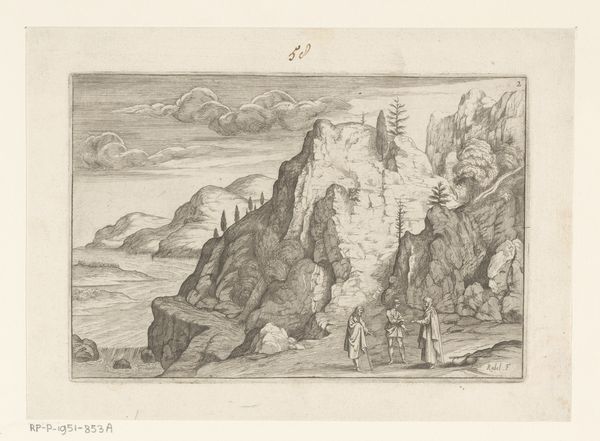
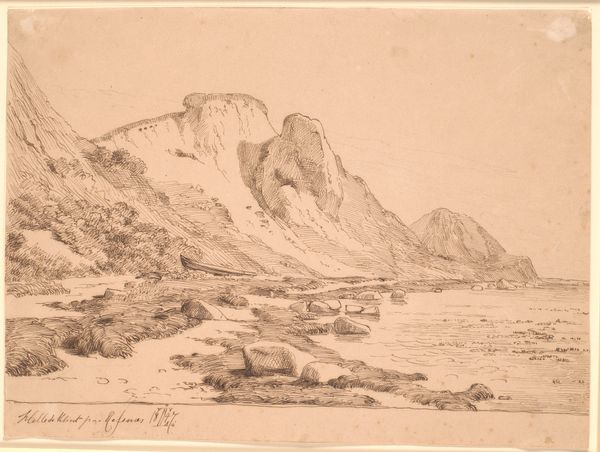
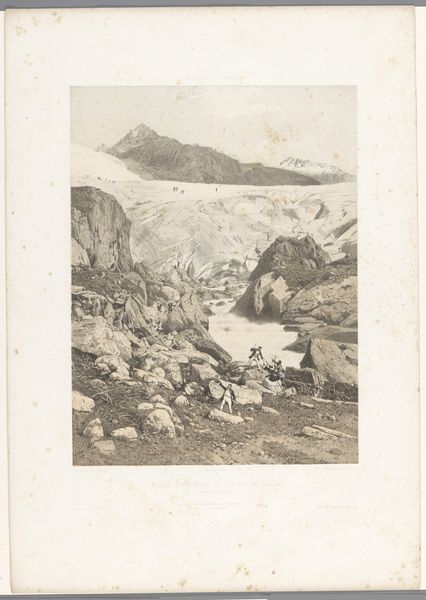
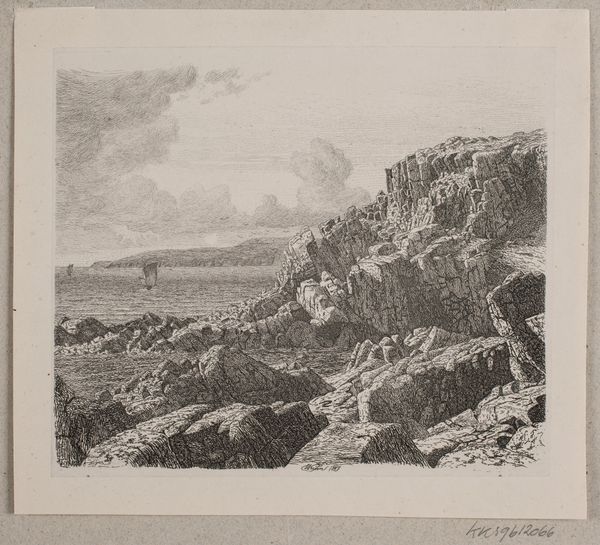
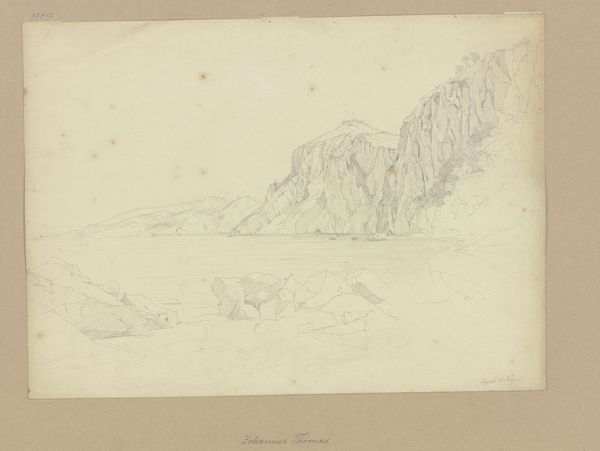
lithograph, print
#
light pencil work
#
quirky sketch
#
lithograph
# print
#
pencil sketch
#
personal sketchbook
#
sketchwork
#
ink drawing experimentation
#
pen-ink sketch
#
sketchbook drawing
#
watercolour illustration
#
sketchbook art
Dimensions: 162 mm (height) x 273 mm (width) (billedmål)
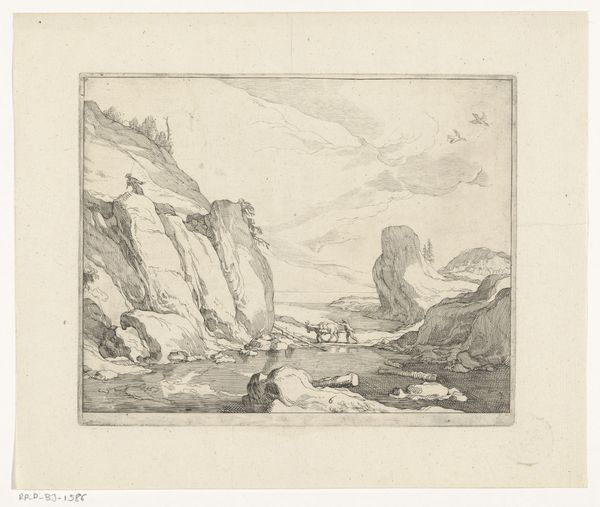
Editor: So, here we have Lars Møller’s lithograph, "KingigtorssuaK kujalîle nunarpâluit," from 1875. The delicate lines and muted tones give it a really serene, almost melancholic feel. What strikes me most is the isolation it conveys. What do you see in this piece? Curator: Beyond the aesthetic beauty, I see a powerful representation of colonialism's impact on Greenland and its people. Møller, as a Danish artist, was capturing a landscape already deeply affected by external forces. Consider the gaze here; whose perspective are we seeing? Is it a neutral observation, or does it carry the weight of colonial power dynamics? The "melancholy" you observe might reflect the imposition of a foreign aesthetic onto an indigenous landscape. Editor: That's a compelling point. I hadn't considered the perspective as potentially loaded. How does that manifest visually? Curator: Look at how the vastness of the landscape dwarfs any potential human presence. It emphasizes a kind of possession, an act of claiming through representation. Whose stories are being told—or silenced—in this seemingly objective depiction? Are the Inuit voices present, or is their relationship with the land filtered through a European lens? This leads to the much wider and urgent contemporary questions about access, exploitation and historical exploitation in places like Greenland. Editor: So, even a seemingly simple landscape print can be a site of complex political and social narratives. That’s a lot to unpack. Curator: Absolutely. By questioning the artist's position and the context in which the work was made, we can uncover the hidden layers of meaning embedded within the image. It’s important to explore how art serves as both a record and a participant in historical processes. Editor: I'll definitely look at landscape art differently from now on. Thanks, that really gave me something to think about! Curator: Indeed! It’s crucial to challenge our assumptions and consider the social and political forces that shape both the creation and the interpretation of art.
Comments
No comments
Be the first to comment and join the conversation on the ultimate creative platform.
 Collect
 React
React Comment
More like this