About this artwork
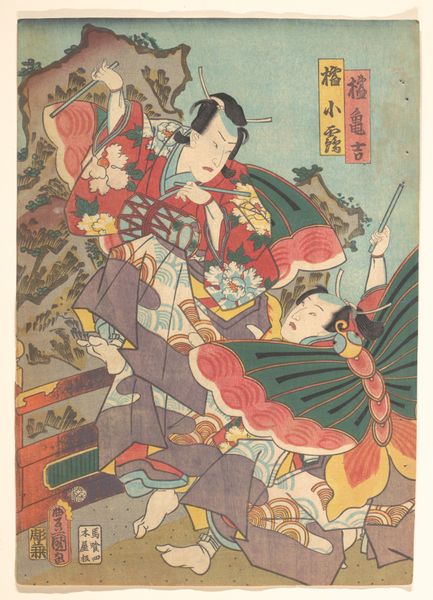
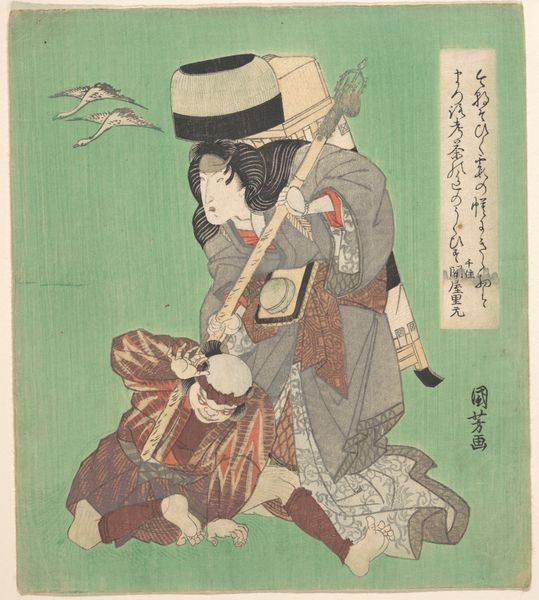
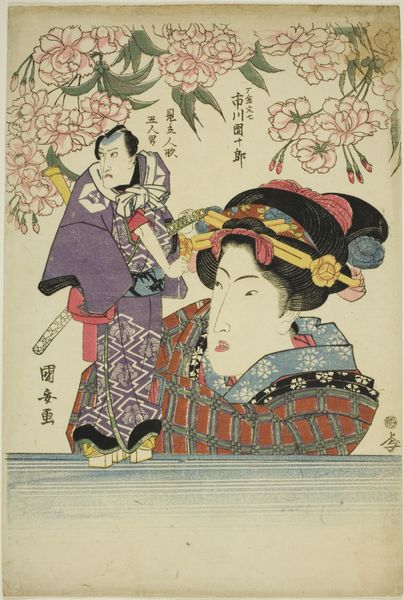
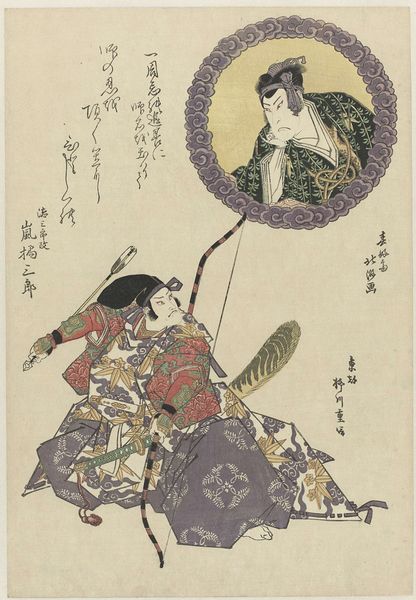
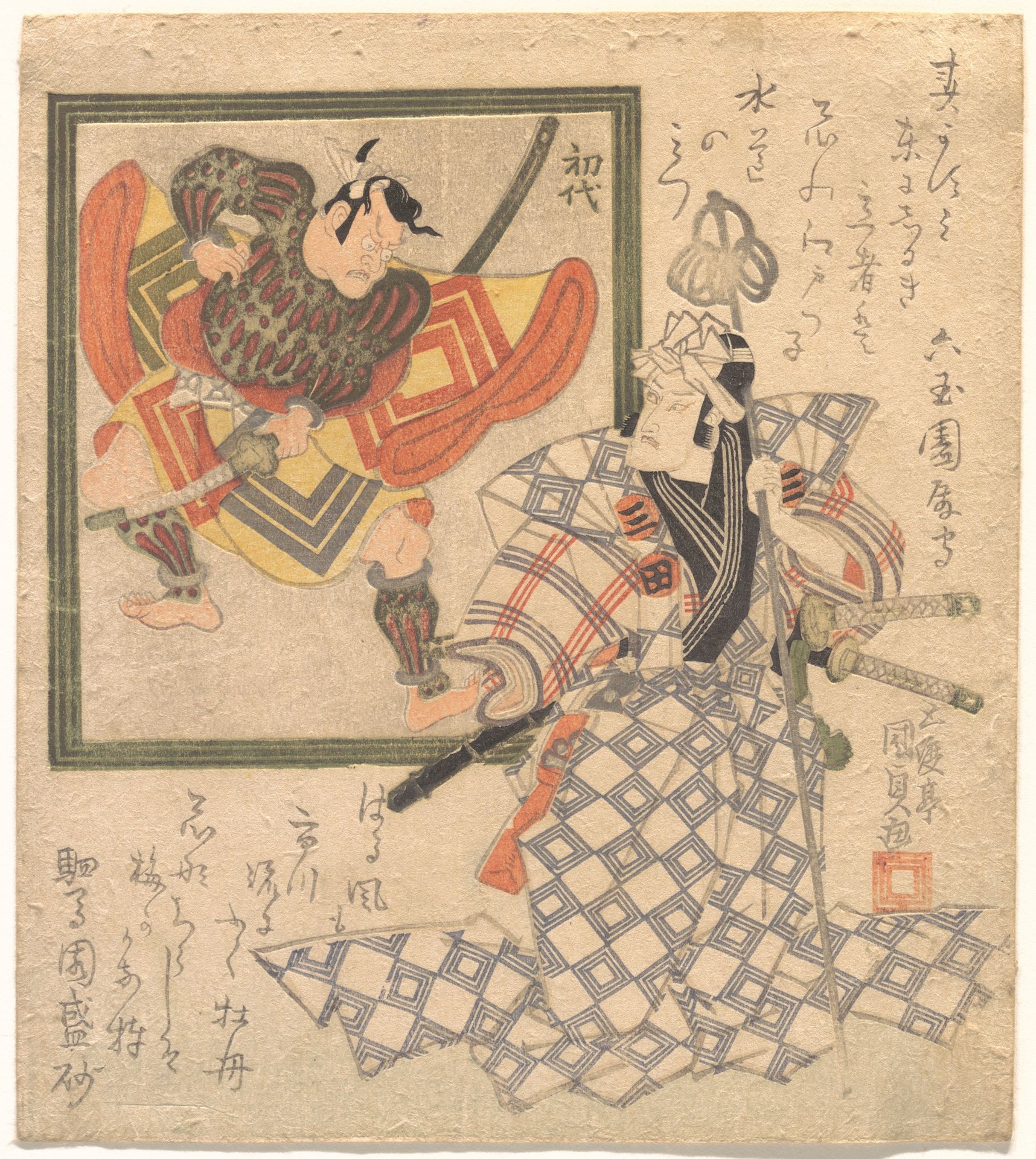
Utagawa Kunisada created this woodblock print, titled "Ichikawa Danjūrō VII Admiring Ichikawa Danjūrō I in an Inset Portrait," to be evocative in its staging. The composition is organized around two contrasting figures: the dynamic, brightly colored image of the first Danjūrō, framed and set against the more subdued, contemplative figure of the seventh. The inset portrait's bold lines and exaggerated features capture a sense of dramatic action, almost leaping off the page. This contrasts sharply with the delicate patterns and restrained palette of the seventh Danjūrō’s kimono, suggesting a reflective stillness. The interplay between these two figures speaks to a complex dialogue between past and present, performance and perception. This contrast destabilizes traditional notions of portraiture, moving beyond simple representation to explore themes of legacy and artistic interpretation. It invites us to consider how the performative aspects of Kabuki theater reflect and shape cultural values, emphasizing that meaning is not fixed but constantly reinterpreted through different lenses.
Ichikawa Danjūrō VII Admiring Ichikawa Danjūrō I in an Inset Portrait
1819


Artwork details
- Medium
- print, woodblock-print
- Dimensions
- 8 1/2 x 7 1/2 in. (21.6 x 19.1 cm)
- Location
- Metropolitan Museum of Art, New York, NY
- Copyright
- Public Domain
Tags
portrait
water colours
ink paper printed
asian-art
ukiyo-e
japan
figuration
linocut print
woodblock-print
genre-painting
Comments
Be the first to share your thoughts about this work.
About this artwork
Utagawa Kunisada created this woodblock print, titled "Ichikawa Danjūrō VII Admiring Ichikawa Danjūrō I in an Inset Portrait," to be evocative in its staging. The composition is organized around two contrasting figures: the dynamic, brightly colored image of the first Danjūrō, framed and set against the more subdued, contemplative figure of the seventh. The inset portrait's bold lines and exaggerated features capture a sense of dramatic action, almost leaping off the page. This contrasts sharply with the delicate patterns and restrained palette of the seventh Danjūrō’s kimono, suggesting a reflective stillness. The interplay between these two figures speaks to a complex dialogue between past and present, performance and perception. This contrast destabilizes traditional notions of portraiture, moving beyond simple representation to explore themes of legacy and artistic interpretation. It invites us to consider how the performative aspects of Kabuki theater reflect and shape cultural values, emphasizing that meaning is not fixed but constantly reinterpreted through different lenses.
Comments
Be the first to share your thoughts about this work.