About this artwork
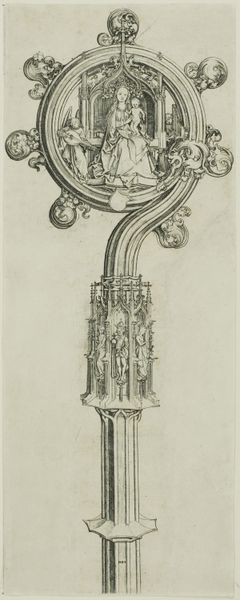
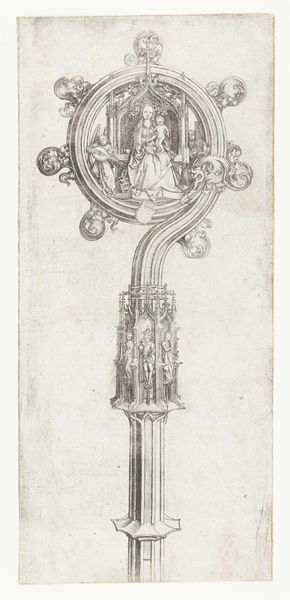
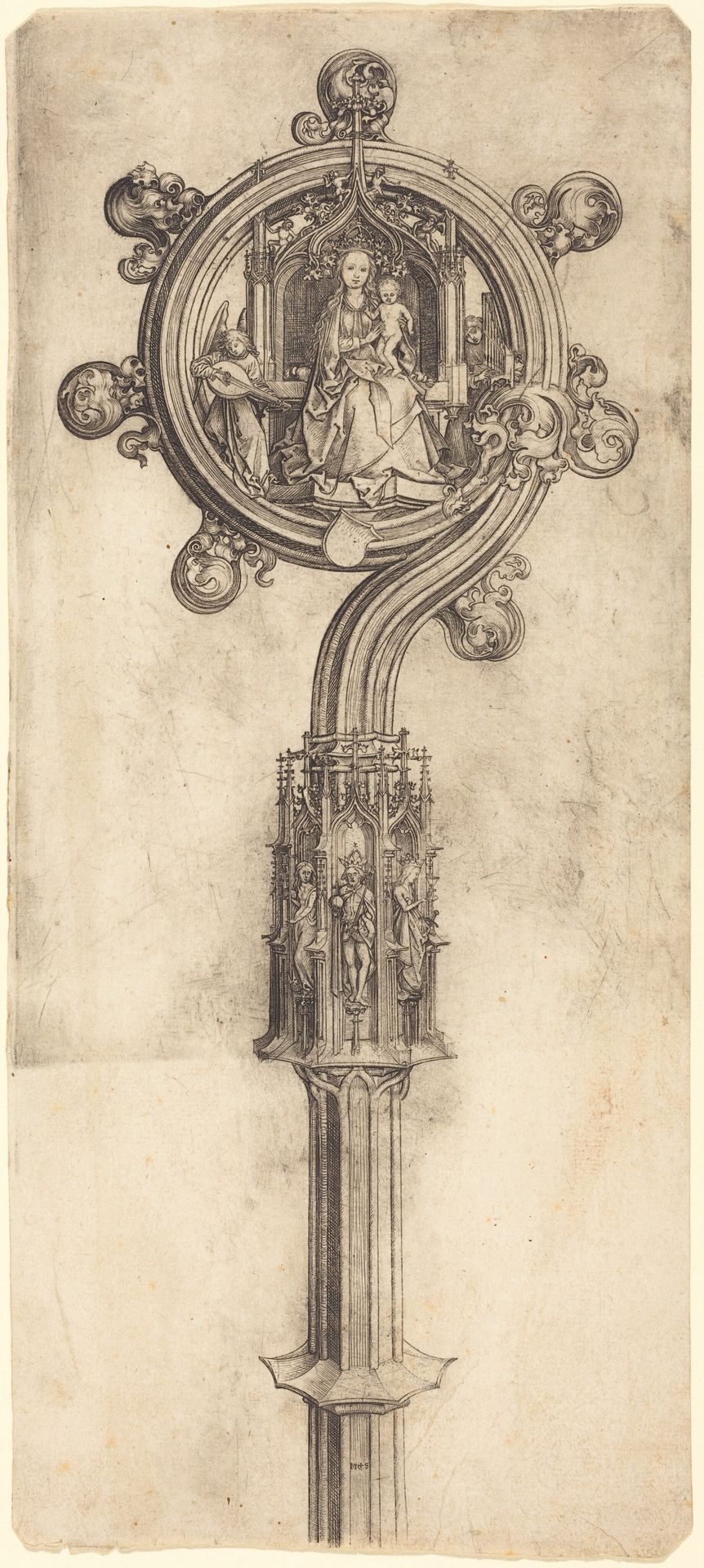
Editor: We're looking at Martin Schongauer's "A Bishop's Crosier," dating back to around 1475-1480. It's an engraving, and the level of detail is astonishing. The printwork forms a complex symbolic form. What do you see when you examine the forms in this engraving? Curator: Initially, the most striking feature is Schongauer's virtuosity with line. The image hinges on that beautiful, curvilinear design. Observe how lines of varying weight and density articulate form and shadow, creating a three-dimensional effect within a two-dimensional plane. Are you struck by the contrast between the solid staff and the circular elements? Editor: I am! The top is circular but highly ornate with a religious scene, and that's on top of a vertical structure. Does the piece's structure hold symbolic value? Curator: Absolutely. The concentric structure is highly important. Focus on the way the inner circle frames the Virgin and Child. Do you perceive how the details amplify and create an inward-spiraling directional effect, guiding the eye to the center and, therefore, to what is valued by the piece itself? Editor: I see what you mean; my eyes really are pulled toward that inner circle. It's quite powerful! I'm going to pay closer attention to how line and shape dictate meaning from now on. Curator: Precisely. The key is recognizing how these elements contribute to the work's formal power and intellectual impact. Remember, visual form precedes emotional impact.
A Bishop's Crosier c. 1475 - 1480


Artwork details
- Medium
- print, intaglio, engraving
- Dimensions
- sheet: 28.8 × 12.7 cm (11 5/16 × 5 in.)
- Copyright
- National Gallery of Art: CC0 1.0
Tags
medieval
intaglio
gothic
figuration
line
engraving
Comments
No comments
About this artwork
Editor: We're looking at Martin Schongauer's "A Bishop's Crosier," dating back to around 1475-1480. It's an engraving, and the level of detail is astonishing. The printwork forms a complex symbolic form. What do you see when you examine the forms in this engraving? Curator: Initially, the most striking feature is Schongauer's virtuosity with line. The image hinges on that beautiful, curvilinear design. Observe how lines of varying weight and density articulate form and shadow, creating a three-dimensional effect within a two-dimensional plane. Are you struck by the contrast between the solid staff and the circular elements? Editor: I am! The top is circular but highly ornate with a religious scene, and that's on top of a vertical structure. Does the piece's structure hold symbolic value? Curator: Absolutely. The concentric structure is highly important. Focus on the way the inner circle frames the Virgin and Child. Do you perceive how the details amplify and create an inward-spiraling directional effect, guiding the eye to the center and, therefore, to what is valued by the piece itself? Editor: I see what you mean; my eyes really are pulled toward that inner circle. It's quite powerful! I'm going to pay closer attention to how line and shape dictate meaning from now on. Curator: Precisely. The key is recognizing how these elements contribute to the work's formal power and intellectual impact. Remember, visual form precedes emotional impact.
Comments
No comments