About this artwork
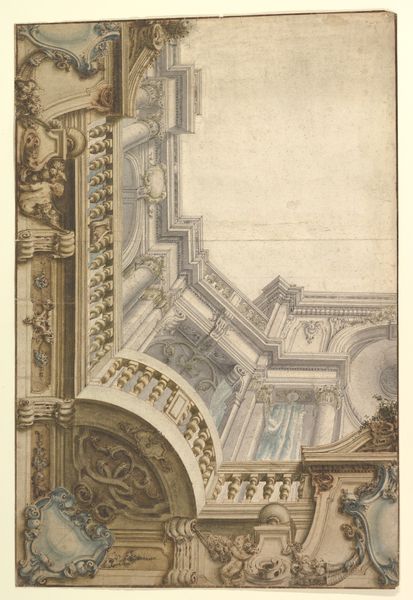
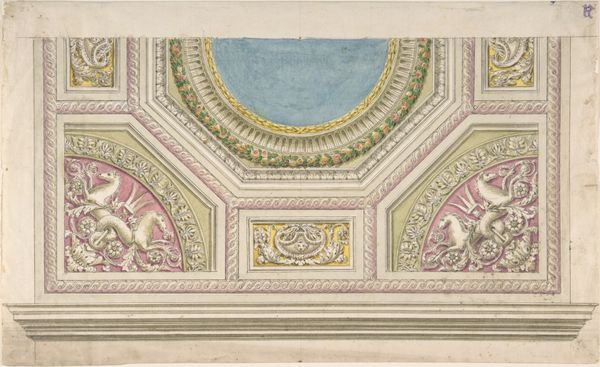
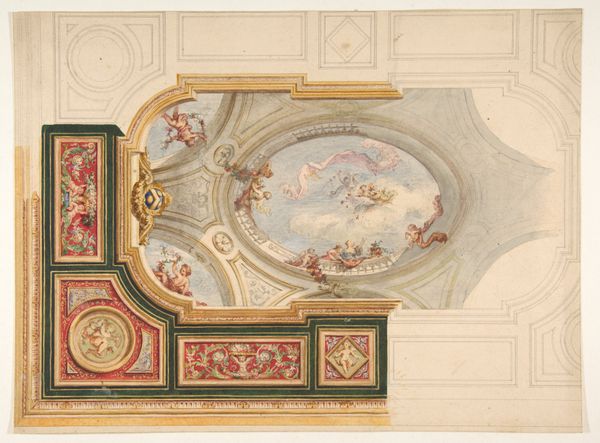
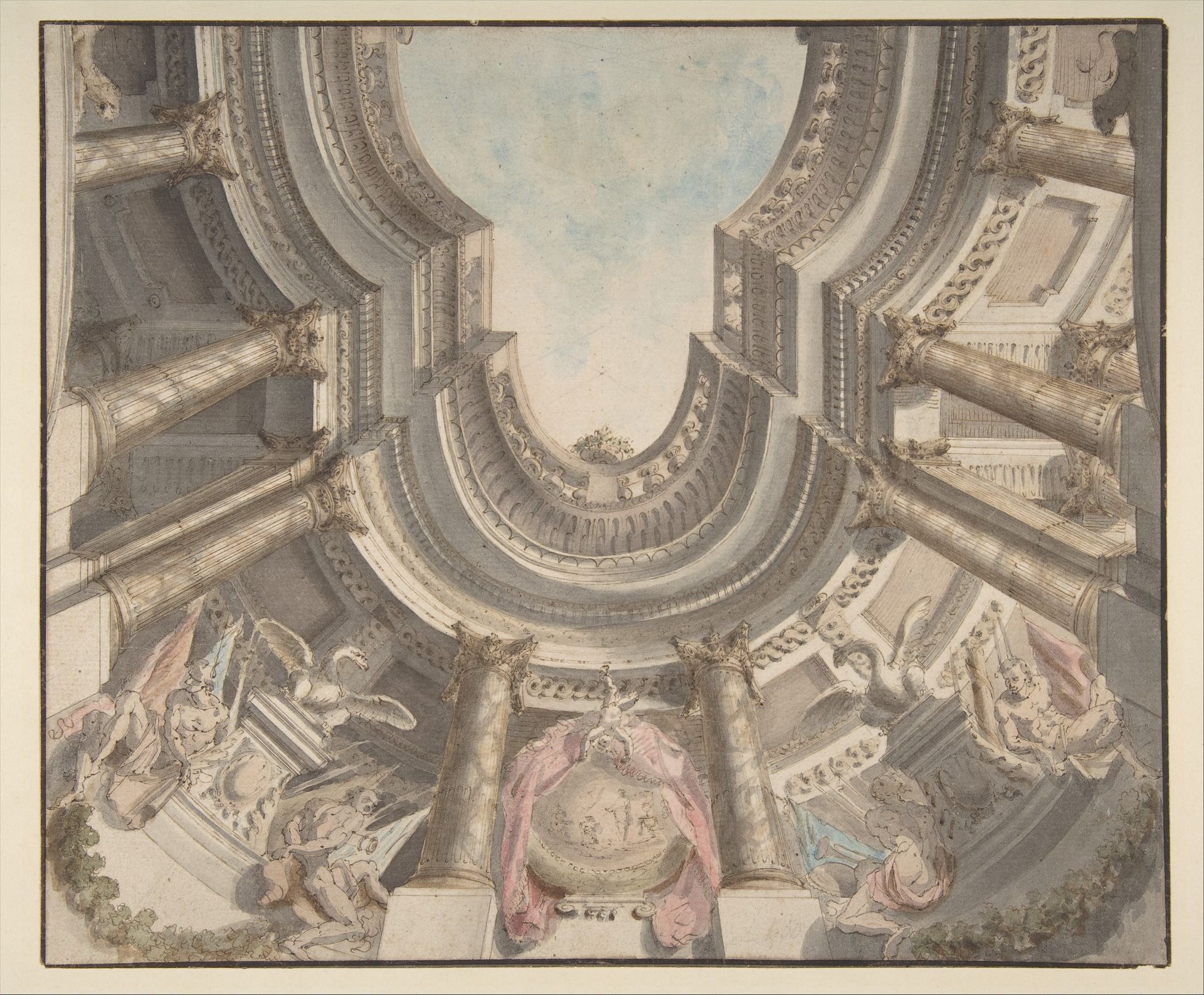
Editor: Here we have Flaminio Innocenzo Minozzi's "Design for a Trompe L'Oeil Ceiling," made sometime between 1750 and 1760. It’s a watercolor and colored pencil drawing, meant to give the *illusion* of a real, incredibly ornate ceiling. It’s kind of dizzying to look at, and really makes me think about how artists can trick our eyes. What strikes you most about it? Curator: It whispers to me of grand deceptions and playful trickery. Trompe l'oeil, a French phrase literally meaning "deceives the eye," aims for the ultimate artistic illusion: to blur the line between what's painted and what's real. The airy lightness of Minozzi's watercolour, combined with his intricate details, really creates the impression of limitless height. Do you feel you could almost float into that painted sky? Editor: Absolutely! The upward perspective is so convincing. Were these types of ceilings common back then? Curator: Immensely! This was the age of Baroque extravagance and aristocratic power. These elaborate ceiling frescoes weren't just decorations; they were statements. They showcased wealth, sophistication, and the power of illusion. Imagine lying beneath it, feeling as though you’re gazing directly into the heavens. Editor: It's almost like performance art, but frozen in paint! Curator: Precisely! It invites a dialogue, a playful interaction between art and viewer, reality and make-believe. Makes you think about our modern-day virtual reality and digital illusions, doesn't it? Editor: It does! Who knew 18th century ceilings had so much in common with the metaverse? I'll definitely be looking at architecture differently now. Curator: Indeed! Minozzi has not just designed a ceiling; he’s composed a stage, a world of wonder waiting to unfold.
Design for a Trompe L'Oeil Ceiling 1750 - 1760

Flaminio Innocenzo Minozzi
1735 - 1817
The Metropolitan Museum of Art
Metropolitan Museum of Art, New York, NYArtwork details
- Medium
- drawing, print, fresco, watercolor
- Dimensions
- 9 15/16 x 11 7/8 in. (25.3 x 30.1 cm)
- Location
- Metropolitan Museum of Art, New York, NY
- Copyright
- Public Domain
Tags
drawing
water colours
allegory
baroque
bird
fresco
watercolor
coloured pencil
cityscape
trompe-l'oeil
academic-art
watercolor
Comments
No comments
About this artwork
Editor: Here we have Flaminio Innocenzo Minozzi's "Design for a Trompe L'Oeil Ceiling," made sometime between 1750 and 1760. It’s a watercolor and colored pencil drawing, meant to give the *illusion* of a real, incredibly ornate ceiling. It’s kind of dizzying to look at, and really makes me think about how artists can trick our eyes. What strikes you most about it? Curator: It whispers to me of grand deceptions and playful trickery. Trompe l'oeil, a French phrase literally meaning "deceives the eye," aims for the ultimate artistic illusion: to blur the line between what's painted and what's real. The airy lightness of Minozzi's watercolour, combined with his intricate details, really creates the impression of limitless height. Do you feel you could almost float into that painted sky? Editor: Absolutely! The upward perspective is so convincing. Were these types of ceilings common back then? Curator: Immensely! This was the age of Baroque extravagance and aristocratic power. These elaborate ceiling frescoes weren't just decorations; they were statements. They showcased wealth, sophistication, and the power of illusion. Imagine lying beneath it, feeling as though you’re gazing directly into the heavens. Editor: It's almost like performance art, but frozen in paint! Curator: Precisely! It invites a dialogue, a playful interaction between art and viewer, reality and make-believe. Makes you think about our modern-day virtual reality and digital illusions, doesn't it? Editor: It does! Who knew 18th century ceilings had so much in common with the metaverse? I'll definitely be looking at architecture differently now. Curator: Indeed! Minozzi has not just designed a ceiling; he’s composed a stage, a world of wonder waiting to unfold.
Comments
No comments