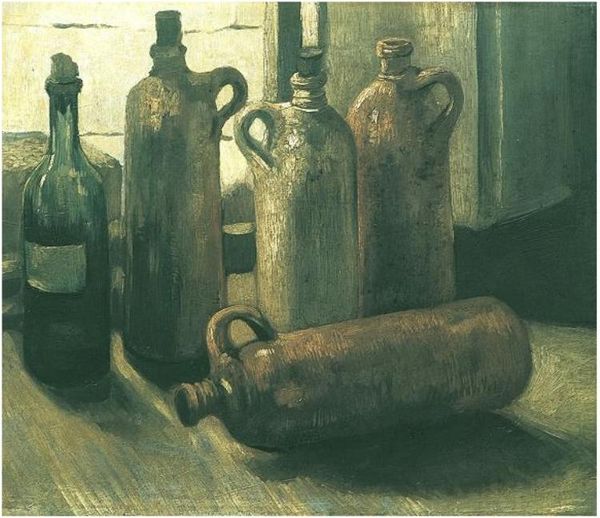
painting, oil-paint, impasto
#
still-life
#
painting
#
oil-paint
#
impasto
#
post-impressionism
Copyright: Public domain
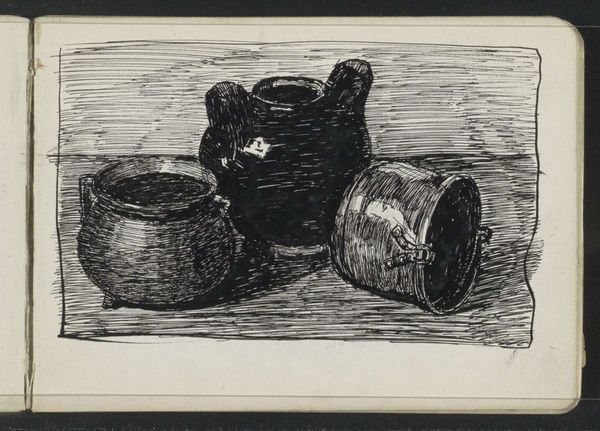
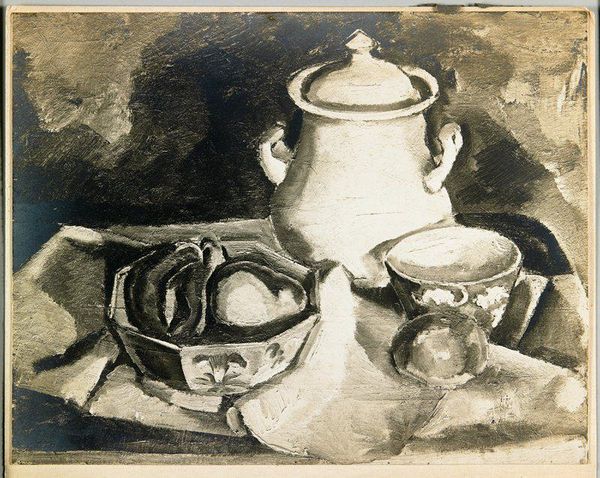
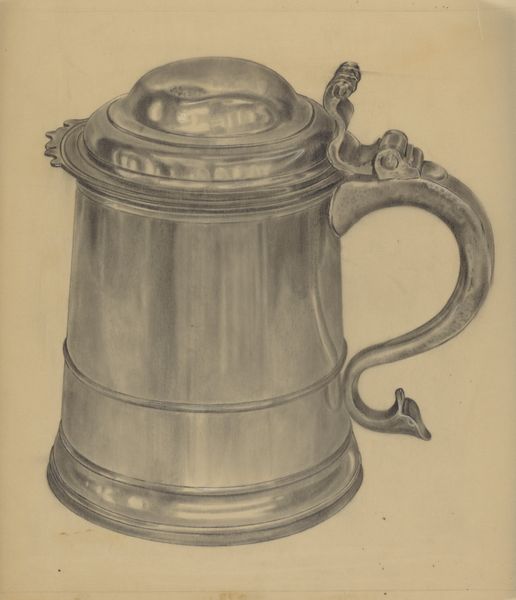
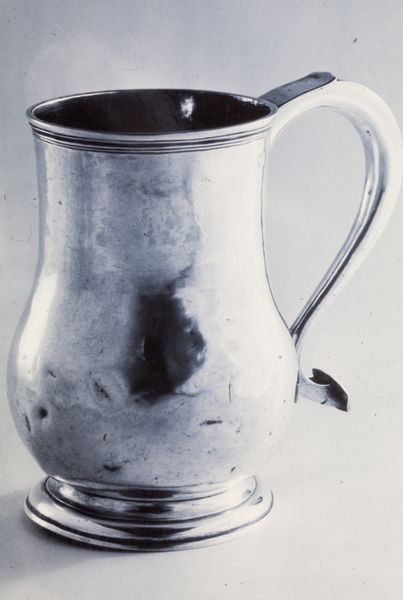
Editor: So, here we have Van Gogh's "Beer Tankards," painted in 1885 using oil paint, employing what looks like a very thick impasto technique. It feels a little melancholic to me, with its dark palette and the somewhat scattered composition of the objects. What strikes you when you look at this painting? Curator: Primarily, I'm drawn to the dynamic interplay of forms. The stout cylindrical shapes of the tankards are contrasted by the varying angles at which they're presented – upright, tilted, even seemingly overturned. Consider the horizontal banding which segments each vessel; do you perceive how this generates a sense of rhythm and variation? Editor: I do. It's almost as if each tankard is communicating something different, or perhaps has a unique presence. Are you also drawn to the materiality of the paint itself? Curator: Precisely. Van Gogh's bold application of paint is not merely representational but structural. Each stroke articulates form and light, simultaneously revealing the object and the artist’s process. Observe how light glances across the ridges of paint, defining volume through texture. Is this consistent throughout the painting, would you say? Editor: Yes, although it's subtle. So, we see how Van Gogh, even in a seemingly simple still life, explores complex relationships between form, texture, and the act of painting itself. Curator: Exactly. The painting's power rests in its capacity to explore the intrinsic qualities of its composition and the artist’s technique. By considering the painting as an arrangement of forms and textures, we appreciate Van Gogh's innovative exploration of visual language. Editor: I now perceive Van Gogh’s expressive intent, not just through what is represented, but how it's presented using paint and composition. Thank you.
Comments
No comments
Be the first to comment and join the conversation on the ultimate creative platform.
 Collect
 React
React Comment
More like this