About this artwork
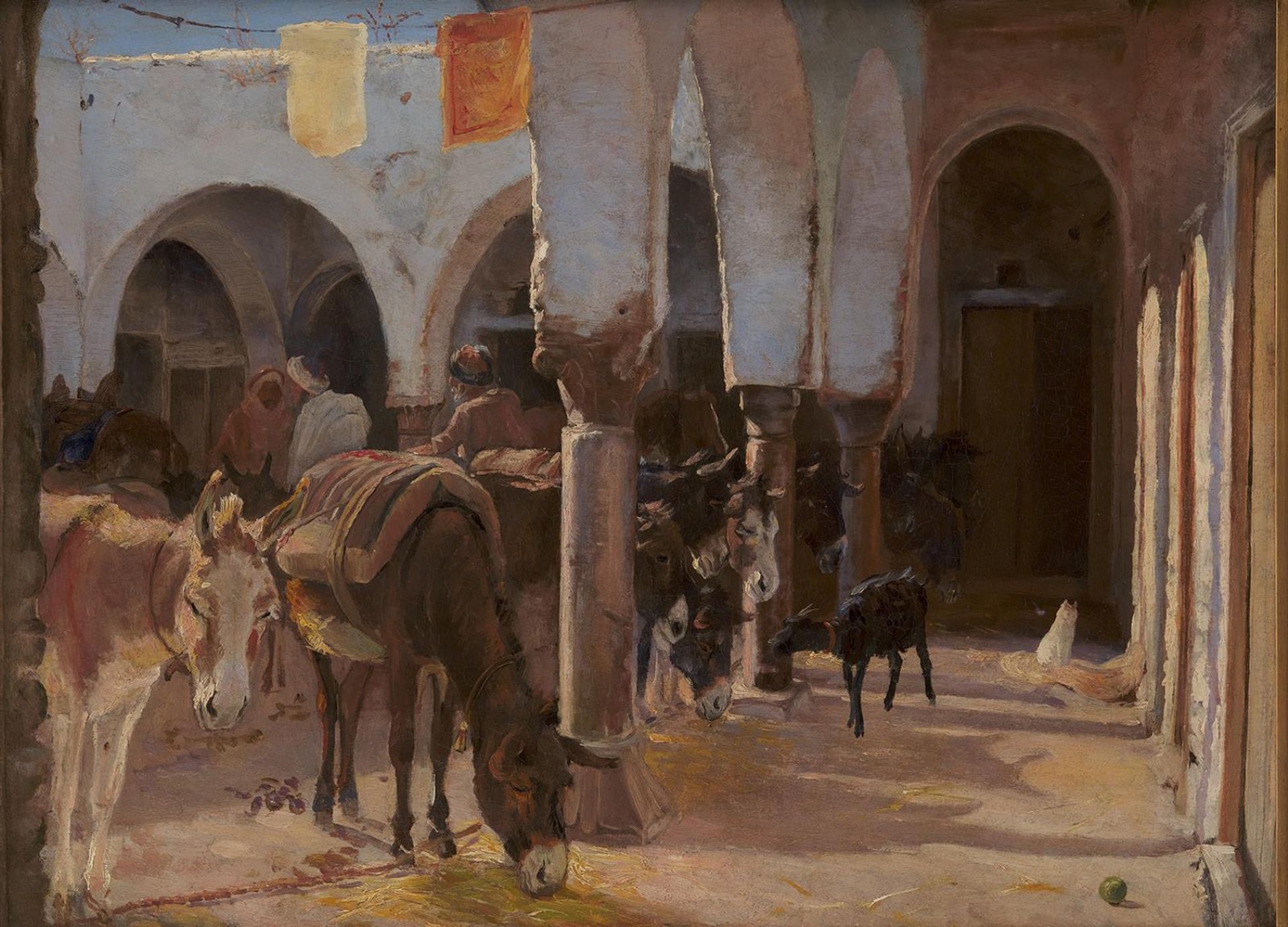
Theodor Philipsen painted “A Donkey House in Tunis”, an oil painting that offers a glimpse into a North African stable, during a time of increasing European colonial influence. Philipsen, a Danish artist, traveled to Tunisia, then a French protectorate. His travels reflect Europe’s fascination with North Africa, often romanticized in art, but also used to justify colonial expansion. In this light-filled courtyard, donkeys stand among local figures, evoking a sense of everyday life. However, this image exists within the complex history of cultural exchange and power dynamics. Philipsen, as a European artist, captures a scene that also represents the colonial gaze, raising questions about representation and authenticity. While the painting captures a specific time and place, it prompts reflection on the complex interplay of cultures and the representation of "otherness." This portrayal invites us to consider the nuanced layers of cultural interaction and the emotional weight of history.
A Donkey House in Tunis
1882


Artwork details
- Medium
- painting, plein-air, oil-paint
- Dimensions
- 40 cm (height) x 53 cm (width) (Netto), 58 cm (height) x 71.5 cm (width) x 6.8 cm (depth) (Brutto)
- Location
- SMK - Statens Museum for Kunst
Tags
Comments
Share your thoughts
About this artwork
Theodor Philipsen painted “A Donkey House in Tunis”, an oil painting that offers a glimpse into a North African stable, during a time of increasing European colonial influence. Philipsen, a Danish artist, traveled to Tunisia, then a French protectorate. His travels reflect Europe’s fascination with North Africa, often romanticized in art, but also used to justify colonial expansion. In this light-filled courtyard, donkeys stand among local figures, evoking a sense of everyday life. However, this image exists within the complex history of cultural exchange and power dynamics. Philipsen, as a European artist, captures a scene that also represents the colonial gaze, raising questions about representation and authenticity. While the painting captures a specific time and place, it prompts reflection on the complex interplay of cultures and the representation of "otherness." This portrayal invites us to consider the nuanced layers of cultural interaction and the emotional weight of history.
Comments
Share your thoughts