About this artwork
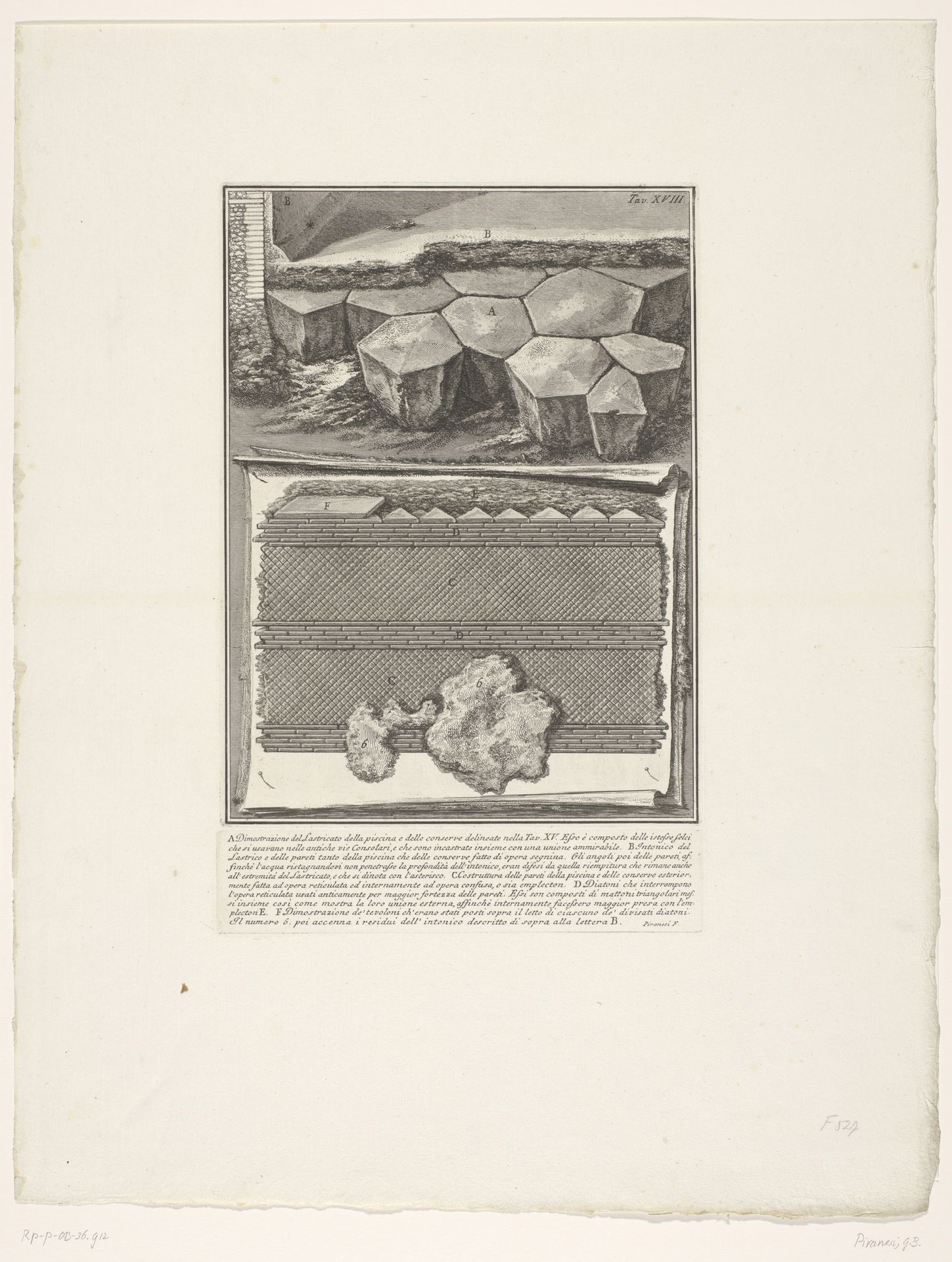
Giovanni Battista Piranesi rendered this print, "Vloer van een waterreservoir in de Albaanse Heuvels", likely in the mid-18th century. The polygonal stonework of the reservoir floor immediately strikes us, echoing ancient foundations—a testament to enduring construction. Consider how similar geometric forms appear across cultures, from the cyclopean walls of Mycenae to Incan architecture, each bearing witness to human attempts to impose order upon the natural world. In our collective memory, stone foundations symbolize stability and permanence, yet they also remind us of time's relentless passage, eroding even the most formidable structures. Piranesi's detailed rendering engages our subconscious, evoking a sense of awe and perhaps a touch of melancholy. The reservoir floor, with its promise of sustenance and life, lies in ruins, a powerful memento mori reflecting the cyclical nature of civilization itself. This motif, like the phoenix, rises, falls, and is reborn across historical epochs, endlessly repurposed and reimagined.
Vloer van een waterreservoir in de Albaanse Heuvels
1762

Giovanni Battista Piranesi
1720 - 1778Location
RijksmuseumArtwork details
- Medium
- drawing, print, metal, etching, engraving, architecture
- Dimensions
- height 307 mm, width 228 mm, height 49 mm, width 230 mm
- Location
- Rijksmuseum
- Copyright
- Rijks Museum: Open Domain
Tags
Comments
Share your thoughts
About this artwork
Giovanni Battista Piranesi rendered this print, "Vloer van een waterreservoir in de Albaanse Heuvels", likely in the mid-18th century. The polygonal stonework of the reservoir floor immediately strikes us, echoing ancient foundations—a testament to enduring construction. Consider how similar geometric forms appear across cultures, from the cyclopean walls of Mycenae to Incan architecture, each bearing witness to human attempts to impose order upon the natural world. In our collective memory, stone foundations symbolize stability and permanence, yet they also remind us of time's relentless passage, eroding even the most formidable structures. Piranesi's detailed rendering engages our subconscious, evoking a sense of awe and perhaps a touch of melancholy. The reservoir floor, with its promise of sustenance and life, lies in ruins, a powerful memento mori reflecting the cyclical nature of civilization itself. This motif, like the phoenix, rises, falls, and is reborn across historical epochs, endlessly repurposed and reimagined.
Comments
Share your thoughts