About this artwork
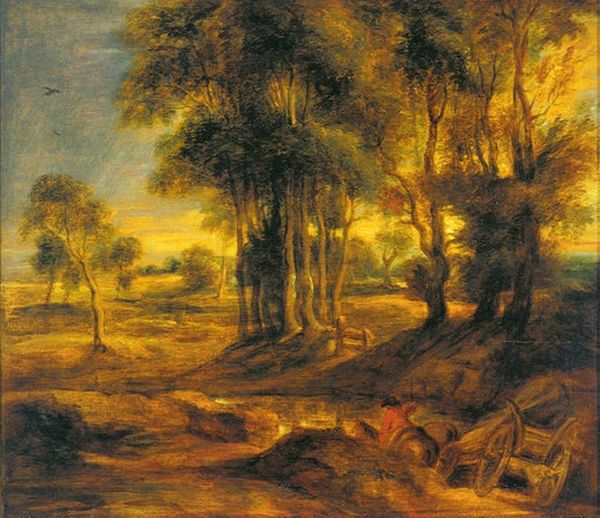
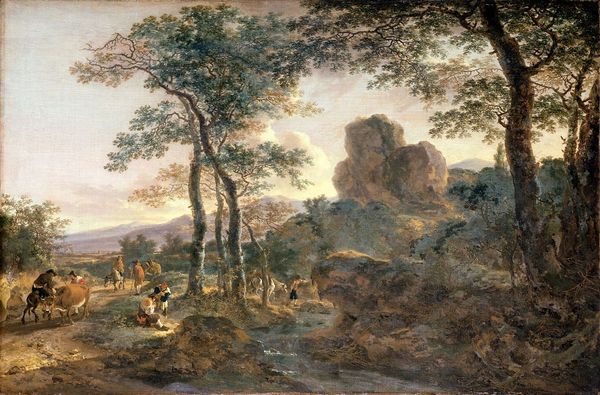
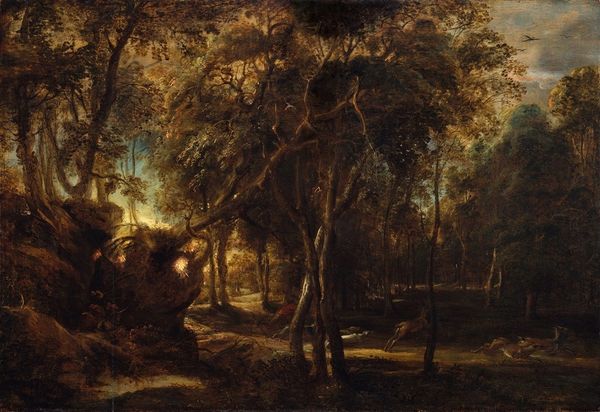
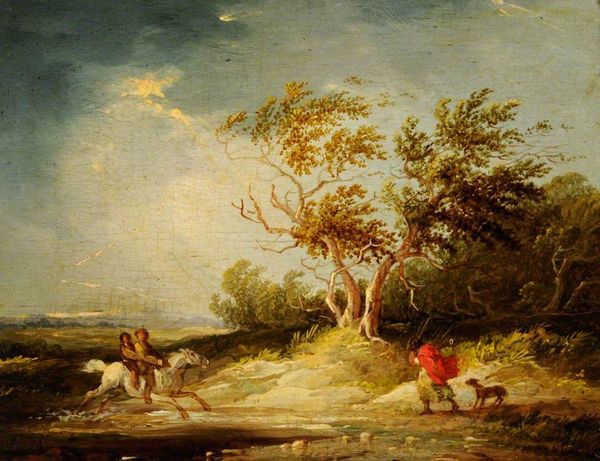
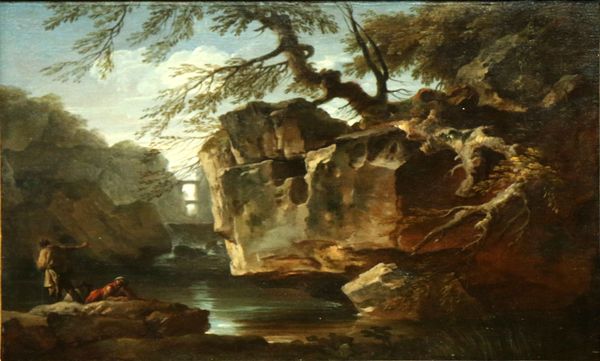
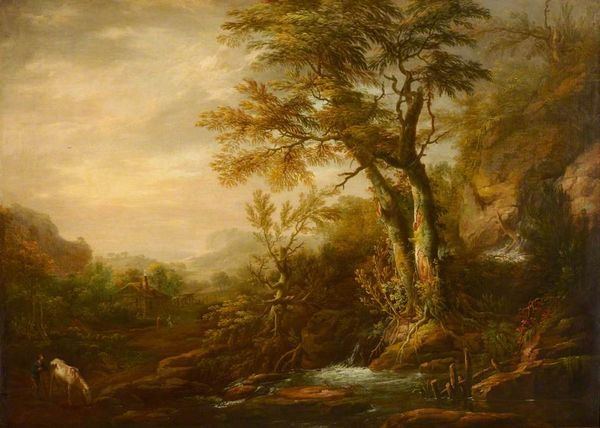
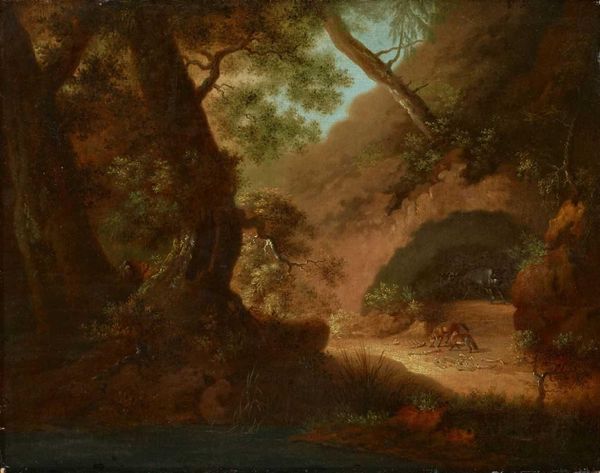
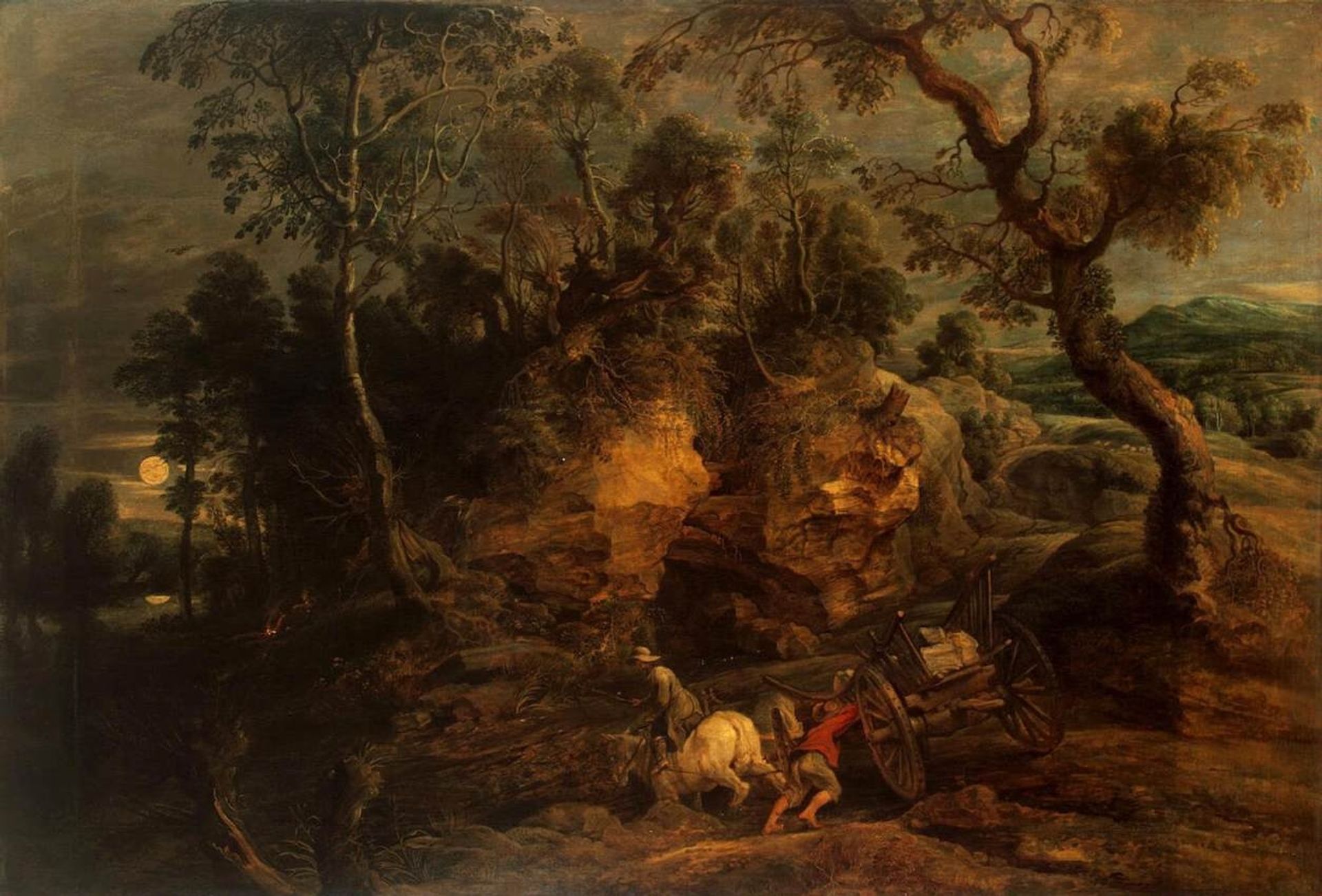
Curator: Here we have Peter Paul Rubens’ "Landscape with Stone Carriers," executed in oil on canvas around 1620. Editor: It's striking how the light focuses your gaze. I’m immediately drawn to that cart laboriously pulled along in contrast to the moon’s soft glow in the distance. Curator: The composition indeed plays with contrasts. Note the dynamic diagonals, how they create a visual rhythm that keeps the eye moving. The juxtaposition of light and shadow accentuates the raw materiality of the landscape, typical of the Baroque style. Editor: I agree. Rubens wasn't just painting a landscape; he was portraying the human drama of labor. We should contextualize this within the social history of 17th-century Flanders where such labor shaped landscapes and communities. I think the history here emphasizes a clear visual relationship between the aristocratic patronage of the artist and the world he's depicting here, even though it appears bucolic and distanced. Curator: And notice the interplay between figuration and setting, where even landscape becomes a stage to explore themes of genre painting. It moves beyond simple mimesis, achieving a grander expression of the relationships within nature. The figures exist within it. Editor: Exactly! And the inclusion of history painting elevates what might simply be a mundane, common task. One can appreciate its connection to the political theater where even landscape bears traces of authority and labor, as well as wealth. Curator: Agreed, that interweaving creates resonance, giving what could simply be brushstrokes greater complexity through implied meaning and artistic agency. Editor: Absolutely. Understanding the visual cues that were culturally symbolic adds more insight to the emotional subtexts in Ruben's rendering here. Curator: Studying it under that interpretation is a compelling approach; this experience illuminates new dimensions in considering formal beauty! Editor: Indeed! Considering its complex contexts, you now understand how paintings offer unique perspectives and hold greater social and political importance.
Landscape with Stone Carriers 1620


Artwork details
- Medium
- oil-paint
- Dimensions
- 86 x 127 cm
- Location
- Hermitage Museum, Saint Petersburg, Russia
- Copyright
- Public domain
Tags
baroque
oil-paint
landscape
figuration
genre-painting
history-painting
Comments
No comments
About this artwork
Curator: Here we have Peter Paul Rubens’ "Landscape with Stone Carriers," executed in oil on canvas around 1620. Editor: It's striking how the light focuses your gaze. I’m immediately drawn to that cart laboriously pulled along in contrast to the moon’s soft glow in the distance. Curator: The composition indeed plays with contrasts. Note the dynamic diagonals, how they create a visual rhythm that keeps the eye moving. The juxtaposition of light and shadow accentuates the raw materiality of the landscape, typical of the Baroque style. Editor: I agree. Rubens wasn't just painting a landscape; he was portraying the human drama of labor. We should contextualize this within the social history of 17th-century Flanders where such labor shaped landscapes and communities. I think the history here emphasizes a clear visual relationship between the aristocratic patronage of the artist and the world he's depicting here, even though it appears bucolic and distanced. Curator: And notice the interplay between figuration and setting, where even landscape becomes a stage to explore themes of genre painting. It moves beyond simple mimesis, achieving a grander expression of the relationships within nature. The figures exist within it. Editor: Exactly! And the inclusion of history painting elevates what might simply be a mundane, common task. One can appreciate its connection to the political theater where even landscape bears traces of authority and labor, as well as wealth. Curator: Agreed, that interweaving creates resonance, giving what could simply be brushstrokes greater complexity through implied meaning and artistic agency. Editor: Absolutely. Understanding the visual cues that were culturally symbolic adds more insight to the emotional subtexts in Ruben's rendering here. Curator: Studying it under that interpretation is a compelling approach; this experience illuminates new dimensions in considering formal beauty! Editor: Indeed! Considering its complex contexts, you now understand how paintings offer unique perspectives and hold greater social and political importance.
Comments
No comments