About this artwork
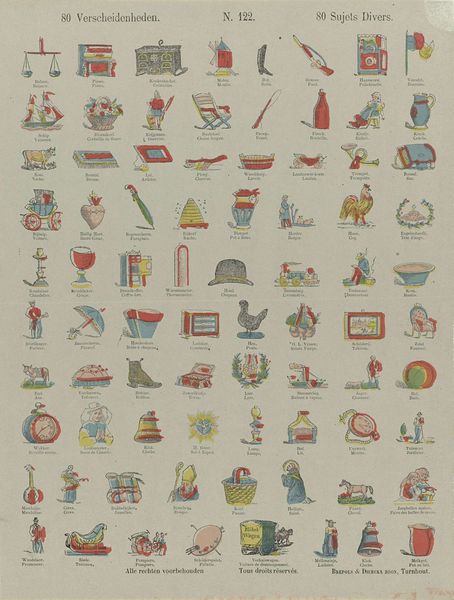
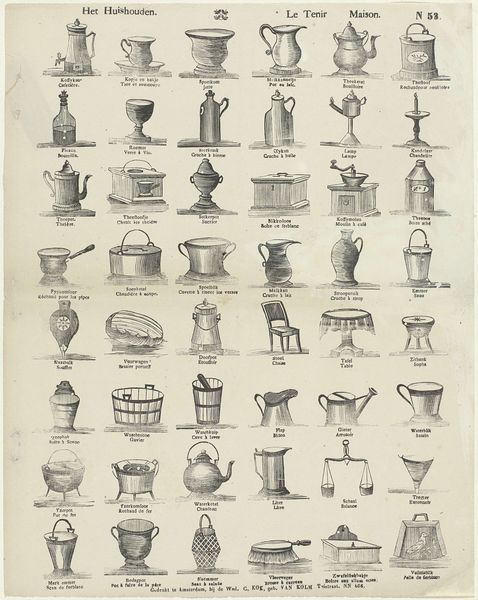
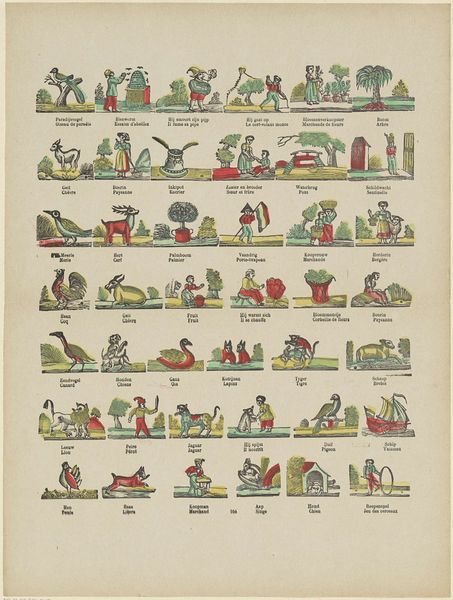
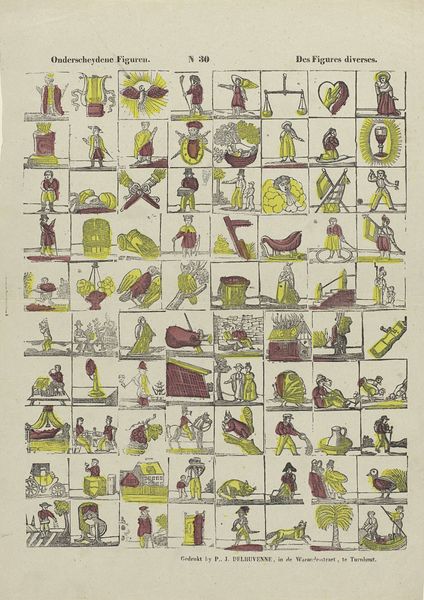
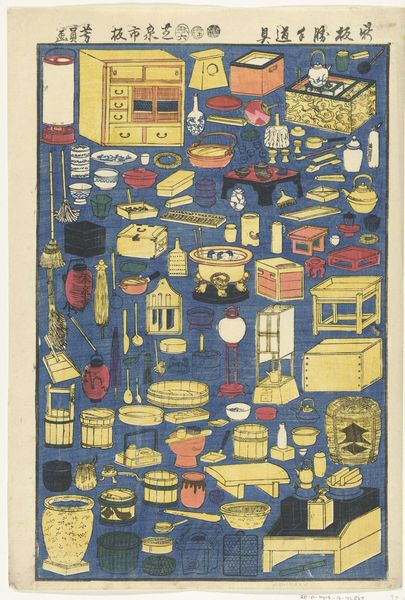
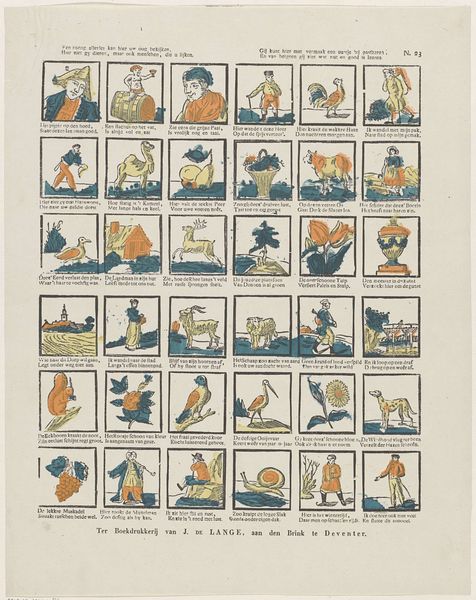
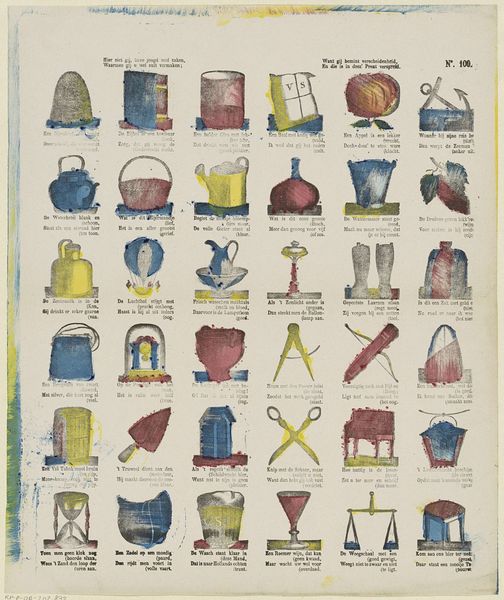
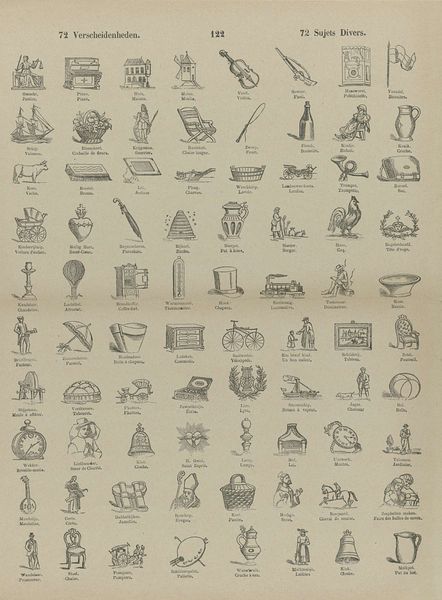
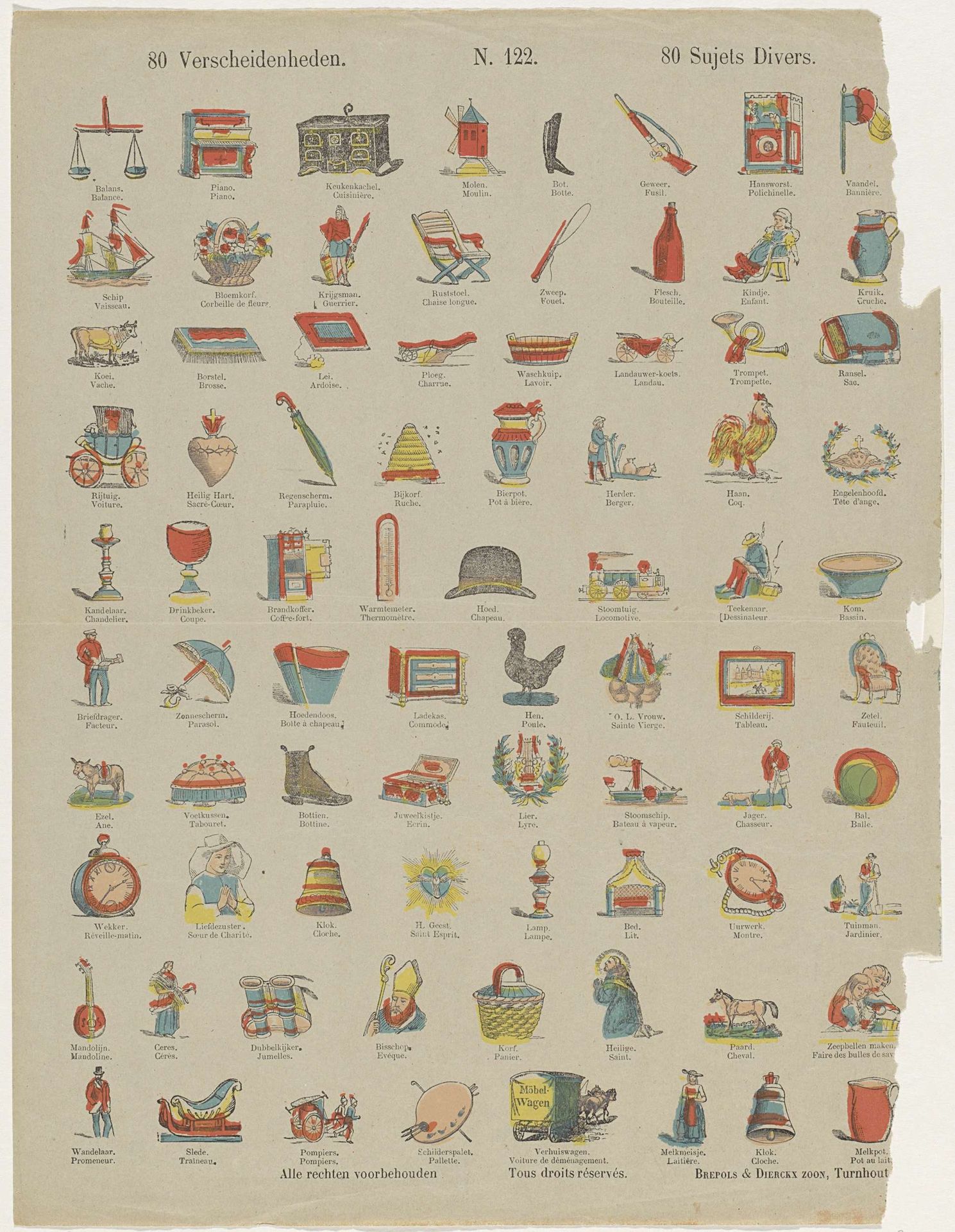
This print titled '80 Verscheidenheden / 80 Sujets divers' was created by Brepols & Dierckx Zoon, in Turnhout, Belgium. It presents a diverse collection of everyday objects, animals, and figures, rendered in a style reminiscent of children’s book illustrations. Prints like this provide a fascinating window into the material culture and visual language of their time. The careful arrangement and depiction of these "80 varieties" likely speak to the growing industrialization and consumer culture of 19th-century Europe. The dual titles in both Dutch and French suggest a society navigating its own multilingualism and multiculturalism, as does the rather eclectic range of the objects depicted. It also hints at Belgium’s complex history and its position as a crossroads of European cultures. The very act of cataloging and illustrating these subjects points to a desire to classify and understand the world. To truly understand this print, one might turn to trade catalogs, social histories of childhood, or even studies of early advertising and marketing. The meaning of this image is always contingent on the social and institutional contexts in which it was made and received.
80 Verscheidenheden / 80 Sujets divers
1833 - 1911

Brepols & Dierckx zoon
@brepolsdierckxzoonLocation
RijksmuseumArtwork details
- Medium
- graphic-art, print
- Dimensions
- height 390 mm, width 299 mm
- Location
- Rijksmuseum
- Copyright
- Rijks Museum: Open Domain
Tags
graphic-art
comic strip
figuration
genre-painting
decorative-art
Comments
Be the first to share your thoughts about this work.
About this artwork
This print titled '80 Verscheidenheden / 80 Sujets divers' was created by Brepols & Dierckx Zoon, in Turnhout, Belgium. It presents a diverse collection of everyday objects, animals, and figures, rendered in a style reminiscent of children’s book illustrations. Prints like this provide a fascinating window into the material culture and visual language of their time. The careful arrangement and depiction of these "80 varieties" likely speak to the growing industrialization and consumer culture of 19th-century Europe. The dual titles in both Dutch and French suggest a society navigating its own multilingualism and multiculturalism, as does the rather eclectic range of the objects depicted. It also hints at Belgium’s complex history and its position as a crossroads of European cultures. The very act of cataloging and illustrating these subjects points to a desire to classify and understand the world. To truly understand this print, one might turn to trade catalogs, social histories of childhood, or even studies of early advertising and marketing. The meaning of this image is always contingent on the social and institutional contexts in which it was made and received.
Comments
Be the first to share your thoughts about this work.