About this artwork
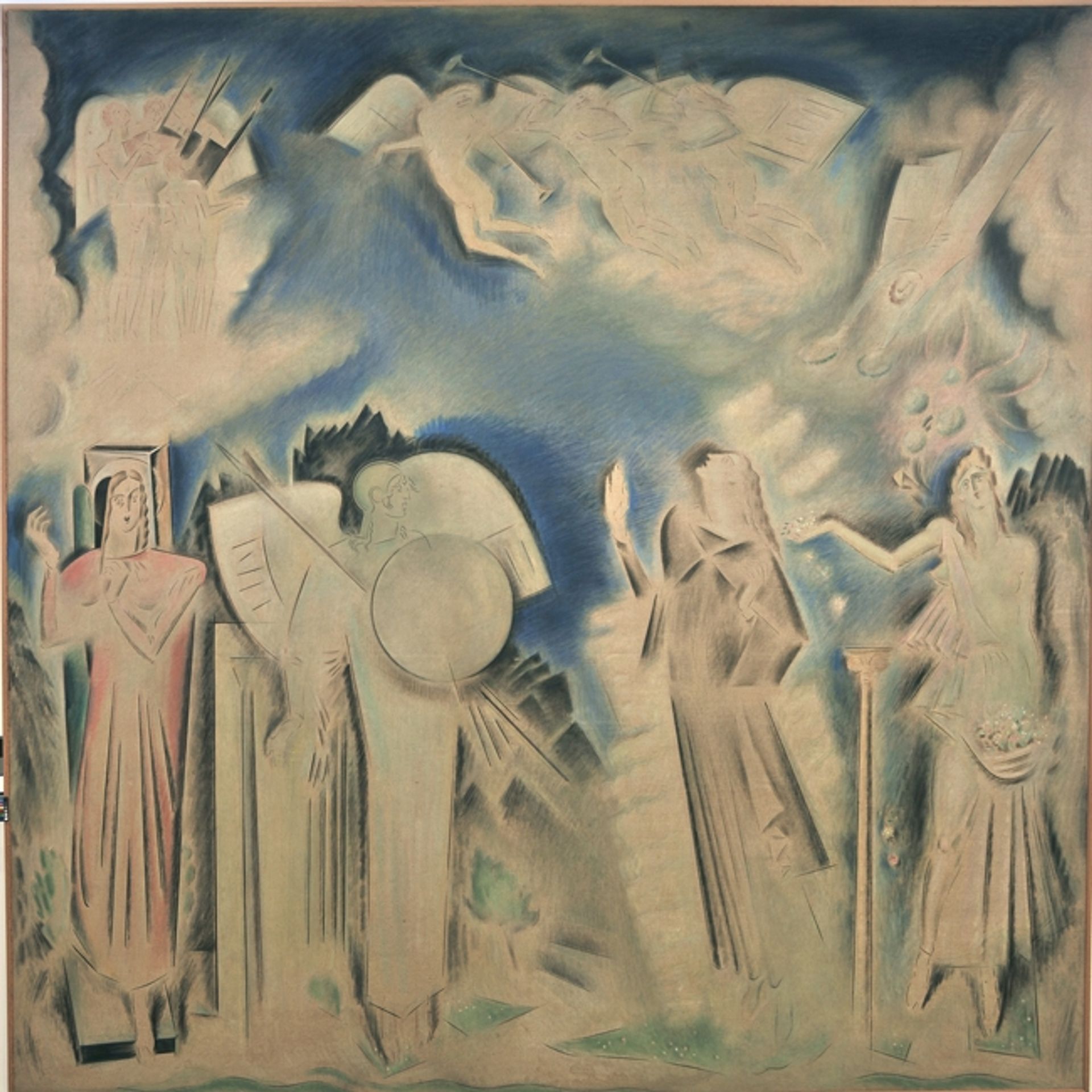
Konstantinos Parthenis made "The Apotheosis of Athanasios Diakos" with oil on canvas, and it feels like he’s scraping away at the surface as much as he's building it up. The palette is really restrained, almost like a faded fresco, with these muted blues and soft grays that give the whole thing a ghostly feel. I’m drawn to the way the figures are rendered, they're so linear and simplified, almost like architectural drawings. There's this figure on the left in a pinkish robe, and the way the fabric is described with these long, straight lines, it's so stylized. I love how this contrasts with the more ethereal, cloud-like forms in the upper part of the canvas. It's as if he's trying to bridge the earthly and the divine through these different modes of representation. Parthenis’s work reminds me of Puvis de Chavannes, but with a more modern sensibility. Both artists have this interest in creating these timeless, allegorical scenes, but Parthenis brings a certain angularity and abstraction to the table that feels very much of his time. Ultimately, this painting is about creating an atmosphere, a space for contemplation, rather than telling a straightforward story.
The Apotheosis of Athanasios Diakos
1933

Konstantinos Parthenis
1878 - 1967Location
National Art Gallery (Alexandros Soutzos Museum), Athens, GreeceArtwork details
- Dimensions
- 380 x 380 cm
- Location
- National Art Gallery (Alexandros Soutzos Museum), Athens, Greece
- Copyright
- Konstantinos Parthenis,Fair Use
Comments
Share your thoughts
About this artwork
Konstantinos Parthenis made "The Apotheosis of Athanasios Diakos" with oil on canvas, and it feels like he’s scraping away at the surface as much as he's building it up. The palette is really restrained, almost like a faded fresco, with these muted blues and soft grays that give the whole thing a ghostly feel. I’m drawn to the way the figures are rendered, they're so linear and simplified, almost like architectural drawings. There's this figure on the left in a pinkish robe, and the way the fabric is described with these long, straight lines, it's so stylized. I love how this contrasts with the more ethereal, cloud-like forms in the upper part of the canvas. It's as if he's trying to bridge the earthly and the divine through these different modes of representation. Parthenis’s work reminds me of Puvis de Chavannes, but with a more modern sensibility. Both artists have this interest in creating these timeless, allegorical scenes, but Parthenis brings a certain angularity and abstraction to the table that feels very much of his time. Ultimately, this painting is about creating an atmosphere, a space for contemplation, rather than telling a straightforward story.
Comments
Share your thoughts