About this artwork
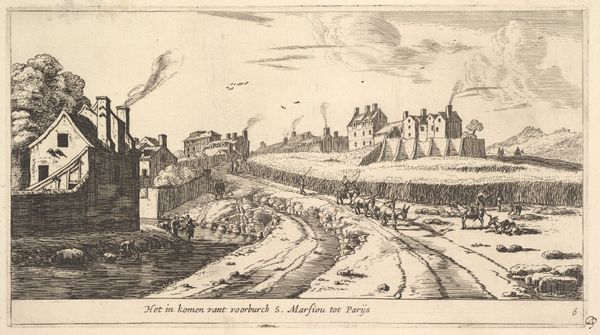
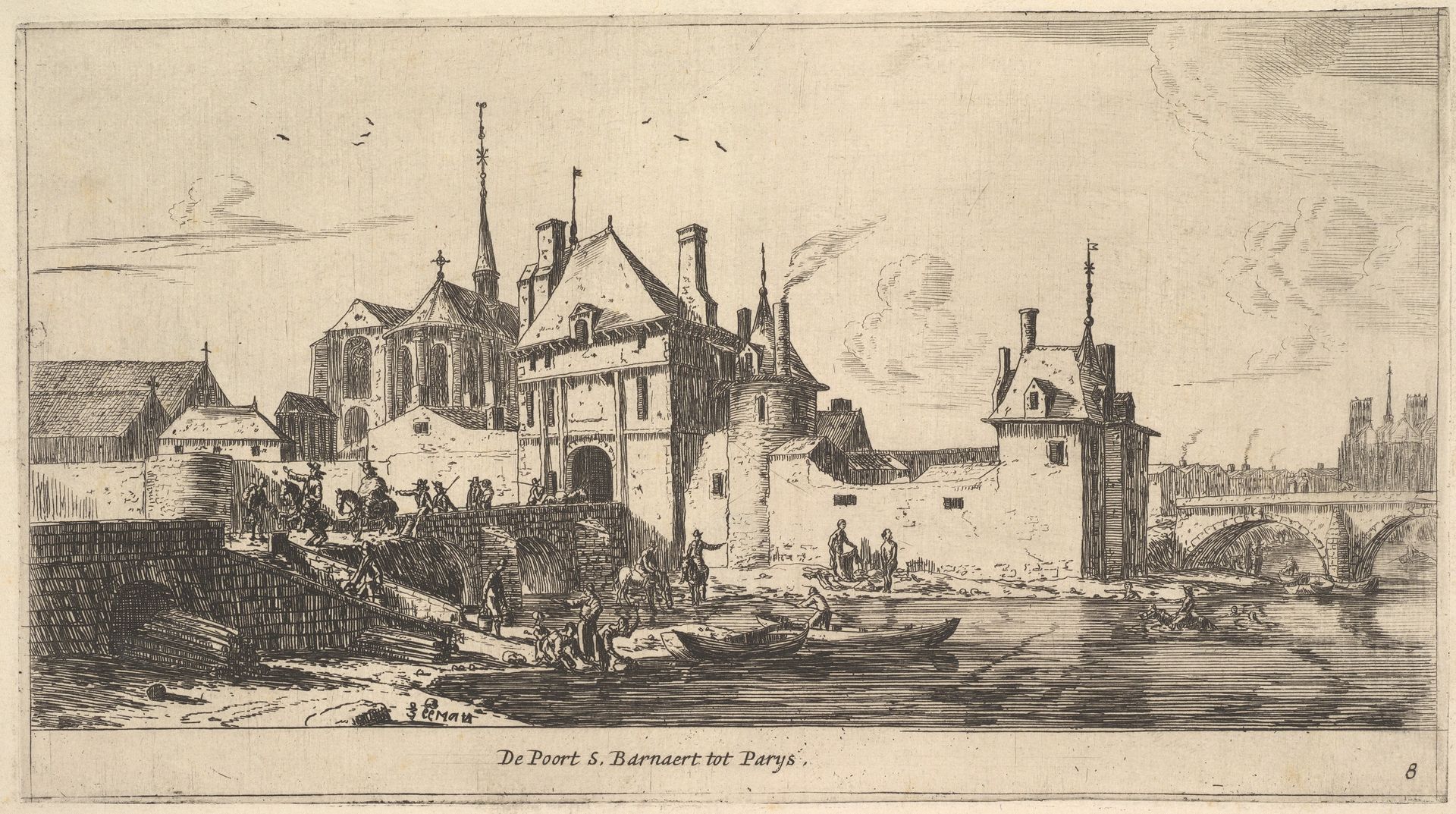
Reinier Nooms created this print of 'The Entrance Gate of St. Bernard in Paris' using etching. Born in Amsterdam, Nooms, also known as Zeeman, meaning "seaman" in Dutch, was renowned for his detailed maritime scenes and city views. Reflecting the bustling atmosphere of 17th-century Paris, this image captures the city's blend of commerce, religion and daily life along the Seine. The gate itself, a point of trade and transit, underscores the economic currents shaping Parisian society. The print subtly highlights the power dynamics of the era, suggesting the gate's role in controlling the flow of goods and people into the city, thus influencing social mobility and wealth distribution. The inclusion of the church alongside the gate perhaps suggests the intertwined roles of religious and secular authority in shaping the city's identity. It asks us to consider how the city's physical and social structures influenced the lives of its inhabitants.
The Entrance Gate of St. Bernard in Paris 1635 - 1670


Artwork details
- Medium
- drawing, print, etching
- Dimensions
- sheet: 6 7/16 x 10 1/2 in. (16.3 x 26.7 cm)
- Location
- Metropolitan Museum of Art, New York, NY
- Copyright
- Public Domain
Tags
drawing
baroque
etching
cityscape
Comments
No comments
About this artwork
Reinier Nooms created this print of 'The Entrance Gate of St. Bernard in Paris' using etching. Born in Amsterdam, Nooms, also known as Zeeman, meaning "seaman" in Dutch, was renowned for his detailed maritime scenes and city views. Reflecting the bustling atmosphere of 17th-century Paris, this image captures the city's blend of commerce, religion and daily life along the Seine. The gate itself, a point of trade and transit, underscores the economic currents shaping Parisian society. The print subtly highlights the power dynamics of the era, suggesting the gate's role in controlling the flow of goods and people into the city, thus influencing social mobility and wealth distribution. The inclusion of the church alongside the gate perhaps suggests the intertwined roles of religious and secular authority in shaping the city's identity. It asks us to consider how the city's physical and social structures influenced the lives of its inhabitants.
Comments
No comments