About this artwork
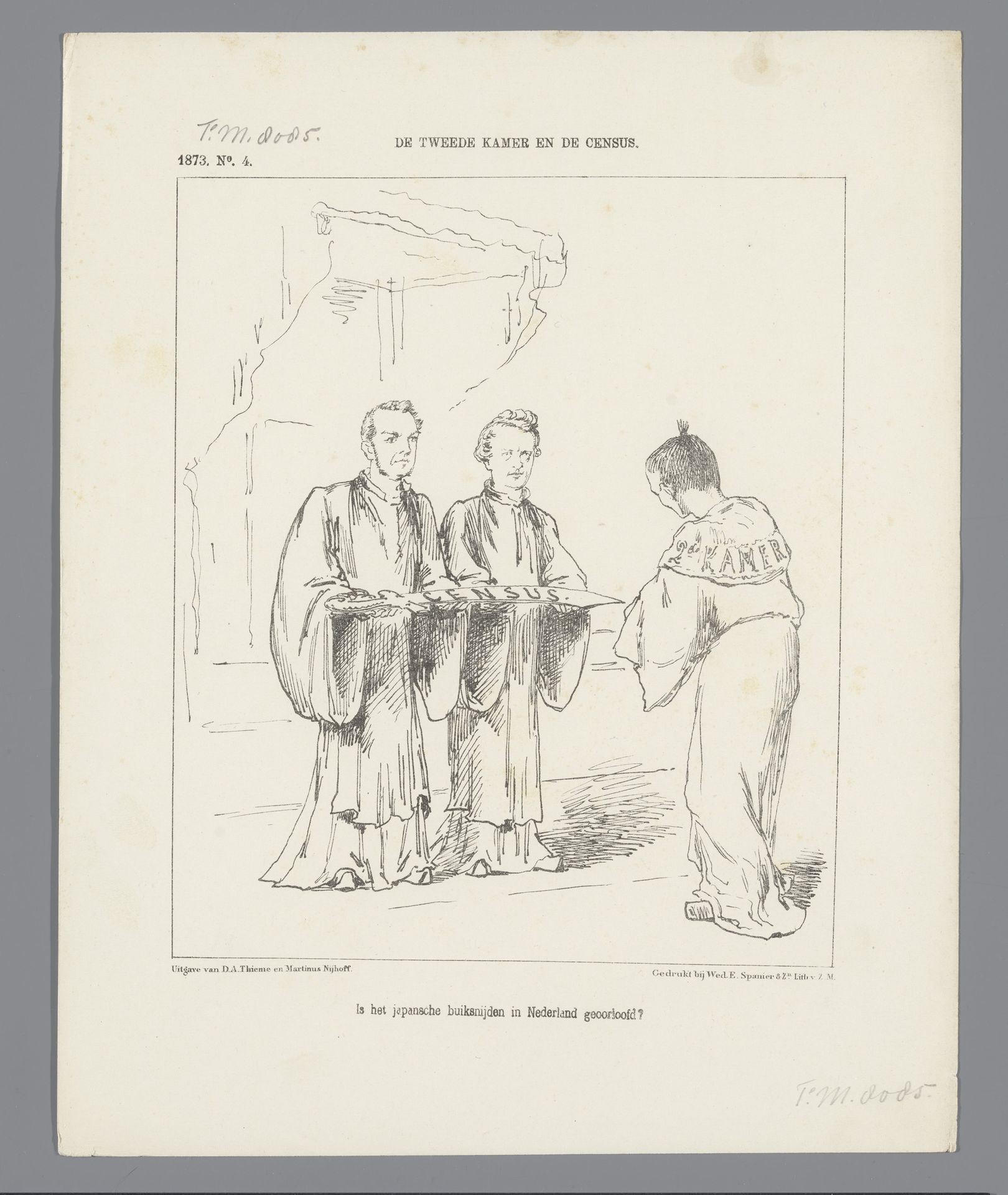
Johan Michaël Schmidt Crans created this print titled 'Spotprent met Geertsema en De Vries' in 1873, and it reflects the complex dynamics of cultural exchange and political satire in the Netherlands at the time. In the image, two Dutch figures in formal attire stand behind a table labeled "census," while an individual dressed in what appears to be Japanese clothing approaches them. The cartoon reflects a broader European fascination with and simultaneous stereotyping of Asian cultures. It raises uncomfortable questions about how the Dutch perceived their interactions with other cultures and the power dynamics at play. The inscription asks: "Are the Japanese baklijders heard in the Netherlands?" It speaks volumes about the anxieties surrounding cultural integration. It serves as a reminder of the often-complicated relationship between identity, representation, and political power.
Spotprent met Geertsema en De Vries, 1873
1873

Artwork details
- Medium
- drawing, print, pen, engraving
- Dimensions
- height 275 mm, width 215 mm
- Copyright
- Rijks Museum: Open Domain
Tags
drawing
comic strip sketch
sketch book
personal journal design
personal sketchbook
idea generation sketch
sketchwork
visual diary
sketchbook drawing
pen
storyboard and sketchbook work
sketchbook art
engraving
Comments
Be the first to share your thoughts about this work.
About this artwork
Johan Michaël Schmidt Crans created this print titled 'Spotprent met Geertsema en De Vries' in 1873, and it reflects the complex dynamics of cultural exchange and political satire in the Netherlands at the time. In the image, two Dutch figures in formal attire stand behind a table labeled "census," while an individual dressed in what appears to be Japanese clothing approaches them. The cartoon reflects a broader European fascination with and simultaneous stereotyping of Asian cultures. It raises uncomfortable questions about how the Dutch perceived their interactions with other cultures and the power dynamics at play. The inscription asks: "Are the Japanese baklijders heard in the Netherlands?" It speaks volumes about the anxieties surrounding cultural integration. It serves as a reminder of the often-complicated relationship between identity, representation, and political power.
Comments
Be the first to share your thoughts about this work.