About this artwork
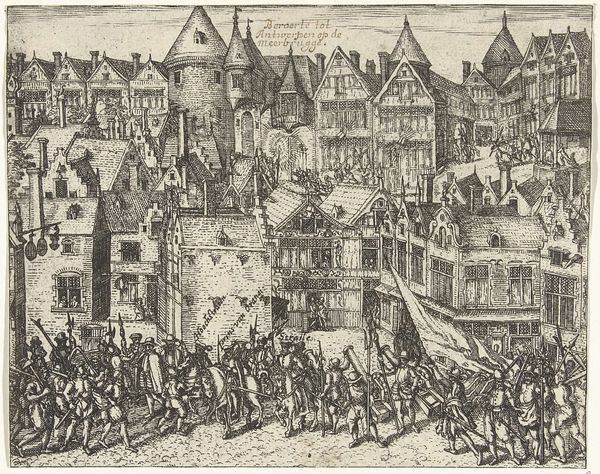
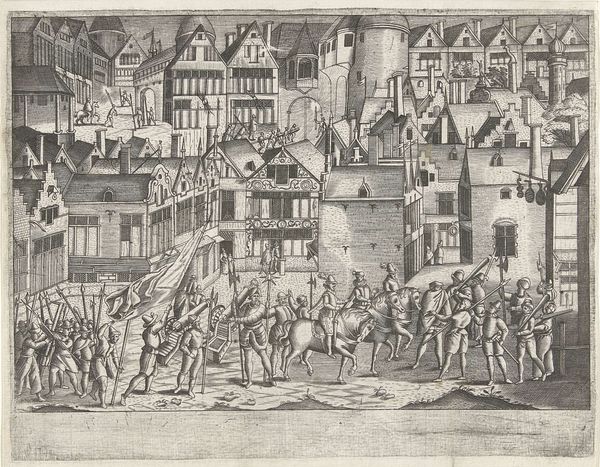
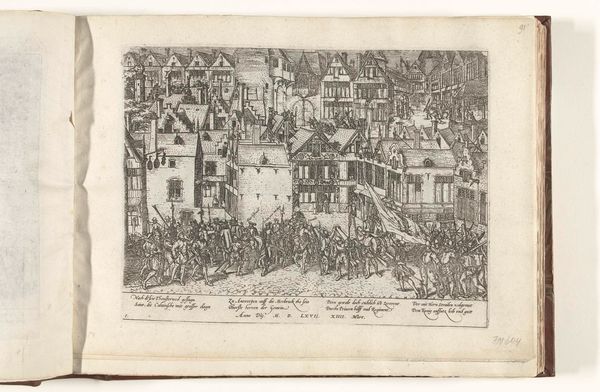
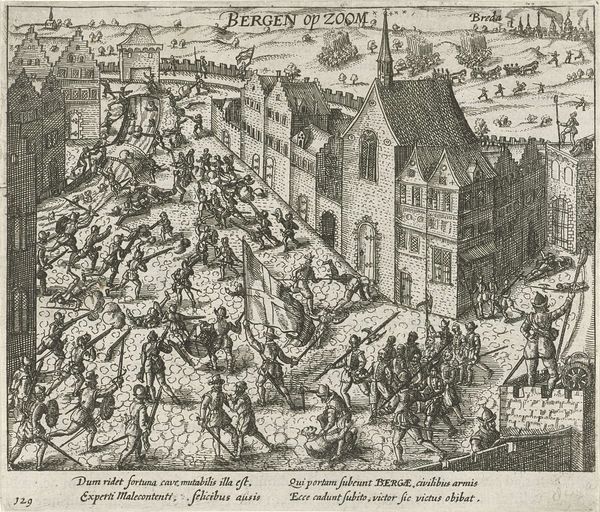
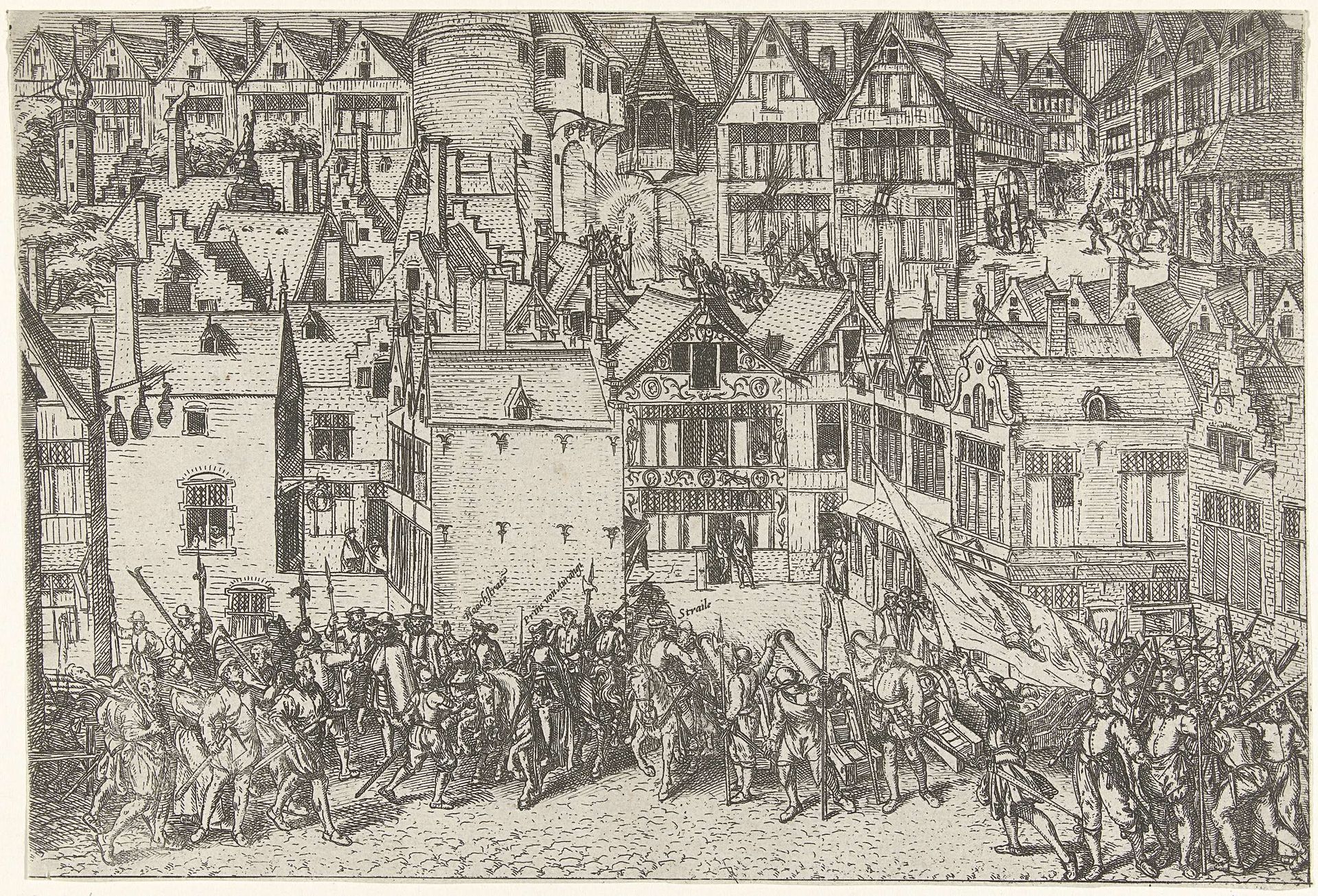
Frans Hogenberg's engraving, "Calvinist Uprising Suppressed in Antwerp, 1567," captures a moment of stark historical tension through its dense composition of lines and forms. The architecture of Antwerp looms over the scene, constructed with a rigorous pattern of hatching to give the buildings a tangible density. The eye is drawn to the lower third of the print, where soldiers form an impenetrable barrier, their spears acting as vector lines, directing our gaze across the tumult. Hogenberg uses scale to amplify the impact of the suppression; the figures become smaller and more uniform, the further they are in the composition, reinforcing a sense of overwhelming force. The strategic arrangement of light and shadow, achieved through the hatching technique, creates a visual hierarchy, drawing the viewer's attention to the areas of conflict and control. The print’s visual structure is not just a representation, but an interpretation of power, order, and the imposition of authority on a dissenting populace. It’s a detailed account, yet also a testament to the artist’s ability to convey complex narratives through calculated, formal means.
Calvinistisch oproer in Antwerpen bedwongen, 1567
1567 - 1570

Frans Hogenberg
1540 - 1590Location
RijksmuseumArtwork details
- Medium
- print, engraving
- Dimensions
- height 190 mm, width 280 mm
- Location
- Rijksmuseum
- Copyright
- Rijks Museum: Open Domain
Tags
narrative-art
figuration
11_renaissance
line
cityscape
history-painting
engraving
realism
Comments
Be the first to share your thoughts about this work.
About this artwork
Frans Hogenberg's engraving, "Calvinist Uprising Suppressed in Antwerp, 1567," captures a moment of stark historical tension through its dense composition of lines and forms. The architecture of Antwerp looms over the scene, constructed with a rigorous pattern of hatching to give the buildings a tangible density. The eye is drawn to the lower third of the print, where soldiers form an impenetrable barrier, their spears acting as vector lines, directing our gaze across the tumult. Hogenberg uses scale to amplify the impact of the suppression; the figures become smaller and more uniform, the further they are in the composition, reinforcing a sense of overwhelming force. The strategic arrangement of light and shadow, achieved through the hatching technique, creates a visual hierarchy, drawing the viewer's attention to the areas of conflict and control. The print’s visual structure is not just a representation, but an interpretation of power, order, and the imposition of authority on a dissenting populace. It’s a detailed account, yet also a testament to the artist’s ability to convey complex narratives through calculated, formal means.
Comments
Be the first to share your thoughts about this work.