About this artwork
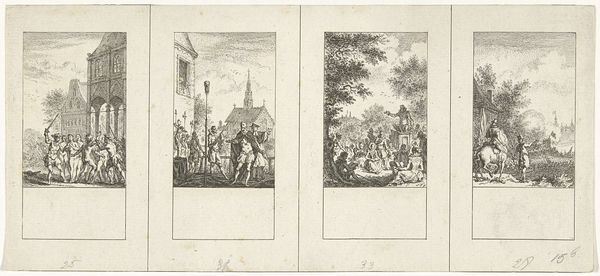
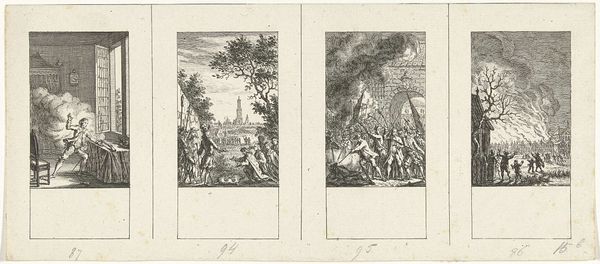
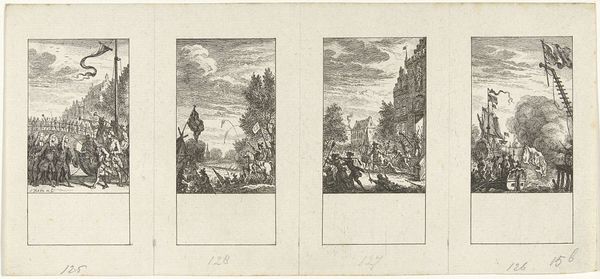
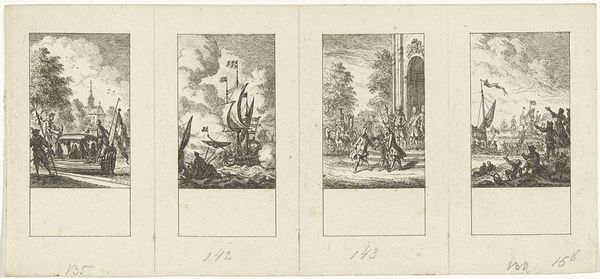
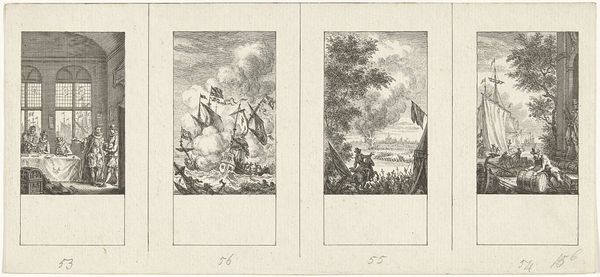
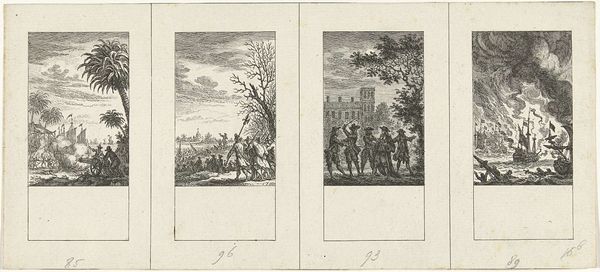
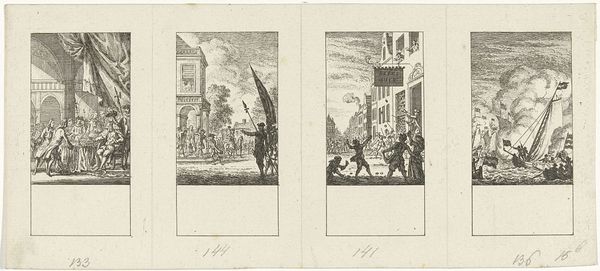
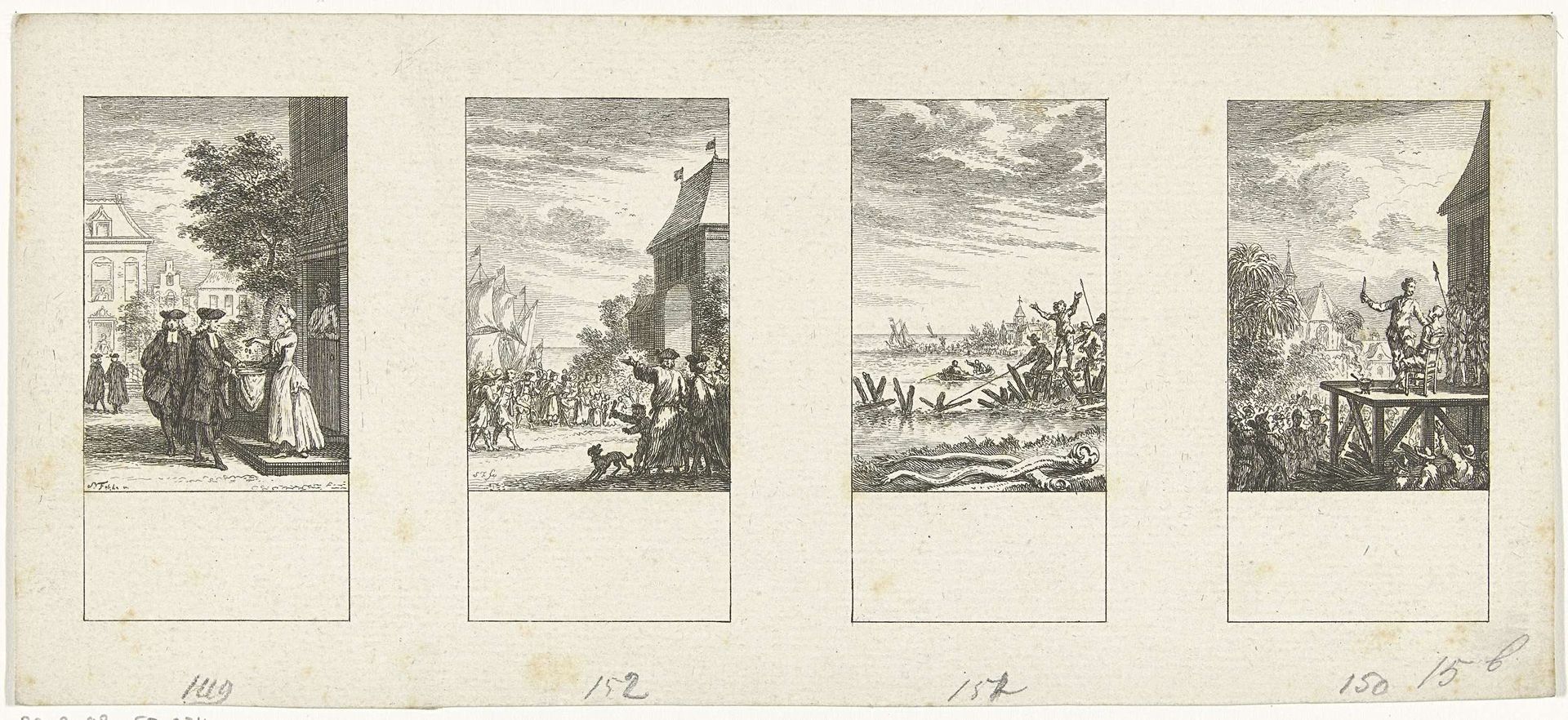
Curator: This print, entitled "Vier episodes uit de vaderlandse geschiedenis", which translates to "Four Episodes from National History", by Simon Fokke, dates to between 1722 and 1784. Editor: Immediately, the composition strikes me. It's intriguing how each episode, framed distinctly, uses line work to guide the eye across vastly different scenes, unified by the medium. The textural contrast and hatching give these historic depictions an incredible immediacy. Curator: Indeed. Fokke, known for his prints illustrating Dutch history and culture, is presenting us with carefully chosen narratives designed to promote civic virtue. This wasn't just art, but political propaganda! Editor: Absolutely, and visually, there’s an obvious structure at play here; the careful arrangements of lines dictates form. Take, for instance, the crowded scenes versus more sparse depictions: does it relate to the story’s complexity, or rather, is it for compositional harmony? Curator: Knowing Fokke's milieu, the scenes aren't arbitrarily chosen. I think that each panel had its purpose: invoking ideals about governance and social structures... For instance, there may be references to historical agreements and conflicts; an argument, perhaps, that is still happening today. It speaks volumes about the enduring power of visual media as a carrier of cultural values. Editor: Well, the artist’s etching technique contributes so significantly to that carrier quality, which creates a detailed yet immediate view. This aesthetic invites a modern audience to appreciate how effectively the period's values could be so communicated, regardless of narrative. Curator: Perhaps that's the biggest success here – seeing the history play out so tangibly reminds me that Dutch pride was an export industry, one designed to reach new viewers while simultaneously informing locals. Editor: I'm fascinated how an era's events, through composition, line, and contrast, can elicit our thoughts about these Dutch experiences now. It reminds me about timeless values; that these pieces have many overlapping yet relatable connections is very exciting.
Vier episodes uit de vaderlandse geschiedenis
1722 - 1784

Simon Fokke
1712 - 1784Location
RijksmuseumArtwork details
- Medium
- print, etching, engraving
- Dimensions
- height 112 mm, width 249 mm
- Location
- Rijksmuseum
- Copyright
- Rijks Museum: Open Domain
Tags
Comments
Share your thoughts
About this artwork
Curator: This print, entitled "Vier episodes uit de vaderlandse geschiedenis", which translates to "Four Episodes from National History", by Simon Fokke, dates to between 1722 and 1784. Editor: Immediately, the composition strikes me. It's intriguing how each episode, framed distinctly, uses line work to guide the eye across vastly different scenes, unified by the medium. The textural contrast and hatching give these historic depictions an incredible immediacy. Curator: Indeed. Fokke, known for his prints illustrating Dutch history and culture, is presenting us with carefully chosen narratives designed to promote civic virtue. This wasn't just art, but political propaganda! Editor: Absolutely, and visually, there’s an obvious structure at play here; the careful arrangements of lines dictates form. Take, for instance, the crowded scenes versus more sparse depictions: does it relate to the story’s complexity, or rather, is it for compositional harmony? Curator: Knowing Fokke's milieu, the scenes aren't arbitrarily chosen. I think that each panel had its purpose: invoking ideals about governance and social structures... For instance, there may be references to historical agreements and conflicts; an argument, perhaps, that is still happening today. It speaks volumes about the enduring power of visual media as a carrier of cultural values. Editor: Well, the artist’s etching technique contributes so significantly to that carrier quality, which creates a detailed yet immediate view. This aesthetic invites a modern audience to appreciate how effectively the period's values could be so communicated, regardless of narrative. Curator: Perhaps that's the biggest success here – seeing the history play out so tangibly reminds me that Dutch pride was an export industry, one designed to reach new viewers while simultaneously informing locals. Editor: I'm fascinated how an era's events, through composition, line, and contrast, can elicit our thoughts about these Dutch experiences now. It reminds me about timeless values; that these pieces have many overlapping yet relatable connections is very exciting.
Comments
Share your thoughts